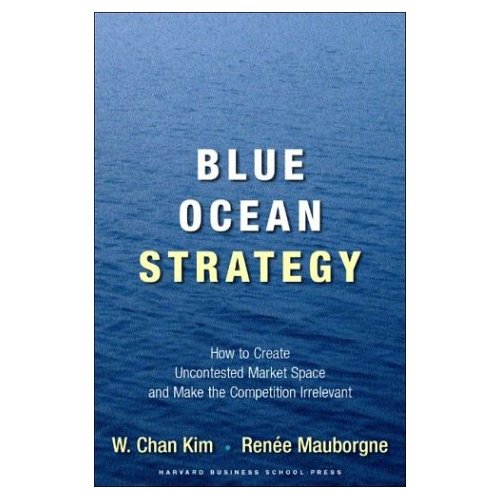
Blue Ocean Strategy is an easy to read book that I managed to zip through in next to no time at all. Kim and Mauborgne have written a book that is accessible and easy-to-read, cover-to-cover or dip in and out of for reference or inspiration.The book’s premise is that most business strategy books are about conflict and competition and this is wasteful. Instead it provides a framework for strategists to Think Different and differentiate their businesses instead.
The blue ocean of the title is the space that the business puts between itself and competitors, in contrast to the red ocean from business conflict. A classic example of a red ocean would be the Chinese approach to business. In China you will see competing restaurants right next to each other. The idea is that one might move in. It becomes successful, which encourages others to compete next to them since it is a known successful formula in that area. The neighbourhood of restaurants does bring in diners, but margins are small due to the level of competition.
A classic example would be to think about the PC manufacturers. A classic red ocean environment where IBM left due to competitive pressures, HP and Compaq merged to unsuccessfully in a failed effort to leverage the economic benefits of their combined scale and Apple and Dell are the only two long-term profitable success stories through innovation.
The problem is now that Dell’s process smarts have become the norm and both Apple and HP have used their operational efficiency techniques to improve their own businesses with leaner supply chains and total product customisation.
I wholeheartedly recommend Blue Ocean Strategy. However the type-a personalities in charge of many organisations that most need to read it, will never touch the book or hear its message and as the bard said there-in lies the rub. More book reviews here.
Advertising Age has a case study of the Yahoo Found campaign that ran in London.The Yahoo Found campaign was interesting because it used the environment as an interaction with the poster executions to give it an experiential feel.
The Yahoo Found campaign reasonated for a long time with consumers and we took found arrows on to the streets long after the poster campaign had finished to hijack the Dukes of Hazzard UK fillm premiere, SES London (with the help of Vegas showgirl outfits) and a Harry Potter book launch.
Running a brand building campaign like Yahoo Found on a sustained basis takes a lot of cojones, especially in a corporate environment. Its a pity that Yahoo Found wasn’t exploited to its full potential.The problem that marketers now face is that brand activating tactics Google Adwords provide a safer option with PowerPoint friendly data that can be dropped into pivot tables and used like a crutch to support their decision-making in the face of a hostile management.
What this doesn’t capture is brand equity through salience and mental availability which provides more diffuse benefits of preference over time.
Influential analyst houses
Interesting survey over at Duncan Chapple’s blog over which analyst houses have the most influence.Whilst the split may may change depending on what tech sector your client is in, its an interesting piece of research; particularly when you see the dominance of US focused players.
And the fact that a good third of the most influential analysts are in the other category indicating a large amount of fragmented trusted expertise.
EU roaming charges
Meanwhile the GSM Association have a handy site that allows you to compare roaming charges when you visit different countries in Europe.
I tried it using Orange post paid as my settings to have a look at different carriers. What I found interesting was that in the countries that I sampled (Germany, Ireland, Spain, France) there was not price differential between the carriers. Of course this was an unscientific test isn’t at all indicative of price fixing is it?
Sausage casing girls – A phrase that is insensitive yet garishly visual phrase used to describe young women and girls who are overweight and wear clothes that are far too small for them. The clothes emphasise giant love handles and letting it all hang out in an ‘unsightly’ manner. You may have heard the phrase ‘muffin tops’ used as well for the overhang of fat between a cropped top and the trouser waistline.
Both phrases are uncharitable in nature. However they are at the centre of a number of debates:
The debate rages on whether they are fashion victims needing to wear the latest slinky tops and hipsters. If so why aren’t clothes manufacturers providing them with clothes that actually fit? I think that there is a wider debate to be had about making fashion work for consumers rather than designers. Fashion assumes that the people who wear their clothes are tall and rake thin. So the fashion industry is partly responsible for the sausage casing girls fashionistas look down on
Are they in denial about their size or showing body pride? Which brings back into focus how media, social media and advertising messages affect women’s self image and diet?
There is one great line from Letting it all hang out (July 5, 2006) by Robin Abcarian of the Los Angeles Times: “Fat or skinny, it doesn’t matter,” she said. “The guys in there will look at you if you’re wearing a little skirt and hoochie tank top.”
I think this quote is interesting because it says a lot about prevailing beauty standards, where perceived sexual availability trumps the beauty conventions that the media and society dictate. We’ve known this for decades, film star Mae West was far from being a conventional beauty. Its also interesting that Unilever brand Dove has explored this territory for a number of years now.
Yahoo! Answers was one of the last projects that I worked on when I was inhouse, I will hold my hand up and admit that I was a hawk in the Yahoo! Answers team. The reasons for my Yahoo! Answers hawk status in terms of the product being a ‘killer application’ was mainly because it failed my own ‘test’ of how is this relevant to my online life. It also suffered from the Yahoo! services problem of an off-putting onboarding process. If you weren’t put off by the sign-up then would be greeted by a product that would be familiar to business online support services. The prototypes that I saw internally reminded me of the self service customer solutions offered by the likes of RightNow Technologies and Transversal and the support forums provided by Apple for users.
I thought that the opportunity may be in sponsored channels: Microsoft sponsoring an XBox channel, or Sainsbury’s sponsoring a recipe channel. But this was poo-pooed as an idea by my immediate director.
In some ways I was wrong about Yahoo! Answers success (and I am happy to be wrong in this case).Windows Live QnA doesn’t seem to have gone anywhere, Lycos IQ: though superior in terms of design and features doesn’t seem to have got that much traction so far.
According to Hitwise (via SearchEngineWatch), Yahoo! Answers is now the third most popular reference site online, however its 2.94 per cent market share is puny in comparision to the 16.76 per cent marketshare of Wikipedia which has a Googlesque sector dominance.
Steve Rubel has talked about Yahoo! Answers on his MicroPersuasion blog Marketers will Answer to Yahoo! and sees the opportunity for sponsored sections, which kind of squares the circle in the way that I viewed the product.
It offers yet another opportunity for direct interaction with consumers and a channel for cummunications, but not a full-on dialogue.
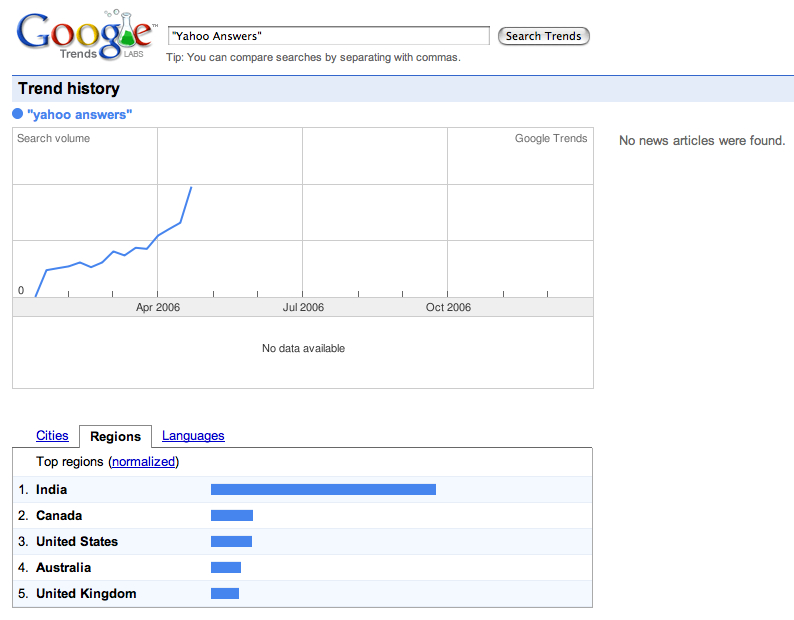
Where it gets interesting is when you look at the Google Trends data on the service, most of the search enquiries for Yahoo! Answers seems to be coming out of India, rather than the US or Europe. This will alter the services attraction for advertisers in terms of the net worth of the consumer, whether they can capitalise on the clicks through presence in the marketplace and the quality of answers given for a global audience – quality control will be a critical ongoing issue.
Over my lifetime I have had a number of moments when I felt like I saw things with crystalline clarity: one time was when I was in the library doing a job search in the papers (this is pre-Monster.com kids).I suddenly came to the conclusion that even if I got a job that I would be in the same cycle soon again and I needed to get out of the blue-collar roles, even if it meant leaving vast tracts of my life behind.
The next one was in April 2000, the internet business had gone mental, the PR agency I was employed in was in mid-flow of the dot.com boom and all the mini-bubbles that went alongside it like the Java boom, the Linux boom, the broadband boom, the web business marketplace boom, the mobile web boom and rise of the PDA.
In fact, about the only thing that we didn’t promote was micro-scooters, though we did employ a German freelancer who commuted in from Brighton and rode one everywhere he had to go around London.
Anyway, things got so busy that we had to interview clients and decide whether we wanted to work for them. I met a gentleman from an incubator fund and quickly decided that they were start-up roadkill, but I couldn’t work out why this man who was obviously a lot more clever than me was involved in the enterprise.I asked him what made his companies offering different, to which replied “Ged, I am surprised that you asked that, we are trying to move at internet-speed, so aren’t thinking about things like that.” I had a sudden jolt of crystalline vision and saw how horribly it was all going to end and that my pension fund wasn’t worth squat. The elemental truth in this moment is that common sense trumps eloquent words and intellect every time.
Which brings me on to 8vo On the outside by Mark Holt and Hamish Muir. Steve bought this for me as a Christmas present and up until my move from Yahoo! and move back to agency life I hadn’t really had a chance to read the book in full.
The book charts the rise and fall of the design agency 8vo, their work and puts into context their pivotal role in modern UK graphic design.
The book is a collaborative work written by 8vo, former employees, former clients and industry observers. It is part history lesson focusing on design and the business of design, part a tale of technological change and part catalogue.
The way the book is written it is almost as if it is therapy for Hamish Muir and Mark Holt, I found it in turns fascinating and uncomfortable as they progressed through their work and found some elemental truths in their approach to design.
Much of their style of work has been co-opted by their modern day peers, so it is no longer remarkable, however what their peers lack is a good understanding of their approach to work. More book reviews here.
Iain Tait over at Crackunit had a link to an interesting interview with Eric Reiss who learned the same elemental truths as 8vo, but via a different road: in his case Vinterberg and Von Tier’s Dogme 95 rules for film making.
Anything that exists only to satisfy the internal politics of the site owner must be eliminated.
Anything that exists only to satisfy the ego of the designer must be eliminated.
Anything that is irrelevant within the context of the page must be eliminated.
Any feature or technique that reduces the visitor’s ability to navigate freely must be reworked or eliminated.
Any interactive object that forces the visitor to guess its meaning must be reworked or eliminated.
No software, apart from the browser itself, must be required to get the site to work correctly.
Content must be readable first, printable second, downloadable third.
Usability must never be sacrificed for the sake of a style guide.
No visitor must be forced to register or surrender personal data unless the site owner is unable to provide a service or complete a transaction without it.
Break any of these rules sooner than do anything outright barbarous.
Oh one completely useless piece of information that I found out today, the ZIP in ZIP code stands for Zone Improvement Program.