Category: branding | 品牌推廣 | 브랜드 마케팅 | ブランディング

The dictionary definition of branding is the promotion of a particular product or company by means of advertising and distinctive design.

I have covered many different things in branding including:

  • Genesis – the luxury Korean automotive brand
  • Life Bread – the iconic Hong Kong bread brand that would be equivalent of wonder loaf in the US
  • Virgil Abloh and the brand collaborations that he was involved in
  • Luxury streetwear brands
  • Burger King campaigns with Crispin Porter Bogusky
  • Dettol #washtocare and ‘back to work’ campaigns
  • Volkswagen ‘see the unseen’ campaign for its Taureg off road vehicle
  • SAS Airline – What is truly Scandinavian?
  • Brand advertising during Chinese New Year (across China, Hong Kong, Singapore and Malaysia)
  • Lovemarks as a perspective on branding
  • BMW NEXTGen event and Legend of Old McLanden campaign
  • Procter & Gamble’s Gillette toxic masculinity ads
  • Kraft Mother’s Day campaign
  • Kraft Heinz brand destruction
  • Porsche Design in the smartphone space
  • Ermenegildo Zegna
  • Nike’s work with Colin Kaepernick
  • Counterfeit brands on Instagram, Alibaba and Amazon
  • Gaytime Indonesian ice cream
  • Western Digital
  • Louis Vuitton collaboration with Supreme
  • Nokia
  • Nike Korea’s ‘Be Heard’ campaign
  • Mercedes SLS coupe campaign
  • Brand collaborations in Hong Kong
  • Beats headphones
  • Apple
  • Henrion Ludlow Schmidt’s considerations of branding
  • Cathay Pacific
  • Bosch
  • Mitt Romney’s failed presidential bid
  • Microsoft Surface launch
  • Oreo Korean campaign
  • Chain coffee shop brands and branding
  • Samsung’s corporate brand
  • North Face’s brand overeach in South Korea
  • Mr Pizza Korean pizza restaurant and delivery service brand
  • Amoy Hong Kong food brand
  • Chevrolet Corvette ‘roar’ campaign promoting a build your own car service
  • Stussy Bearbrick

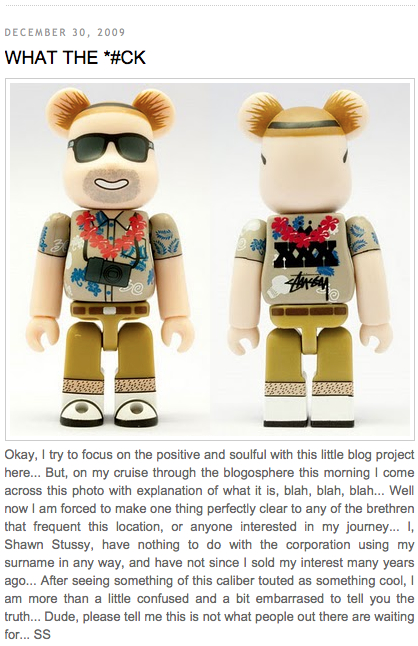
    Shawn Stussy just threw down on a Stussy Bearbrick. Admitted the Stussy Bearbrick looks pretty lame. Imagine if you set up your own company and you named after yourself because you signed all your work. Over time your signature became the most valuable design asset of the company. Over time you decide that you want to take some of your hard earned cash, take time out and do the stuff that you actually enjoy. You leave your business, having been bought out.

    However, you then have the problem of seeing your name plastered over absolute tat.

    taking your name in vain

    Welcome to Shawn Stussy’s world. They guy invented streetwear as we know it. He mixed American classics like the oxford cotton button down, denim and t-shirts together. On top of that he added American workwear beloved of surfers.  Shawn also got Japan and what they could bring to the table back when everyone else was just thinking about Sony.

    And then the copy and paste aspects of punk culture. There is a reason why Stussy designs come off like old school fanzines. They both come from a common cultural route. The backward SS was a homage to Chanel. The repeating pattern a nod to the luxury brands from Gucci and Louis Vuitton to MCM.

    Supreme, Palace, Neighborhood, Off-White all are following in his footsteps.

    I am a big Stussy fan and it is a rare season where I don’t buy something from their collection. It is hard to keep banging out new streetwear, season after season, even when you’re delving into an archive like Stussy has.  But some of the stuff ends up being pretty ropey and I sympathise with Shawn Stussy’s predicament. Which is why I look forward to seeing what his long-awaited new venture S-Double Studios will come out of the trap with. More on luxury here.

  • Black precious resin & Montblanc

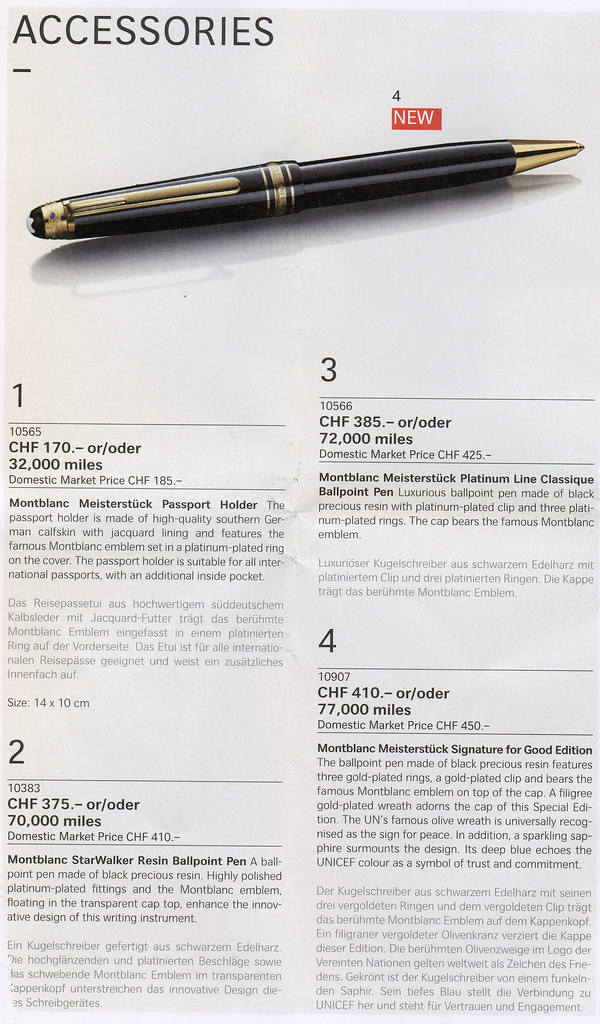
    I had a short haul flight and went over the duty free catalogue on Swiss Airlines. This section on Montblanc pens stuck out at me because of its wording. Each pen was described as being made of ‘black precious resin’. Click on the image if you want to see a larger version.

    Precious Resin Montblanc spiel

    So what does black precious resin actually mean? One would presume some form of black shiny plastic, which doesn’t seem quite so precious. Now the use of plastic isn’t a bad thing in pen manufacture. For instance fellow German writing instrument manufacturers Pelikan and Kaweco both make writing instruments out of plastic, but they also don’t charge over 300 pounds for a ballpoint pen.

    Plastic feels thoroughly modern. It defined the post-war world and accelerated further with globalisation. Black precious resin isn’t particularly rare in itself like ebony wood or precious metals. 

    What the black precious resin explanation misses is the real elements at the heart of Montblanc’s authenticity:

    • History: Montblanc is actually over a century old as a firm
    • Country brand: It’s pens are still made in Germany, so it can take advantage of the German country brand: precision manufacturing excellence and craftsmanship
    • Craftsmanship: making a pen write smoothly is an art, too much ink and you will get splodges. A badly designed nib or ballpoint mechanism will scratch the paper, deliver the ink unevenly and even stain the writer
    • Design: One of the reasons why Montblanc managed to upset A.T. Cross in the market for luxury pens because their pen design feels much better in the hand because of its fuller barrel size

    But none of these factors are reflected in the description of the Montblanc pens featured in the duty-free catalogue, instead we get smoke-and-mirrors which engenders distrust and makes for an authenticity FAIL.

  • Saab

    Saab has been a pioneer in the automotive sector and it is now facing imminent death in the car business. Saab made the first production cars with safety belts, the first headlight washer and wiper facilities, the first impact absorbing bumper, pioneered pollen filters in the air system of its cars and the first CFC-free climate control. Saab along with the Mercedes S-Class it has had a disproportionate impact on the modern car.

    I have a personal attachment to the Saab brand. I can still remember the smell of the interior of a family friend’s Saab 99, the brooding brow over the dashboard that the VDO instruments used to look out from, the heated seats and the ignition key that also locked the gear box.

    stig_blomqvist_rally99

    Motorsport, in particular rallying was the preferred sport of my Dad and my hero didn’t wear a polyester Liverpool shirt, but a set of fireproof overalls. His name is Stig Blomqvist, one of the most talented men ever to get behind the wheel of a car. He has competed successfully in circuit racing and rallying for the past 38 years.

    saab_rally_99T

    Blomqvist’s vehicle during the late 1970s was a Saab with a distinctive avant-garde paint job that caught my imagination as an 8-year old. With the rise of four-wheel drive, he then moved to Audi, and my team allegiance went with him – when Saab bowed out of top flight rallying. But that avant garde paint job still has a place in my heart.

    Saab is now staring oblivion in the face. A financial rescue has been scuppered and the car company is likely to be consigned to the annals of history. At this point Saab reminded me of Apple circa 1996, however one thing Apple had in its darkest hours were fans of the Macintosh platform. I can remember when having an Apple Mac wasn’t cool, but marked you out as a bit of weirdo.  I know, I was one of them weirdos; and thankfully the company is still around making insanely great products that shows my loyalty was not misplaced.

    If I was a potential saviour for Saab; not even a business plan by the best brains from Goldman Sachs would persuade me after reading feedback from the loyal members of the New York Saab Owner’s Club by Michael Corkery on the Deal Journal blog on the Wall Street Journal online.

    Some of the things that caught my eye:

    1. …there are some guys in the club who are going to say : ‘good riddance they haven’t made a good car in a long time.’
    2. There are some vintage guys in the club who say that Saab hasn’t made a good car since 1999…
    3. Over the last few years club members have started bringing their non-Saab cars to meetings. It speaks to the fact that Saab has gotten away from what made them a fun driving car.
    4. There are some people who work with me and will ask for car advice. But unless they are a car person, I won’t recommend Saab. I don’t want them to come back and yell at me.

    I wouldn’t even like to guess what the net promoter score is amongst some of Saab’s long-suffering fans. Saab has lost what it was to its customers. It was no longer authentic, this isn’t about globalisation; its about a company and its brand losing its soul. This happened whilst the company was a completely-owned subsiduary of GM. General Motors is ultimately responsible for management decisions that didn’t just destroy shareholder value and brand value, they nuked it.

    The only bit of Saab that remains is in the camaraderie of the club and vintage vehicles. Graham Brown frequently talks about authenticity being the keystone for successful youth marketing, its also true for marketing to the not-so-young. More on brand related posts here.

  • Brands in China – be true to yourself

    I was reading a post the other day (and forgot to bookmark it – my OCD having been taken out by the man flu) about how a substantial minority of  respondents thought that US-originated international brands in China like Coca-Cola were  local Chinese brands. Coca-Cola originally entered the Chinese market in 1928 and then re-entered when the country re-opened to the outside world in the early 1980s.

    Coca-Cola Chinese design

    The drink’s Chinese logo marries the traditional Coke flowing lines with the Chinese characters for ‘delicious happiness’. Coke welded itself to China’s caterpillar-like emergence at the Olympic games – so it is easy to see how Coca-Cola has become a Chinese brand for Chinese people. Here in the UK, Coca-Cola is an unashamedly US brand: from GI’s swigging it back during the war to halcyon images of American Graffiti to the urbane cougars (Sex in the City before Sex in the City) featured in the original diet Coke adsand hippies offering the world a Coke.

    Yahoo! in the US is an all-American brand: Jerry Yang and David Filo building a business in the proverbial garage is the quintessential American story. They were not trust fund kids like Bill Gates, one was from the American South and the other was a first generation immigrant.

    In Asia the company has managed to define itself as a local Asian brand. Yahoo! Japan is as much about Softbank founder Masayoshi Son as Yang and Filo. In each of the Asian countries where it has been successful the brand has developed specialist services that meet the needs of the local population and give them ‘ownership’ of the brand.

    By comparison, in Europe, Yahoo! is a big amorphous brand that people don’t really get since what it stands for hasn’t been clearly articulated on a regular basis.

    With Japanese brands Muji, Uniqlo and Nintendo they are unashamedly Japanese. Chauncey Zalkin in her recent article for Brandchannel Made in Japan: The Culture Behind The Brand points out how Japanese companies have made a virtue of being Japanese. If I see one flaw in her argument it would be that I would argue Sony has redefined itself as a global brand that stands for nothing rather than competitors like Nintendo or Nikon who have managed to retain their ‘Japanese-ness’ and maintained a respectable financial performance over the long term (at least this far).

  • Authority beats leadership

    I had been thinking about authority versus thought leadership for a while and my interest in it got reignited over lunch with Wadds just before Christmas. We were discussing the pros and cons of sharing expertise on a blog or other social media, particularly when it comes to marketing and marketing communications disciplines.

    On the one hand, its giving your competitors (in the professional and the career sense) a leg-up. That expertise could be used for competitive advantage so I may want to hide my light under a bushel. I could then enshrine this expertise as a business process or service mark and leverage this in competitive situations. This assumes that I am smarter than everyone else online, which of course is complete hogwash: Mrs Carroll didn’t raise no fool, but she’s also aware of my limitations.

    The secondary consideration is that if I have this business process or service mark, how would the man in the street know the real power of it vis-à-vis competitor offerings? You are are in a ‘he said. she said situation’.

    Chances are I am not that much smarter than everyone else, but considerably smarter than some people (yeah and modest too.)  So kicking out ideas via this blog or other channels is way of having them picked, poked and prodded: kind of like peer review in academia but with only ten per cent of the politics and none of the corduroy jackets with leather patches or the reek of cheap pipe tabacco. Sharing ideas negates any leadership advantage that I may have, but does help to build authority.

    Authority is about trust which is more substantive than anything competitive leadership could have given me. Trust would be further enhanced by successful delivery.

    In addition, sharing ideas freely means that I don’t need to think about all areas all the time because I can build upon the thinking that other people have done elsewhere; I benefit from reviewing and critiquing commons content as well as adding to the body of the commons.

    Moving thinking forward allows the industry as a whole to grow and helps spur demand in clients once they understand what is possible.  At a time when over half the clients for online PR choose agencies from other disciplines to develop strategy and execute campaigns growing the collective opportunity has never been more important. More related content can be found here.