Category: china | 中國 | 중국 | 中華

Ni hao – this category features any blog posts that relate to the People’s Republic of China, the Chinese communist party, Chinese citizens, consumer behaviour, business, and Chinese business abroad.

It is likely the post will also in other categories too.  For example a post about Tong Ren Tang might end up in the business section as well. Inevitably everything is inherently political in nature. At the moment, I don’t take suggestions for subject areas or comments on content for this category, it just isn’t worth the hassle.

Why have posts on China? I have been involved in projects there and had Chinese clients. China has some interesting things happening in art, advertising, architecture, design and manufacturing. I have managed to experience some great and not so great aspects of the country and its businesses.

Opinions have been managed by the omnipresent party and this has affected consumer behaviour. Lotte was boycotted and harassed out of the country. Toyota and Honda cars occasionally go through damage by consumer action during particularly high tensions with Japan.

I put stuff here to allow readers to make up their own  minds about the PRC. The size of the place makes things complicated and the only constants are change, death, taxes and the party. Things get even more complicated on the global stage.

The unique nature of the Chinese internet and sheltered business sectors means that interesting Galapagos syndrome type things happen.

I have separate sections for Taiwan and Hong Kong, for posts that are specific to them.

  • DLD 2019 & things that made last week

    Scott Galloway presented at DLD 2019, Munich this week. DLD is a German version of Paddy Cosgrave’s Web Summit. You get attendance from the EU, the German government and German banking and industry as well as the tech sector. For those that don’t know him, Scott Galloway is a business professor at NYU’s Stern School of Business and the founder of L2 Inc. which was recently acquired by Gartner.

    funicular freak – amazing Tumblr account, words that I don’t often have in the same sentence any more

    7 of the Cutest (and Smartest) ‘Year of the Pig’ WeChat campaigns | Jing Daily  and here is how you can get it wrong. The flexibility of the WeChat platform for marketers is something that western social platforms can learn from. In terms of the content, Gucci consistently manages to come up with the right product designs and content for WeChat around lunar new year.

    Chloe managed to do a good job using celebrities in their campaign. It was interesting that they collaborated with an Indian artist Rithika Merchant, rather than a Chinese artist for the New Year designs.

    I had another late addition to my collection of the best Chinese New Year creative. Heineken did a Chinese New Year advert for the Singapore market. But its not on their social feeds so I can’t share it. I presume that the content must be a TV only campaign.

    Starbucks opens interactive coffee sanctuary in Bali as tribute to Indonesia’s Arabica coffee | The Drum 

  • Airlines + more things

    Fliers Find an Old Friend on More Planes: Empty Seats – WSJ – Airlines’ average passenger loads first crossed 80% capacity in 2007, after climbing from 55% in 1978. Ryanair and other discount airlines must skew these numbers, which means that other airlines must run almost empty flights on some routes.

    Friends Don’t Let Friends Become Chinese Billionaires | Forbes – not surprised by the executions, as Balzac said, behind every great business lies a crime. And you can’t do anything in China without the necessary permits which means getting dirty. What I was more surprised by was the number of billionaires who have been murdered

    Automation in the transition region | Vox – really interesting read

    VW’s chairman says even small electric cars aren’t going to be cheap | Quartz – which makes a lot of sense as you haven’t seen Silicon Valley semiconductor type transformation in price and performance for the components. More automotive related content here.

    “Brand purpose” is a lie – a lot of truth right there

    North Korean Hackers Gain Access to Chilean ATMs Through Skype – impressive social engineering skills by the hackers

    BJ Fogg’s persuasive technology design has been abused by the likes of Google. The Stanford Lab is name checked in the article. What is interesting is that Tristan Harris doesn’t talk about the ethical aspects of the persuasive technology course curriculum – which graduates tend to ignore.

    Under house arrest in Vancouver, Huawei CFO lives in luxury and spends her days out shopping – Financial Post“I’ve been working hard for 25 years,” she said through her lawyer during her bail hearings last month. “If released, my only simple goal would be to spend time with my husband and daughter. I haven’t read a novel in years.”

    China threatens reprisals if Canada bans Huawei from 5G contracts | RCR Wireless – no choice about it, Canada needs to ban Huawei now that the Chinese have drawn that line in the sand

  • Apple and Jaguar Land Rover in China

    Apple and Jaguar Land Rover blamed the Chinese economy for their recent financial results. The truth is probably more complex. What factors are affecting affecting Apple and Jaguar Land Rover that aren’t directly related to the Chinese economy?

    The reality is that Apple and Jaguar Land Rover are being buffeted by very different forces, some of which are their own making.

    Apple

    China is a unique mobile environment and in some ways it mirrors the hopes (and fears) for the internet in the late 1990s. Oracle and Sun Microsystems spent a lot of time during the dot com boom developing technologies that would allow applications to run on the web. Enterprise software sudden had a user experience that could be accessed via a web browser. Java allowed applications to be downloaded and run as needed. Netscape had a vision of the internet replicating the operating system as a layer that would run applications. Microsoft also realised this which was why they developed Internet Explorer, integrated it into Windows and killed off Netscape. The Judge Jackson trial happened and that was the start of the modern tech sector allowing Google and Apple to rise.

    Move forwards two decades and most computing is now done on mobile devices. In China, WeChat have managed to achieve what Netscape envisioned. Their app as a gateway to as many services as a consumer would need including a plethora of mini applications. It doesn’t suffer the problems that native web apps have had in terms of sluggish user experiences. In addition, WeChat has invested in a range of high-performing start-ups to built a keiretsu of businesses from cab services, e-commerce, property companies and even robotics. In the meanwhile Tencent who own WeChat have a range of consumer and business services as well.

    What this means for Apple is that many of its advantages in other markets are negated in China. The OS or even performance of a smartphone doesn’t matter that much, so long as it can run WeChat and a couple of other apps. The look and feel of the app is pretty much the same regardless of the phone OS. Continuity: where the iPhone and a Mac hand-off seamlessly to each other doesn’t matter that much if many consumers use their smartphone for all their personal computing needs.

    This has been the case for a few years now in China – but Apple haven’t found a way around it.

    As for phone industrial design – Apple lifted the game in manufacturing capability by introducing new machines and new ideas. To make the iPhone 5, Apple helped its suppliers buy thousands of CNC machines. This grew the manufacturers capability to supply and the amount of pre-owned machines that eventually came on the marketplace. It meant that other manufacturers have managed to make much better phone designs much faster.

    That meant Chinese consumers can buy phones that are indistinguishable from an iPhone if you ignore the logo and function the same because of China’s app eco-system. Again this has been the same for a few years and has accelerated due to the nature of the dominant smartphone form factor. The second iteration of the iPhone X form factor is what really changed things. The phones were different to what has come before, but they weren’t demonstrably better. They were also more expensive.

    In the mean time Huawei and others have continued to make progress, particularly in product design and camera technology – the two areas where Apple led year-on-year. Huawei devices can be expensive for what they are, but they gave domestic manufacturers ‘brand permission’ in the eyes of many Chinese consumers to be as good as the foreigners.

    This wasn’t helped by Samsung’s missteps in the Chinese market that started with the global recall of the Samsung Galaxy Note7 battery recall. Samsung hasn’t managed to make that gap back up and seems to make marketing missteps regularly such as its recent tie-in with the ‘fake’ Supreme brand holder China. If you’re a Chinese consumer the additional value or status that you used to see in foreign handset brands is now diminished. This seems to be a wider theme as domestic brands are also making similar gains in market share compared to foreign FMCG brands. Although there are also exceptions like baby formula.

    Domestic brands have done a good job marketing themselves. BBK in particular are very interesting. Whilst Huawei makes lots of noise and bluster at how big they are, BBK creeps up. It has a number of brands in China and abroad OnePlus, Oppo, Vivo and RealMe going after particular segments. The brands are focused but run separately like companies in their own right. Apple’s marketing riffs on its global marketing (though it did a great Chinese New Year themed ad last year). This reinforces the perceived common view that foreign businesses are full of hubris and don’t sufficiently localise for China. Apple’s recent pricing strategy in a market where this is so little to show in value provided looks like the epitome of hubris.
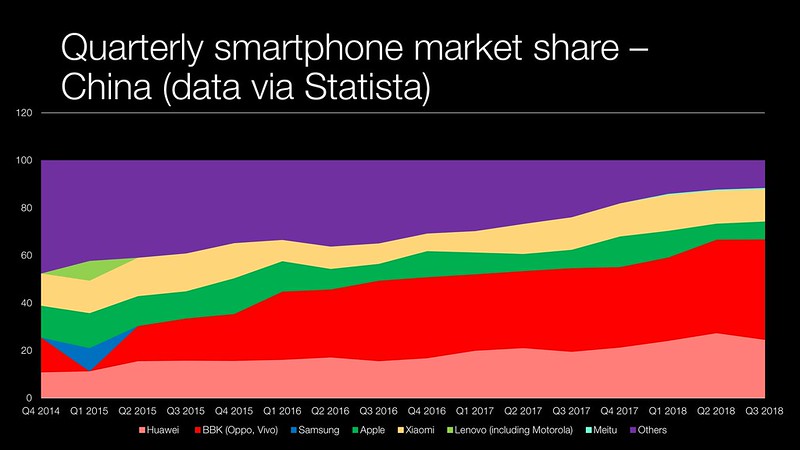
    180120 - China smartphone market

    Finally, there has been a massive amount of consolidation of brands in the China smartphone market over the past four years. That provides for scale in terms of logistics, supply chain, design, component sourcing and marketing.

    Jaguar Land Rover

    If we move to the automotive sector and look at Jaguar Land Rover – their problems in China look self inflicted. China’s car market has declined for the first time in 20 years. But it seems to have mostly affected brands like Hyundai rather than prestige brands like Mercedes Benz or BMW. The reasons why aren’t immediately apparent. Yes diesel cars are less popular, but BMW, Audi and Mercedes make diesel cars.

    Jaguar Land Rover aren’t the only foreign brand suffering: Toyota has had problems in China since the last round of strong anti-Japanese sentiment exploded in 2012.

    More information

    Why Does WeChat Block Competitors, While Facebook Doesn’t? | Walk The Chat

    Apple’s China Problem | Stratechery

    Samsung recalls Galaxy Note 7 worldwide due to exploding battery fears | The Verge

    Samsung angers hypebeasts by partnering with fake Supreme brand in China | The Verge

    Fake News: Samsung China’s Deal With Supreme “Knock-off” Spurs Drama | Jing Daily

    Chinese car sales fall for first time in more than 20 years | World news | The Guardian

  • ICYMI | 당신이 그것을 놓친 경우

    Ogilvy consulting – the digital transformation arm of ad agency Ogilvy put together their annual trends presentation, which is worth going through. Ogilvy Consulting came out of Social@Ogilvy, Ogilvy Red and OgilvyOneMore related content here.

    About Placement asset customization on Facebook, Instagram and Audience Network | Facebook Ads Help Center – via James Whatley

    Evaluating the GCHQ Exceptional Access Proposal – Lawfare
    – great piece by Bruce Schneier and dangerous ideas. Once it can be done, it won’t be just the good guys that will be demanding it

    Jury awards T-Mobile $4.8M in trade-secrets case against Huawei | The Seattle Times – this has been going for years

    Navigating luxury in China: advice from the front line | Campaign Asia2018 was an interesting year for brands in China. It was the year of the WeChat pop-up mini program, and also the co-branded limited edition KOL collection. Standouts included collaborations between Mr Bags (the pseudonym of fashion blogger Tao Liang) with Tod’s—a collection that sold out in seven minutes—and Longchamp, for whom Liang made RMB 5 million [US$738,000] in two hours; and top KOL Fiona Xu’s collaboration with Roger & Gallet, which saw 500 limited edition pieces sell out online in minutes.

    Transformation | PMI – Philip Morris International – interesting regulatory push Philip Morris is making around smoke-free cigarettes

    Swiss Watchmakers Brace for Slowing Chinese Demand | BoF – they are are remarkably more resilient than I was expecting

    WSJ City | Poland tries to balance reliance on Huawei with spy fallout – just wait until they get into the water, electricity and railways….

    CES 2019: A Show Report – Learning By Shipping – Sit back and think for a minute that it actually got easier to turn off your lights in New York by tapping a button on smartphone and sending the off command into outer-fricking-space and back through a datacenter in Idaho than to simply send 4 bytes worth of infrared 12 feet across the room.

  • Cathay ticketing error + more things

    Cathay ticketing error … again: first-class fares at tenth of original price – Is there problems in Cathay’s Pacific backend algorithm that is causing the Cathay ticketing error? This is the second time that a Cathay ticketing error has happened recently. More related posts here.

    NGT48 pop idol Maho Yamaguchi’s apology for home assault sparks outrage at Japanese victim-blaming | South China Morning Post – A Japanese girl group pop star gets assaulted in her own home by a crazed fan. She is then made to apologise by her management company for the whole incident. So reading between the lines management are likely to be scum bags, possibility connected to the criminal underworld, if not a yakuza family. The yakuza historically have had strong links to the entertainment industry. Periodically there is a scandal where photos of entertainers mingling with Yakuza appear in the media

    2019 Predictions | The Daily | Gartner L2 – no surprise on the Amazon predictions. Amazon has little incentive to buy legacy retailers as its advantages comes from the lack of legacy infrastructure and people. Amazon’s increase in value makes sense due to its cloud computing market share, and increase in share of basket and performance advertising.

    Qualcomm CEO defends chip licensing business in FTC trial – CNETQualcomm’s “no license, no chips” policy is at the heart of the FTC’s case against Qualcomm, which lawyers are arguing before Judge Lucy Koh in US District Court in San Jose this month. Mollenkopf was among the witnesses who testified on Friday. Under the policy, companies must license Qualcomm’s patents before it will sell them chips. Qualcomm customers, such as Apple, don’t like that one bit.

    Hong Kong-based online travel agent Zuji, now without a licence, unable to operate | South China Morning Post – just wow, I remember when Zuji was a hot start-up. Like European countries Hong Kong startups have challenges when they are up against competitors with scale.