Category: ideas | 想法 | 생각 | 考える

Ideas were at the at the heart of why I started this blog. One of the first posts that I wrote there being a sweet spot in the complexity of products based on the ideas of Dan Greer. I wrote about the first online election fought by Howard Dean, which now looks like a precursor to the Obama and Trump presidential bids.

I articulated a belief I still have in the benefits of USB thumb drives as the Thumb Drive Gospel. The odd rant about IT, a reflection on the power of loose social networks, thoughts on internet freedom – an idea that that I have come back to touch on numerous times over the years as the online environment has changed.

Many of the ideas that I discussed came from books like Kim and Mauborgne’s Blue Ocean Strategy.

I was able to provide an insider perspective on Brad Garlinghouse’s infamous Peanut Butter-gate debacle. It says a lot about the lack of leadership that Garlinghouse didn’t get fired for what was a power play. Garlinghouse has gone on to become CEO of Ripple.

I built on initial thoughts by Stephen Davies on the intersection between online and public relations with a particular focus on definition to try and come up with unifying ideas.

Or why thought leadership is a less useful idea than demonstrating authority of a particular subject.

I touched on various retailing ideas including the massive expansion in private label products with grades of ‘premiumness’.

I’ve also spent a good deal of time thinking about the role of technology to separate us from the hoi polloi. But this was about active choice rather than an algorithmic filter bubble.


  • Innovation stuckness + more 2018 trends

    There are a number of people who have done great trends / predictions for 2018. I thought that I would focus on what I would like to see across three trends: innovation stuckness, lean web design, machine learning ethical considerations, buffer bloat and redefining what a technology start-up is.

    Smartphones are stuck in a period of innovation stuckness. It is becoming increasingly difficult to justify upgrades to your handset. This has had knock-on effects to mobile networks. In markets where subsidised handsets are the norm like the UK we’re seeing that SIM-only contracts are becoming the norm.

    Apple is trying to innovate its way out of this problem with its work on augmented reality interaction. Consumer media consumption will take a good while to catch up.

    Smartphone cameras are as good as consumers need (at the moment). Displays are now good enough that improvements look indistinguishable. They are also large enough for you to watch Amazon Prime or Netflix during a commute. Mobile wallets are merely a back-up in case one leaves your wallet at home.

    Whilst the app names have changed, much of the smartphone usage now is for the same things I used a Nokia or Palm smartphone ten years ago:

    • Alarm clock
    • Web surfing
    • Entertainment
    • Media playback
    • Communications

    I hope that we start to see smartphones going back to the future and looking at different form factors. My iPhone would be much more useful as a productive device if it was available in a similar form factor to the old Nokia communicator. Different form factors of devices for different users. Gamers would benefit from better controls a la the Nokia nGage.

    Interfaces can make better use of haptic feedback, and be designed to take advantage of more hardware-optimised devices.

    Innovation isn’t only the responsibility of app developers and phone makers. What about a modern 4G version of ‘Enhanced Full Rate’ on GSM (GSM-EFR) ‘hi-fi voice calls’. UK operator One2One launched GSM-EFR on 2G networks in the late 1990s as part of their Precept tariffs, but I haven’t seen any other carrier try to do a similar thing since. Why not? I suspect part of the problem is that ‘innovation’ in your average mobile network provider now is testing vendor products in a lab to ensure they work properly on their network.

    The web has developed a digital equivalent of clogged arteries. Part of this is down to buffer bloat and a lack of lean web design approach. Unfortunately the mobile web has not brought a clean slate approach but hacked together adaptations. A bigger issue is the layers of advertising technology trackers, analytics and assorted chunks of Javascript. Ad tech hammers page load time and responsiveness.

    Share of time spent viewing video content in selected countries using ad blockers

    We’ve seen Apple and Mozilla try to redesign their browser technology to slow down or stimmy ad technology. Consumers are adopting ad blockers to try and improve their own web experience.

    There needs to be a collective reset button. I am not sure if we see a resurgence of the paid web or a kinder lighter footprint in advertising technology. Otherwise we have an unending conflict between the media industry and the rest of us.

    The debate around machine learning in 2017 highlighted a Black Mirroresque dystopia awaiting us. The good news is that we tend to overestimate technology’s impact in the short term. In the long term the impact tends to meet our expectations all be in a more banal way.

    Part of the current problem around machine learning is that Silicon Valley seems to only consider technology rather than the consequences of potential use cases. This needs to change, unfortunately the people in charge of technology companies are the least capable people to achieve it. We need a kinder more holistic roadmap. Legislation and regulation will be far too late to the party. We won’t be able to stop technological progress, but we can influence the way its used.

    Lying in bed ill over the Christmas period, I read that crypto currency mining currently required as much energy as Bahrain. By the end of 2018, it will require as much energy as Italy. That is insane.

    Apart from speculation and buying products on the dark web what is the killer app for crypto currencies? Why is worth the energy overhead? Steve Jobs focused on computing power per watt as part of his vision for laptops and moving the Mac range to Intel. Part of the move to the cloud was about making computing more efficient for businesses and providing computing power over the network for consumers on ‘low power’ mobile devices. Yet almost a decade and a half later, the hottest thing in technology is a grossly energy inefficient process.

    We are starting to see regulators in Korea and China step in to regulate the market and energy supply to miners, but western economies need to look at this. And I haven’t even got on to the ICO (intial coin offering) as Ponzi scheme…

    If you substitute the words ‘fax machine’ or ‘call centre’ for app would Uber, Deliveroo etc be considered as technology companies? I suspect that the answer is no.  A company may use a lot of technology – it happens a lot these days. But that doesn’t make Capita, Mastercard or Goldman Sachs a technology company, lets  apply a bit of critical thinking. I wouldn’t mind, but this same mistake was made in the late 1990s during the dot com boom.

    Many companies including Enron were ‘repackaged’ by management, venture capitalists, investment banks and consultancies (cough, cough McKinsey) as asset-light technology driven businesses aka ‘an internet company’. It didn’t work out well last time. It won’t this time either.

    More information
    Enhanced full rate (GSM) – Wikipedia
    Bitcoin Energy Consumption Index | Digiconomist
    Setback for Uber as European court advised to treat it as transport firm | Reuters
    Other trends reports
    Fjord: 2018 Fjord Trends
    iProspect: Future Focus 2018: The New Machine Rules
    Isobar: Augmented Humanity: Isobar Trends Report 2018
    J. Walter Thompson Innovation Group: The Future 100
    Ogilvy & Mather: Key Digital Trends for 2018 – Whatley and Manson are doing webinar presentations this week if you want to catch them
    Campaign Asia did a nice precise of them all
    Past prediction stuff that I’ve done
    2016: crystal ball gazing, how did I do? | renaissance chambara
    2016: just where is it all going? | renaissance chambara
    2015: crystal ball gazing, how did I do? | renaissance chambara
    2015: just where is it all going? | renaissance chambara
    2014: crystal ball gazing, how did I do? | renaissance chambara
    2014: just where is it all going? | renaissance chambara 
    Crystal ball-gazing: 2013 how did I do? | renaissance chambara
    2013: just where is it all going? | renaissance chambara
    Crystal ball-gazing: 2012 how did I do? | renaissance chambara
    2012: just where is digital going? | renaissance chambara
    Things I’d like to see in 2012 | renaissance chambara
    Crystal ball-gazing: 2011 how did I do?
    2010: How did I do? | renaissance chambara
    2010: just where is digital going? | renaissance chambara
    Predictions for 2009 | renaissance chambara

    SaveSave

    SaveSave

    SaveSave

    SaveSave

    SaveSave

    SaveSave

    SaveSave

    SaveSave

    SaveSave

    SaveSave

    SaveSave

    SaveSave

  • HBN & other things from last week

    Human by Nature or HBN are a relatively new streetwear brand. This HBN football shirt caught my eye; a logo that skirts perilously close to the wrath of New Balance. And the HBN geometric pattern looks like a blown up version of the adidas ‘leaf design’ 1990-92 Manchester United away shirt, but at the same scale as the ‘vee’ motif on the 1991-1993 Arsenal away shirt.

    human by nature

    In order to get into the Christmas season I have been listening to this Amerigo Gazaway seasonal mixtape

    I also love listening to this seasonal mix that used to be played in the much missed Hideout boutique throughout the holiday season

    I can recommend Lo and Behold: Reveries Of A Connected World by Werner Herzog who gives an iconoclastic history of the internet and where it is taking us. It is currently available on Netflix.

    SaveSave

    I am currently working my way through a few different books, including Steve Coll’s forthcoming book Directorate S. Coll is a former journalist and academic. He is has written a number of non-fiction books on central Asia and companies such as Exxon. His research is exhaustive which is why my galley copy is a bit of a door stop. More later on my thoughts.

    Directorate S
  • You are not safe

    You are not safe was a theme that echoed through a period drama on Silicon Valley yet is equally applicable today.

    IBM 360 Announcement center

    I have been catching up on Halt and Catch Fire. It is a fiction based on various aspects of Silicon Valley lore. I have enjoyed watching it immensely to a point.

    I was especially struck by  episode eight in the third series. One of the main characters in series three hacks his employer and releases their anti-virus software online for free. But its the mid-1980s through a thoroughly modern lens. It resonates because it speaks to our age, not to the 1980s or even the mid-1990s.

    YOU ARE NOT SAFE

    I, Ryan Ray, released the MacMillan Utility source code. I acted alone. No one helped me, and no one told me to do it.  I did this because ‘security’ is a myth.  Contrary to what you might have heard, my friends, you are not safe.  Contrary to what you might have heard, my friends, you are not safe.  Safety is a story. It’s something we search our children so they can sleep at night, but we know it’s not real.

    Yes, there was software piracy, it was a mainstream part of computing culture which had sprung up from the ‘homebrew’ mentality.  Prior to founding Apple, Steve Wozniak used to give out the schematics of what then became the Apple I. Punched paper tapes of software used to be exchanged between members when they met up in aMenlo Park garage and later on in an auditorium at Stanford University.

    Back then the narrative was overwhelmingly positive in terms of technology. The main problem was whether the Japanese, Microsoft, Intel or IBM was going to crush the rest of the technology eco-system in Silicon Valley. Consumers  had a bright new world of technology ahead of them.  Video games were still a niche interest compared to VCRs (video cassette recorders). VHS versus Betamax was as important a format war as Windows versus Macintosh.

    Here’s the thing. This show (rightly or wrongly) may frame the way a lot of people think about this part of the digital age. For those who aren’t well read about the history of Silicon Valley OR didn’t live through the 1980s – it will colour their view of history. That detail rankled me a bit; I’m not quite sure why.  Part of it is knowing where we’re going is understanding where we have been in past.

    That’s all very nice, but why does this matter? It provides you with perspective and the ability to critique ideas. Either way you are not safe. More related content here.

  • Gig work + more news

    WSJ City | Gig work may stifle some startups – a gig work firm’s entry into a given area caused a decline in the number of unfunded and underfunded Kickstarter campaigns launched locally a year later

    Ctrip launches global rebrand to Trip.com – interesting staking out global ambitions against Agoda, Booking.com and Expedia

    Google Translate: Telefonini e patenti | L’Espresso – Umberto Eco making the valid point that communications by phone are often less circumspect because of the immediacy of the medium. Writing a letter allows more time for consideration and weight in the communications

    Red Bull Content Pool – interesting that Red Bull has its own inhouse picture agency

    Vote Leave donations: the dark ads, the mystery ‘letter’ – and Brexit’s online guru | Politics | The Guardian – The Guardian have the bit between their teeth on this and other media aren’t picking it up at all. How to Use Facebook Dark Posts | Duct Tape Marketing – nice simple explanation of dark ads for non marketers out there – far more elegant than when I have explained it. Despite the name it isn’t sinister

    PR Research: The death of Twitter as a marketing tool? Recent research says half of marketers don’t see the point of Twitter any more | PRmoment – probably not the most scientific pieces of research, I think the answer is more nuanced

    Understanding “New Power” | Harvard Business Review – interesting read, if you haven’t had the chance already

    Is The Streetwear Market Headed For The Mainstream? : NPR  – interesting piece on streetwear by NPR. It echoes some of the concerns I had about the streetwear market. If you want to know how it all got so big: Louis Vuitton, Supreme and the tangled relationship between streetwear and luxury brands

    JR Tokai gives media a peek at maglev work underway at Shinagawa Station | The Japan Times – so cool

    Chadlington: ban all ads and promotion for gambling | PR Week – (paywall)

  • The media of me

    media of me post

    Wadds came up with 13 theses about the media of me with more than a nod and a wink to The Cluetrain Manifesto. The main thrust of it is that the media model is broken, technology has a lot of the blame at its door.

    Picking through it are some worthy aspirations, but it was diagnosing symptoms rather than causes. I believe that the main problems in the media of me are wetware, not software. People and civil society rather than networks and servers.

    Technology has its own momentum

    As with many things, the reality and where we are going is much more complex. Kevin Kelly posited that technological progress is a natural force of its own. He called this force the ‘technium’. It is not moral, it doesn’t understand good or bad. It can be slowed down for a time, but never stopped.

    Even during the European dark ages, the golden age in Muslim countries saw Arab scholars:

    • Collate classical knowledge
    • Translate it into their own language
    • Build upon the body of knowledge

    This knowledge came back into Europe. It helped provide a foundation for the renaissance.

    We’re not going to be able to stop bots or algorithms. As they improve; their impact will be harder to discern. There will be a tension in online platforms; shareholder value versus good citizenship.

    Digital is a winner takes all world

    As with many previous technology markets such as the PC and smartphone operating systems online is an oligopoly of two. Digital media provides a disproportionate amount of benefit to very few platforms.

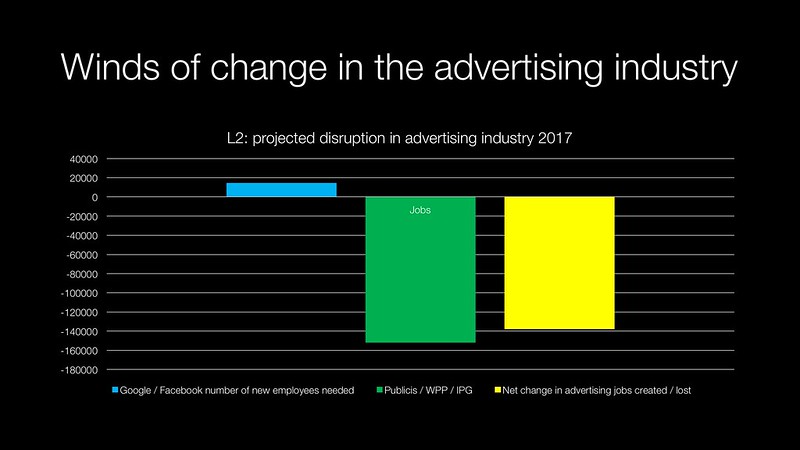
    Facebook and Google count for 85-90% of online advertising growth.

    In China, online media is dominated by Tencent and Baidu. We could ‘Balkanise’ the media landscape. But that would mean a poorer experience for users outside the US and China. The technology sector does not have:

    • Commercial scale in funding
    • Sufficient talent
    • Comparable addressable markets

    Timms & Heimans hypothesis of ‘new power vs. old power’ rubs up against technology as an uncomfortable vector.

    This all means that the tensions in society, civic society and societal discourse is accelerated and amplified.

    From the perspective of technology platforms this isn’t their problem. They are only tackling it with reluctance, they don’t have a silver bullet solution.
    In their eyes:

    • ‘Online’ isn’t a problem, it is the breakdown in social norms, which are then amplified and gamed online
    • In the real world we’re insulated from views unless we chose to explore alternatives. Algorithms have amplified this process further to create a filter bubble. Algorithms are only mimicing our natural desires. This is mirrored in the lack real-world discourse and polarisation of views
    • Algorithms are accused of having a reductive effect on an individuals breadth of media consumption. News feed algorithms jobs are to make platforms money. Before their widespread use netizens widely flocked to chatrooms and forums with a similar narrow focus. News readers using RSS which would allow individuals to read widely have proved to be only a niche interest

    Reading widely is important to be being well informed, but its a conscious choice that people have to make. But in order to read widely one has to be:

    • Sufficiently educated to be confident in their reading ability
    • Confident enough to ignore any scorn that might come from ‘books, learning and being an expert’
    • Sufficiently curious to have the motivation to read
    • Having sufficient time to be able to read

    These bullets are affected by quality of education, social norms and income. If you are just getting by with a series of side hustle jobs you might too time poor to read widely.

    These are not universal traits in society. In the UK the idea of the self-educated literate working-man who goes to classes at the Mechanics Institute is long dead. That wasn’t done by Facebook or Google.

    The notion of an easily swayed populus wasn’t an invention of Cambridge Analytica, Google or Facebook. The Roman poet Juvenal famous for the concept of ‘bread and circuses’ would see something similar in populist politics. From Brexit, to Germany’s AfD the focus on diversion, distraction and immediate satisfaction ‘palliative’. A significant amount of common people are selfish in nature and often pay little attention to wider concerns.

    A quote from near the end of Jean-Paul Satre’s play No Exit sums it up quite well

    “All those eyes intent on me. Devouring me. What? Only two of you? I thought there were more; many more. So this is hell. I’d never have believed it. You remember all we were told about the torture-chambers, the fire and brimstone, the “burning marl.” Old wives’ tales! There’s no need for red-hot pokers. HELL IS OTHER PEOPLE!”

    Whilst in a democracy, all opinions should have the opportunity to be voiced; should they have a right to be heard? Should politicians really reflect the will of the people? I think there is a strong argument to be made against it. I am not advocating authoritarian rule, but that we need leaders who reflect on the greater good. Edmund Burke – one of the founding fathers of British conservatism is a widely cited example of a politician who didn’t reflect the will of the people. Burke recognised that democracy can create a tyranny over unpopular minorities. He didn’t consider politicians to be delegates; conduits for votes without moral responsibility.

    He is widely cited as being a better man for it:

    • Burke viewed the British conduct in India under the East India Company immoral
    • He advocated representation for American colonists
    • Acknowledgement of wrongdoing by the Crown in America and an appropriate apology

    Facts versus Emotion

    Facts and emotion have always duelled and facts have frequently come off the worse for it. Western politicians from Adolf Hitler to Barrack Obama have little in common except being successful exponents of rhetoric and emotion in their speeches. Technical skills and knowledge don’t make the cut. A classic example of this is the dissonance between the advice of John Redwood as a strategist with Charles Stanley versus his political stance on Brexit. Mr Redwood knows what works as a politician.

    Those that wield emotion now, have a greater understanding of how it works. It is why populist organisations win. It is why experts fail to persuade voters to act in their own interest. That won’t change with technology but with stonger, harsher electoral commission powers.

    Fact versus Fiction

    Yellow journalism and fiction has been with us for as long as civilisation existed. It’s modern roots are in the American media industry of the late 19th century, as publishers battled for circulation. They work because audiences love ‘good stories’. A good story is one that:

    • Surprises
    • Entertains
    • Reinforces our own beliefs

    American journalist Frank Mott listed the following characteristics of :

    • Scare headlines
    • Lavish use of images
    • Faked expertise: misleading headlines pseudo-science and false learnings

    All of Mott’s points sound like a thoroughly modern media playbook. Yellow journalism pioneers Hearst & Pulitzer were only stopped by public vilification and shame. The Pullitzer Price, like the Nobel Prize was a penitent act at the end of a successful  commercial career in media. Hearst & Pullitzer were owner-proprietors, it is a lot harder (though not impossible) to shame a public company today. The bigger issue is that a century of mass-media practice has lowered the bar in standards for ‘new media’ companies. A brutal legislative machine that would replace compliance through guilt with compliance through fear is a possible solution. However the legislative executive by its nature tends to favour the wealthy.

    More information
    What Technology Wants by Kevin Kelly
    Trend Watch: New Power v. Old Power by Beth Comstock
    No Exit and Three Other Plays by Jean Paul Sartre
    Satires by Juvenal
    Media of me: 13 theses

    SaveSave

    SaveSave

    SaveSave

    SaveSave

    SaveSave

    SaveSave