Category: jargon watch | 術語定義 | 용어의 정의 | 用語の定義

Jargon watch as an idea was something that came from my time reading Wired magazine. I found that in my work terms would quickly spring up and just as quickly disappear. So it made sense to capture them in the moment.

The best way of illustrating jargon watch is by example. I came across the term black technology through mainland Chinese friends. One of the key things that Chinese consumers think about technology products is the idea of ‘black technology’. This makes no sense to your average western reader. It equates to cool and innovative.

The term itself comes from a superior technology featured in a Japanese manga series plot. As an aside the relationship between Chinese and popular Japanese culture is becoming increasingly attenuated due to Chinese nationalism.

What might be black technology this year might be humdrum in six months as the companies quickly catch up. Black technology is a constant moving target, but generally its sophisticated and likely has a cyberpunk feeling to it.

I keep an eye out for jargon like this all the time, hence jargon watch. I find this content in my professional reading and in the sources that I follow online. What makes something worthwhile to appear here is purely subjective based about how I feel about it and how much I think it resonates with my ideas or grabs my attention. A lot of British youth culture doesn’t make it because it doesn’t have that much of an impact any more beyond the UK.

  • NORA

    Last week I heard the acronym NORA mentioned with regards the kind of problems that Microsoft’s algorithm could solve. NORA stands for no one real answer. Search is already pretty good at answering questions like ‘what time is it in Osaka’ or ‘what is the capital of Kazakhstan’.

    In the mid-2000s NORA would have been called ‘knowledge search‘ by the people at Google, Yahoo! and Bing – who were the main search engine companies. So its not a new idea in search, despite what one might believe based on the hype around chatbot enabled search engines. ChatGPT and other related generative AI tools have been touted as possible routes to get to knowledge search.

    Knowledge search

    Back when I worked at Yahoo! the idea of knowledge search internally was about trying to carve out a space that useful and differentiated from Google’s approach as defined by their mission:

    To organise the world’s information and make it universally accessible and useful

    Our approach to search – Google

    Google was rolling out services that not only searched the web. It also covered maps, the content of books including rare libraries and academic journals. It was organising the key news stories and curating which publications were seen in relation to that story. It could tell you the time elsewhere in the world and convert measures from imperial to metric.

    Google’s Gmail set the standard in organising our personal information, making the email box more accessible and searchable than it had been previously. We take having a journaled hard drive for granted now, but at one time Google Desktop put a search of the files on your computer together with online services in one small search box.

    Google Desktop Mac

    Being as good as Google was just table stakes. So when I was at Yahoo! we had our own version of Google Desktop. We bought Konfabulator, that put real time data widgets on your desktop and were thinking about how to do them on the smartphone OS of the time Nokia’s Symbian S60. Konfabulator’s developer Arlo Rose went on to work on Yahoo!’s mobile experiences and Yahoo! Connected TV – a photo-smart TV system that was before the modern Apple TV apps. Tim Mayer led a project to build out an index of the web for Yahoo! as large, if not bigger than Google’s at the time. And all of these developments were just hygiene factors.

    My colleagues at Yahoo! were interested in opinions or NORA; which is where the idea of knowledge search came in. Knowledge search had a number of different angles to it:

    • Tagged content such as my Flickr photo library or social bookmarking provided content from consumers about a given site that could then be triangulated into trusted context, or used to train a machine learning model of what a cat looked like
    • Question and answer services like Quora, Yahoo! Answers and Naver’s Jisik In Service improved search. Naver managed to parlay this into becoming the number one search engine for Korea and Koreans. Google tried to replicate this success with Knol and failed
    • Reviews. Google managed to parlay reviews into improving its mobile search offering. Google acquired Zagat in 2011. This enabled Google to build a reputation for good quality local restaurant reviews. It eventually sold the business on again to another restaurant review site The Infatuation

    The ChatGPT type services in search are considered to provide an alternative to human-powered services. They create NORA through machine generated content based on large data sets trawled from the web.

    Energy consumption

    A conventional Google internet search was claimed to consume 0.3 watt/hours of power according to Google sources who responded to the New York Times back in 2011. This was back when Google claimed that it was processing about one billion (1,000,000,000) searches per day. It accounted for just over 12 million of the 260,000,000 watt hours Google’s global data centres use per day. The rest of it comes from app downloads, maps, YouTube videos.

    But we also know that the number of Google searches ramped up considerably from those 2011 publicly disclosed numbers
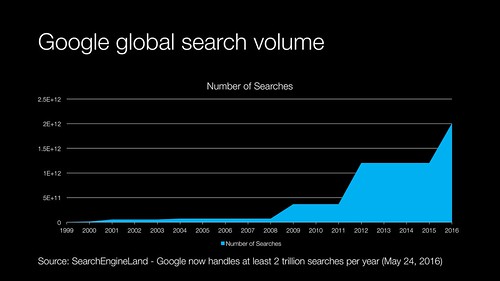
    Google global search volume

    The driver for this increase was mobile search including more energy intensive Google Lens and voice activated searches thanks to Android.

    Large language models (LLMs) are computationally intensive and this will result in a corresponding rise in energy consumption. That also has implications in terms of business profit margins as well as ESG related considerations.

    Legal liabilities

    With NORA content being created by machine learning services, it might be different to the previous generation of knowledge search services. These services were platforms, but machine learning services become publishers.

    This becomes important for a few reasons

    • Increased costs (while they aren’t using an army of writers, they are using a lot of computing power to generate the responses)
    • Legal protections (in the US)
    • Intellectual property and plagiarism issues, currently they can handle it just by taking down the content. Once they become a publisher rather than a platform things become more complicated

    “no provider or user of an interactive computer service shall be treated as the publisher or speaker of any information provided by another information content provider”

    Communications Decency Act of 1996.Section 230

    Section 230 has been repeatedly used to regulate Facebook, Google et al in a lax manner as they haven’t been ‘publishers’, with ChatGPT this may change. The question of whether an algorithm is a creator has some precedence. Financial reporting has used machine learning to create news reports on company financial results over a number of years. Combine that with the general political antipathy towards Meta and Alphabet from both of the main US political parties and things could get interesting very fast.

    It is interesting that OpenAI is putting a lot of thought around ethics in LLM, which will impact future services and they probably hope stave off regulation.

    Regulated industries and liability

    Given an LLM’s ability to make things up it can:

    • Gives advice without pointing out health risks by creating a workout plan or a weight loss diets
    • Gives bad legal advice
    • Infringe regulations surrounding different industries like financial services

    This is just the tip of the iceberg that NORA content powered by LLMs face.

    Business model disruption

    Search advertising as we know it has been the same for the past two decades. The disruption to the look and feel of search results through Bing’s chat response has a negative impact on Google’s advertising model with the search ads along the top and down the right hand side of the search engine results page. Instead you’ll end up with the ‘correct’ answer and no reason to click on the search adverts.

    Currently if a non-relevant site shows up in Google. The lack of relevance is blamed on the site rather than the search engine. However an error in a machine learning created NORA response will see the search engine blamed.

    Which is pretty much what happened when Google demonstrated their efforts in the area. Inaccuracies in a demonstration held in Paris cause the share price of Alphabet to decline by 7 percent in one day. Technology news site TechCrunch even went as far as to say that Google is losing control.

    Microsoft probably doesn’t have a lot to lose in Bing. So integrating ChatGPT’s LLM might give them a few percentage points of search market share. Microsoft thinks that each percent gain would be worth 2 billion dollars in extra revenue.

    The 2 billion number is an estimate and we don’t know how the use of NORA results generated by LLM will affect bidding on search keywords. That 2 billion might be a lot less.

    Is NORA the user problem that Google and Bing’s use of LLMs are fixing?

    Around about the time that Google enjoyed a massive uptake in search it also changed search to meet a mobile paradigm. Research type searches done by everyone from brand planners to recruiters and students have declined in quality to an extent that some have openly questioned is Google dead?

    Google search box

    Boolean search no longer works, Danny Sullivan at Google admitted as much here. While Google hasn’t trumpeted the decline of Boolean search, ‘power’ users have noticed and they aren’t happy. That narrative together with the botched demo the other week reinforced each other.

    Unfortunately, due to the large number of searches that don’t require Boolean strings, Google wasn’t going to go back. Instead, chat-based interfaces done right might offer an alternative for more tailored searches that would be accessible to power users and n00bs alike?

    Technology paradigm shift?

    At first the biggest shock that myself and others had seeing the initial reports was how Google and Microsoft could have been left in the dust of OpenAI. Building models requires a large amount of computing power to help train and run.

    Microsoft had already been doing interesting things in machine learning with Cortana on Azure cloud services and Google had been doing things with TensorFlow. Amazon Web Services provides a set of machine learning tools and the infrastructure to run it on.

    Alphabet subsidiary DeepMind had already explored LLM and highlighted 21 risks associated with the technology, which is probably why Google hadn’t been looking for a ChatGPT type front end to search. The risks highlighted included areas such as:

    • Discrimination, Hate speech and Exclusion although there is research to indicate that there might be solutions to this problem
    • Information Hazards – there has already been a case study on how an LLM can be influenced to display a socially conservative perspective.
    • Misinformation Harms – researchers claimed that LLMs were “prone to hallucinating” (liable to just make stuff up)
    • Malicious Uses
    • Human-Computer Interaction Harms
    • Environmental and Socioeconomic harms

    Stories that have appeared about ChatGPT and Bing’s implementation of it seem to validate the DeepMind discussion paper on LLMs.

    The Microsoft question of why they partnered with ChatGPT rather than rolling out their own product is more interesting. Stephen Wolframs in-depth explanation of how ChatGPT works is worth a read (and a couple of re-reads to actually understand it). Microsoft’s efforts in probabilistic machine learning looks very similar in nature to ChatGPT. As far back as 1996, then CEO Bill Gates was publicly talking about how Microsoft’s expertise in Bayesian networks as a competitive advantage against rivals. Microsoft relied on research and the Bayesian network model put forward by Judea Pearl which he describes in his book Heuristics.

    Given the resources and head start that Microsoft had, why were they not further along and instead faced being disrupted by OpenAI? Having worked in the past with Microsoft as a client, I know they won’t buy into anything that they can build cheaper. That raises bigger questions about Microsoft’s operation over the past quarter of a century and its wider innovation story to date.

    Flash in the pan

    At times the technology sector looks more like a fashion industry driven by fads more than anything else. A case in point being last years focus on the metaverse. The resulting hike in interest rates has seen investment drop in the field. Businesses like Microsoft and Meta have shut down a lot of their efforts, or have scaled back. It is analogous to the numerous ‘AI winters‘ that have happened over the past 50 years as well.

    Bing’s implementation of LLM is already garnering criticism from the likes of the New York Times. This new form of search may end up being a flash-in-the-pan like Clubhouse. The latent demand for NORA in search will still be there, but LLM might not be the panacea to solve it. Consumers may continue to rely on Reddit and question-and-answer platforms like Quora as an imperfect solution in the meantime.

    In summary….

    • NORA content generated by LLMs represent a new way to solve a long known about challenge in online search
    • NORA as a concept was previously called knowledge search
    • NORA content competes with: social media including Reddit, specialist review sites including Yelp or OpenRice and question and answer services including Quora
    • ChatGPT and similar services affect human perceptions of search and the experience makes them more critical of the search engine response is not of an acceptable standard
    • LLMs represent a number of challenges that large technology companies have discussed publicly, but were still attractive for some reason
    • ChatGPT shows up the the decades of research that Google, Microsoft and Amazon have put into machine learning, this will negatively affect investors attitudes to these companies and merits a more critical nuanced examination of ‘innovation’. These large companies seem to be struggling to put applied innovation into practice. Microsoft buying into ChatGPT is essentially an admission of failure in its own efforts over at least 3 decades. Even ChatGPT’s deeply flawed product is considered to be better than nothing at all by these large technology companies
    • Use of ChatGPT like services expose Google and Bing to business risks that are legal and regulatory in nature. It could even result in loss of life
    • ChatGPT’s rise has surfaced deep seated concerns amongst technologists, early adopters, power users and investors about Google’s ability to execute on innovation successfully now (and in the future). Google’s search product has been weakened over time by its focus on mobile search dominance. Alphabet as a whole is no longer seen as a ‘leader’
    • LLMs, if successful would disrupt the online advertising business model around search engine marketing
    • ChatGPT and its underlying technology do not represent a paradigm shift
    • There is evidence to suggest that ChatGPT and other LLM powered chat search interfaces could turn out to be a fad rather than a future trend. The service as implemented has underwhelmed
  • Patagonia vest recession

    The Patagonia vest recession was a phrase that I first heard touted by Scott Galloway to encapsulate the economy in 2022. In most recessions, the first sectors to go under are construction, retailing and manufacturing – blue and pink collar working class people suffer the blunt of lay-offs and site closures due to recession.

    The kind of vest thought of when one talks about a Patagonia vest recession. It is called a Better Sweater vest and was popular with media firms, technology companies and investment banks as employee schwag.

    Chart House Restaurant
    Taken by soq

    What’s a recession?

    recession, in economics, a downward trend in the business cycle characterized by a decline in production and employment, which in turn causes the incomes and spending of households to decline.

    (December 5, 2022) Recession. United Kingdom: Encyclopaedia Britannica

    A recession generally isn’t felt uniformly across the economy. It doesn’t affect all households. In the past, the middle class might be affected but not as severely affected as working class people. My Dad had managed to move off the shop floor and into an office job in the shipyard as a planner. He was made redundant because he worked in heavy industry and he was in a minority compared to the thousands of other blue collar workers let go.

    Not all businesses experience actual declines in income, for instance accountancy firms, business consultancies and change management firms may find a high demand for their services. However, there is a general expectation about the future being less certain during a recession. This causes businesses to delay making large purchases or investments and possibly look to reduce costs to conserve cash.

    In recessions, the output decline can be traced to a reduction in purchases of durable household goods such as computers and washing machines by consumers. This drives a corresponding decline in corporate purchases of machinery and other equipment.

    If the companies aren’t already running ‘just-in-time’ there reduction in additions of goods to stocks or inventories. Where ‘just-in-time’ is in place, the client reduces their forecast demand to their supply chain driving a similar effect. The greatest effect is likely on inventory; businesses stop adding to their existing inventories and become more willing to draw on them to fill production orders. Inventory declines thus have a double impact on production volume as it filters through the supply chain like a Mexican wave.

    So what happened?

    But the Patagonia vest recession was different. A number of things happened:

    • Technology stocks and start-ups had been swept up in a decade of irrational exuberance in terms of business values
    • Funding suddenly declined for startups. This was partly due to interest rates and a realisation that crypto-currencies weren’t worth what many investors had assumed. This led to a raft of redundancies
    • Crypto companies started falling one after the other. Prominent exchange FTX and related investment fund Alameda Research go under with allegations of fraud. Their rival Binance is ensnared in legal issues too
    • Cloud software firms suddenly find that their pay-as-you-go model can result in sharp cash flow declines which affect their profits
    • Big technology companies had staffed up to meet the COVID-19 related demand, found themselves with an employee overhang. This particularly affected e-tailing and cloud services business. They cut back on staff as they release poor financial results. BUT, the amount of people cut as a percentage was still below the proportion of head count Microsoft would have let go back when it practiced stack ranking. The mainstream media focus on the big numbers rather than the small overall proportion of lay-offs. Secondly those getting made redundant are finding it a reasonable market to get work outside the technology sector
    • Activist investors object to what they consider to be more indulgent projects like Meta’s deep investment in the future metaverse, which is a very long term bet
    • Meanwhile, services and manufacturing industry kept ramping up to meet supply-chain related challenges and meet latent demand. But had problems getting staff. You have restaurants that open up limited hours due to their problems hiring. Manufacturing businesses have been hoarding staff, because they know how hard it is for them to recruit
    • Inflation in the US is starting to come under control as supply chains started to balance out

    Of course, all of this doesn’t mean that the Patagonia vest recession won’t bleed on to Main Street, but at the start it looked very different.

    The Patagonia vest boom prior to the Patagonia vest recession

    To the general public, awareness of the Patagonia vest as an emblematic garment of class came from the press photos taken at the Sun Valley conference hosted by private investment firm Allen & Co. which built up a bit of a reputation in terms of ‘speed dating’ for mergers and acquisitions deals. Media titans like the Murdoch family met Silicon Valley CEOs and Jeff Bezos of Amazon. Telecommunications was represented primarily through the cable TV company executives who attended.

    Amazon founder Jeff Bezos decided to buy the Washington Post when he was at Sun Valley. It was also where the Time Warner | AOL merger was cooked up.

    Cameras aren’t allowed inside the conference which operates in a Chatham House-style arrangement. So press photographers could only take pictures when people were arriving or leaving the conference centre. Sun Valley sat at the nexus of a media and technology sector boom over almost two decades. The bulk of the media photos showed people walking cropped at the knees or their grotch, which focused readers attention on the tops that they were wearing. And a uniform emerged to the general public. The uniform was the Patagonia vest to deal with the cool early morning and early evenings of Sun Valley. These vests were given out some years by Allen & Co.; but the Patagonia vest has extended itself far beyond Sun Valley.

    It became such a cultural touchstone that the Sun Valley conference complete with vests was lampooned in a story arch of Succession.

    Why a Patagonia vest recession?

    Why is this a Patagonia vest recession rather than a North Face vest recession or a Columbia Sportswear vest recession?

    From working with dot com clients to when I worked at Yahoo!, Silicon Valley fashion was bifurcated in nature. The reality of Silicon Valley couture is that many people wore a t-shirt jeans and layers like hoodies. Footwear would vary somewhere between sneakers and trekking sandals.

    Men's Monterey Brown Teva Sandals With Socks

    But the ‘MBA class’ of professional managers tended to wear collared shirts, ‘smart’ jeans or chinos. They may have worn a sleeveless pullover or fleece vest. Their venture capital counterparts who where probably their MBA class colleagues wore a similar uniform, with a bit more of lean towards Ralph Lauren country club friendly shirts or polo shirts.

    Corporate branded wear started with bags. I had my share of corporate branded Timbuk 2 bags. Different engineering projects would have celebratory t-shirts for things like hack days. Eventually we started to see branded corporate wear, from the cringeworthy chambray or scratchy polo shirts issued to booth staff at an exhibition to hoodies and fleeces. I knew engineers who bragged about being dressed almost head to toe (sweatshirt material top, t-shirt, boxers and socks) in schwag that they had picked up for free as an anti-fashion statement.

    You can see these dual styles in the TV show Silicon Valley. Coming from a creative agency background, I felt more at home in the hoodie wearing crowd.

    Secondly, there was a cargo cult amongst try-hards in the early to mid-2000s there was a move towards turtle necks with Silicon Valley types looking suspiciously like architects as they tried to ape Steve Jobs. There has been a similar buzz has surrounded Allbirds sports shoes

    The finance sector had its own transformation. Early dot com era west coast-based tech focused investment bank financiers such as Frank Quattrone mirrored the east coast convention of the tailored business suit, usually in grey with a conservative tie and pocket square. This would be paired with a set of brown shoes, usually loafers. You could buy the look at Armani, Barneys or Brooks Brothers depending on your budget.

    Frank Quattrone
    Frank Quattrone by JD Lasica

    The 2008 Great Recession hit the finance centre like a shockwave. There was a need to dress down. A few things drove this:

    • An Armani suit is an obvious target when you have Occupy Wall Street camped outside your place of work
    • Wall Street had to modernise and attract new types of talent and competed against tech firms
    • The need to mirror the look of the hedge funds and technology companies that investment bankers wanted to do business with. They already stood out with their east coast vibe, the outfits communicated that ‘actually we’re just like you’ with varying degrees of success

    The look has morphed into a relaxed yet sophisticated uniform that drew on preppyness, or the Ivy League look and the country club vibe evoked by Silicon Valley VCs. This resulted in a grey or navy fleece vest paired with a button-down, chino pants, and maybe even leather sneakers. It fitted in with weekend wear in more high class neighbourhoods and didn’t scream privilege in the same way that traditional Wall Street did.

    However this became a power validation all of its own, dubbed the “Midtown Uniform” by many for its popularity throughout Midtown Manhattan as the business casual look rolled across the cultural wallpaper of Wall Street.

    Expired?

    Patagonia haven’t enjoyed their vests being the punchline of a joke. They are a mission led company that looks to be sustainable and environmentally friendly. They’ve been described as the conscience of the outdoor industry. Patagonia doesn’t want its products sold on Amazon, not because it’s luxurious and exclusive. But because Patagonia believes that Amazon encourages thoughtless consumption and is bad for the environment. Being seen as the uniform of the privileged didn’t go down well. So in April 2019, Patagonia announced that it wouldn’t provided corporate branded clothing to financial institutions or fintech companies, preferring to focus on mission-led environmental businesses instead. Given its iconic status within these sectors, the news was given the kind of coverage that would usually be reserved for an uncharacteristically large drop in the S&P 500 index.

    The case against fintech businesses is down to their rapidly expanding energy footprint, which I have covered in depth elsewhere.

    While a clear successor to the Patagonia vest hasn’t become apparent yet, there are brands looking to take their crown such as

    • Cotopaxi – who are environmentally friendly, but also corporate friendly
    • North Face – have been doing some interesting work in more environmentally friendly materials and already well known in the corporate branding space
    • SCOTTeVest – famous for being traveller-friendly. It comes with routing for your headphone cables, a plethora of pockets and charging wires. Their CEO called the Patagonia stance PR BS

    Grandfathered in

    Secondly, Patagonia decided that it wouldn’t leave long term customers in the lurch, which probably means that your favourite investment bank or big tech firm is safe from the customer purge.

    According to Corley Kenna, senior director of global communications at Patagonia, customers and the press had inquired as to “whether we’re leaving ‘bros out in the cold.’” Kenna confirmed again that long-term customers would be grandfathered in.

    (April 5, 2019) Are Bankers and Venture Capitalists Really Getting Fleeced by Patagonia? United States: New York Times

    And those left in the economic cold can still enjoy a Patagonia vest recession. I am thankful that it wasn’t called the Carhartt or Chore coat recession signalling a creative class layoff-led recession.

    More information

    Starbucks, Airpods, and the Fleece Vest: The Rise of Wall Street’s Greatest Fixture | California Review

    Patagonia suggests finance bros aren’t a fit for its fleece vests | Quartz

    Patagonia distances itself from tech bros with new branded vest policy | Guardian

    Patagonia Is Refusing To Sell Its Iconic Power Vests To Some Financial Firms | Buzzfeed News

    The finance bro uniform is officially dead as Patagonia stops adding corporate logos to its ubiquitous fleece vests | Business Insider

    How to dress tech bro | Financial Times

    I Wore A Fleece Vest To Work To See If I Felt Like A Tech Bro | Buzzfeed News

    Patagonia will no longer sell vests with finance firm logos on them | CBS News

    Will Patagonia’s New Corporate Gifting Policy Affect the Event Industry? | BizBash

    Moguls, Deals And Patagonia Vests: A Look Inside ‘Summer Camp For Billionaires’ | WBUR

    Shock, horror: Patagonia bans sale of corporate branded vests to fintech and Wall Street firms | City AM

  • New Power by Heimans & Timms

    New Power by Jeremy Heimans and Henry Timms was recommended to me by a friend of mine who works with a number of campaigning organisations. It took four years after it was published for me to take it down from the shelf and get stuck in.

    New Power

    Since then, we have had the Hong Kong protests, January 6 disturbances in the US Capitol building where both of their legislative houses operate from. We’ve also had movements around cryptocurrency and the infamous OneCoin scam.

    The book promises to reveal:

    How Power Works in Our Hyperconnected World – and How to Make It Work for You

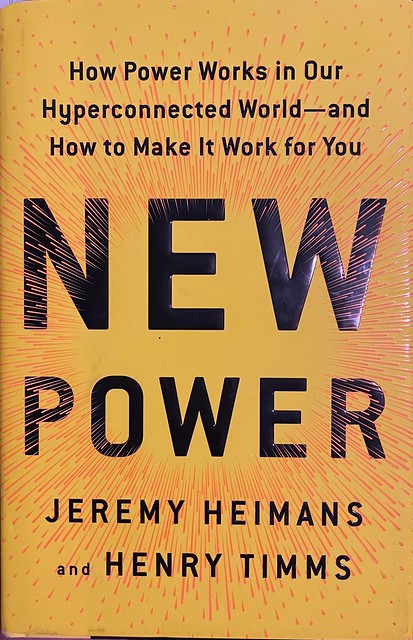
    Front cover of New Power by Jeremy Heimans and Henry Timms

    Jeremy Heimans

    Heimans is an ex-McKinsey consultant who now runs a social impact agency called Purpose. So one could think that New Power is basically part of Heiman’s marketing strategy. Make of that what you will.

    Henry Timms

    Timms heads up the Lincoln Center for the Performing Arts in New York and has been heavily involved in promoting philanthropic donations.

    Old Power and New Power

    Heimans and Timms provide a model for what they think old power is. A top down power structure, think everything from mainstream advertising, government responses to the COVID-19 epidemic, authoritarian regimes like China’s crushing of dissent or the Russian invasion of Ukraine.

    By comparison, new power is participatory in nature and more of a peer to peer relationship. Examples include memes, crypto bros, the leaderless movement that fuelled the 2019 Hong Kong protests, support for populism and ISIS. ISIS recruitment is actually used as an example in the book.

    How power works in our hyperconnected world

    Heimans and Timms provide an analysis on the general thinking behind how campaigning works in a way that would be most familiar to anyone who has run a social media marketing campaign. I would describe it as a primer for typical corporate management types.

    How to make it work for you

    I personally think that this is where the book falls down. New Power isn’t replicable in the same way that a business process rengineering exercise might be. Sometimes these things take off, sometimes they don’t. They talk about some of the factors in the book, but movements often need a catalysing event like the recent apartment fire in Urumqi, Xinjiang that sparked anti-zero COVID lockdown protests in China.

    You can try and create a catalysing event, but too often it’s astro-turfing that no one ever sees, particularly if you are relying on a dominant platform algorithm. Your new power is actually reliant on old power held by the likes of Mark Zuckerberg or Elon Musk. Instead these platforms have been successfully mastered by authoritarian regimes including the Chinese government who manage to demonetise and have content taken down on western platforms.

    Secondly, the authors try to claim showing a bit of moxie is new power. The example they give is a junior employee speaking to a senior executive that they manage to meet by chance.

    Finally, the book lacks the intellectual rigour and scientific method of Mark Ritson or Byron Sharp’s work, instead relying anecdotal evidence, similar to Malcolm Gladwell’s body of work or Paul Polman’s  Net Positive.

    So, should you buy this book?

    If you like TED talks model of learning a little bit about a lot of things and are reading for your own personal interest or to get a high level understanding of campaigning organisations might work, buy New Power. If you are thinking about changing your business into a more purposeful organisation, read this first instead (and its free).

    You you can find out more about New Power here, find the rest of my book reviews here, and the books that I find most useful here.

  • Tectonic shift + more stuff

    Tectonic shift

    The heat from radioactive processes within the planet’s interior causes the plates to move, sometimes toward and sometimes away from each other. This movement is called plate motion, or tectonic shift

    National Ocean Service of the US government’s National Oceanic and Atmospheric Administration (NOAA)

    Zeitenwende

    Olaf Scholz, Hamburg weiter vorn.
    Olaf Scholz, Hamburg weiter vorn.

    German Chancellor Olaf Scholz declaration of a zeitenwende or epochal tectonic shift following the Russian invasion of Ukraine. Part of this tectonic shift is Germany’s desire to become a security guarantor in Europe. A lot of coverage has focused on how far away Germany is from this aspiration in terms of military preparedness and over-reliance on the very countries likely to threaten European security.

    In an opinion piece Chancellor Scholz asked a rhetorical question

    How can we, as Europeans and as the European Union, remain independent actors in an increasingly multipolar world? 

    Scholz, O. (December 2022) “The Global Zeitenwende. How to Avoid a New Cold War in a Multipolar Era“. Foreign Affairs. United States

    Scholz implies that the tectonic shift also adversely affects the United States efforts to jumpstart green industries and contain a globally more aggressive China. One could argue that Scholz’s approach is business as usual. For decades, large German enterprises have encouraged the government to work with authoritarian regimes, creating a Germany highly dependent on bad actors.

    China

    UK council rejects China’s plan to build new embassy in London – Hong Kong Free Press HKFP – a few things went wrong here:

    • China went after elites, but ignored the British public’s dim view of them and councillors who would be much more sensitive to Xinjiang problems
    • The Manchester consulate incident damaged China more than they realised
    • China isn’t likely to make profit on the site that they own any time soon

    HSBC chief denies Beijing is behind Ping An push to split bank | Financial Times – that’s about as reassuring as the football club chairman saying that he’s got every confidence in the player manager after a string of home match losses

    Finance

    Credit cards as a legacy system – complaints about credit cards. The problem these arguments have is that credit cards work

    Ideas

    My cyberpunk city, my cyberpunk world – by Noah Smith – I read this and thought about my own experiences of Hong Kong

    Indonesia

    Indonesia set to penalise sex outside marriage in overhaul of criminal code | Reutersthe new code could be passed by as early as next week. The code, if passed, would apply to Indonesian citizens and foreigners alike, with business groups expressing concern about what damage the rules might have on Indonesia’s image as a holiday and investment destination. – the question is if this is going to take Indonesia on a similar path of economic stagnation as Malaysia has taken?

    Innovation

    Air Force Unveils New B-21 Stealth Bomber After Seven Years in the Making – Defense One 

    Luxury

    Watchfinder Expands Pre-Owned Business with Third-Party Sellers – Robb Report and even Rolex is going into CPO market: Rolex’s Certified Pre-Owned Watch Program: What You Need to Know | Gear Patrol – allowing it to profit on the secondary market boom

    Can NFT-based private clubs disrupt a centuries-old model? | Techinasia – this doesn’t even make sense

    Online

    Vietnam’s answer to Tencent, VNG, eyes overseas expansion after taking on Facebook at home | South China Morning Post 

    French Pornhub case shows how hard it is to regulate the internet | Financial Times 

    Twitter’s decline continues. I noticed this morning that Twitter allowed me to post the exact same Twitter post twice. That isn’t something that was possible previously and I could see how it could be used for nefarious reasons.

    Duplicate twitter posts
    My twitter account this afternoon when I checked it

    Quality

    How Semiconductor Chips Changed the Driving Experience Forever – Robb Report 

    Retailing

    Shein Confusion: The Fast-Fashion Giant’s New Resale Site Doesn’t Make Buying Easy — The InformationAnnie tries out Shein Exchange, the e-commerce brand’s foray into the bustling resale market. On its face, the platform seems like a good idea, given the ongoing controversies over Shein’s cheap, disposable, landfill-clogging apparel. But there is something distinctly off about the brand’s effort to sell used clothes

    Technology

    Amazon to warn customers on limitations of its AI | Reuters 

    Amazon’s new AI tool may take over work from employees facing layoffs and buyouts – Voxthe tech giant has been working for at least the last year to hand over some of its recruiters’ tasks to an AI technology that aims to predict which job applicants across certain corporate and warehouse jobs will be successful in a given role and fast-track them to an interview — without a human recruiter’s involvement. The technology works in part by finding similarities between the resumes of current, well-performing Amazon employees and those of job applicants applying for similar jobs

    Web of no web

    EU throws party in €387K metaverse — and hardly anyone turns up – POLITICO 

  • Michelin Snow Sock + more things

    Michelin Snow Sock

    The Michelin Snow Sock or to give it its proper name SOS GRIP(R) Evolution does a similar job to studded tyres or snow chains (often called RUD Chains after the German company RUD Ketten – a famous manufacturer of snow chains).

    snow sock

    The Michelin Snow Sock looks much easier to store and fit than snow chains and is likely to be less damaging to road surfaces. This new Michelin Snow Sock seems to rely on the black bands across the face of the tyre.

    A key difference is that snow chains can also be used in really muddy conditions and can be used to protect the tyres in hard surfaces such as quarries and mines – although this is usually the domain of a specialist product. You can’t doe these things with the Michelin Snow Sock.

    Inspecting a car before purchase

    Interesting tips on inspecting a car that you are interested in buying. Its interesting how democratised specialist tools have become.

    Twitter

    Professor Scott Galloway talks to Christiane Amanpour about the current economy and the rollercoaster moves at Twitter. My favourite quote from this, describing the recession as a ‘Patagonia vest’ recession affecting knowledge workers the most so far.

    Junya Watanabe Menswear Fall/Winter 2022

    I am about 10 months late to this, but Junya Watanabe did a menswear collaboration with Jay Kaye from Jamiroquai mirroring his mid-to-late 1990s style. Its a mix of indigenous wear that was popular from gap year students (or people who wanted that boho look), rave culture and Goa trance, sports wear and technical outdoor clothing.

    Here is the mini video look book that Junya Watanable made for the menswear collection.

    Here is the original video for Virtual Insanity

    Behind the scenes on how the Virtual Insanity video was made. How the effect was achieved was quite surprising.

    Shakatak

    I didn’t realise how popular jazz fusion group Shakatak was in Japan. To me there where pre-house UK dance music. I found this Japanese festival performance by them.

    The Tokyo Crossover Festival was was originally organised by the Kyoto Jazz Massive member Shuya Okino.

    It was April 2002. I was invited to the Future Jazz Festival held at Zagreb, Croatia. The well select lineup for this 3-days event was Victor Davies, Jessica Lauren, Rainer Truby, Azymuth, Zero dB and many more. The huge success all owed to Eddy & Duss and their incredible local support attracted 1500 enthusiastic people each day! Frankly, and forgive my ignorance, I was quite shocked. This was Zagreb, Croatia. The media that I was exposed to depict the negative image of an on-going civil war for all what I remember. Needless to say, I was inspired and at the same time wondered why Japan never had such festivals. Sure we have money-flowing mainstream Rock Festivals and Techno Festivals but nothing such as Deep House or Future Jazz festivals – which is surprising especially when Japan holds the biggest market share for such music. What is more depressing is that the “traditional” Jazz summer festival seems to be loosing its energy every year… I waited. I thought someone would eventually do the future-jazz festival here in Japan. There were few attempts but did not leave strong impact. Waited few more years…and thought it was time for me to take some action. I called it “Tokyo Crossover Jazz Festival”! This is the first year and I am treating it as an introduction or presentation for the successful year to come. Therefore, it will not be a gigantic outside “typical” festival but the main purpose for this first festival is to cause Crossover Jazz awareness and for artists who have same music vision to gather together. Of course, I am aiming for the fan-pleasing exciting showcases. We have a good “crossover” jazz scene in Japan and I want the fans, all over the world, to know. In the future, the festival will feature artists from Jazz, Techno, Hip- Hop, House and the music will cross all over – the ideal festival that I keep visioning and working hard for! At the end though, all I want for everyone and myself is to…have a good time!

    Shuya Okino (Kyoto Jazz Massive)

    Internet explained in five levels of difficulty

    I showed this to my Dad and he loved it. So I thought I would share it here too.