Blog

  • Nine years span + more news

    Nine years span platform deal

    Reckitt Benckiser and Facebook announce partnership to get digitally closer to consumer – partnership over nine years. In the space of nine years Geocities went from vibrant community to graveyard. Over nine years MySpace relaunched twice – this agreement between RB and Facebook is a bet against disruptive innovation. That implies a whole range of issues regarding antitrust considerations. More FMCG related content here.

    Branding

    Oakley Disruptive by Design | Designboom – interesting how Oakley is trying to now associate itself with design goodness, rather than being disruptive designers themselves now

    TD Bank Boost Customer Advocacy via ATMs | VisibleBanking.com – nice iteration on the Coca-Cola campaigns of recent years

    JWT Launches ‘Forever Faster’ for Puma | MediaBistro – we were watching this advert in the office this morning and didn’t make any sense beyond being mildly entertaining

    Business

    Why Ebay Tells Manufacturers in China What You’re Searching For – The Atlantic – interesting thoughts around authenticity and nostalgia

    Here’s The Difference Between Working At Facebook, Google, And Microsoft — According To Someone Who Has Worked At All Three – some cultural insights at different companies. Interesting how stack ranking doesn’t seem to have turned Microsoft into a pressure cooker

    Guest post: has doing business in China just got too risky? | FT – don’t overreact (paywall)

    The Most Fascinating Profile You’ll Ever Read About a Guy and His Boring Startup | Business | WIRED – great interview with Stewart Brand

    An Insider’s Account of the Yahoo-Alibaba Deal – Harvard Business Review – interesting view of the deal from Sue Decker

    Chilling policy announced for China’s instant messaging services | WantChinaTimes – not really surprising, China has already tried to implement real name policy for cell phone SIMs and Weibo accounts. We’ll see how successful it actually is

    20 of 21 provinces probed engaged in property-related corruption | WantChinaTimes – openness by the Chinese government

    Online

    Forget :) Baidu’s Simeji App Captures Teenage Hearts in Japan – Bloomberg – interesting how traditional media is still a major driver of memes and trends

    Survey: YouTube Stars More Popular Than Mainstream Celebs Among U.S. Teens | Variety – self-serving data points

    15 specialist social network apps in China | Techinasia – interesting set of applications

    Meme

    Weibo user solicits pics for ‘most beautiful bosom’ contest|WantChinaTimes.com – could you get away with this on Twitter, I doubt it

    Security

    Hacker’s own guide to the exploit | Pastebin – I found it really interesting that Google was do important in the process

    Technology

    China Online Shopper Spent $12.5 Billion Buying from Oversea E-tailers | ChinaInternetWatch – which is especially interesting given the ubiquity of UnionPay within China

    New Strategy as Tech Giants Transform Into Conglomerates | NYTimes – I would have thought that Microsoft and Cisco where already at conglomerate status?

    Wireless

    Huawei to slash low-end mobile phone models: executive | WantChinaTimes – interesting move, probably struggling to compete against other Shenzhen businesses living on razor thin margins
  • Post 90s generation & things this week

    China’s post 90s generation

    Some nicely presented data insights on China’s post 90s generation, who are the most likely people to drive China’s next stage of economic growth through domestic consumption. The post 90s generation don’t have the same strong affinity for western brands that their older peers have. The post 90s generation have grown up as China has got better and better with sustained economic growth, infrastructure and power.

    It isn’t often that you see an interesting accessible presentation on online analytics, which is the reason why I thought I would share this one

    An interesting documentary on the relationship between ‘young people’ and brand interactions on social media. In many respects it reminds me of the way that I used brands as a teenager all be it in a real-world setting through consumerism. The power of brands as ‘social’ totem for identity. More related content here.

    A great drone-eye view of Hong Kong, though the Apple TV screensaver with an aerial view of Hong Kong is even better.

    The soundtrack of my week was a mix by Graham Park that he remastered and published online. He played the set at The Hacienda on February 1, 1992. It is a great snapshot of The Hacienda before a myriad of troubles finally closed the venue down. The set marks a time of eclecticism; with deep house, proto-progressive tracks and breaks all being played in the same mix; which would be largely unheard of in a club for the best part of 20 years.

  • A content desert?

    I started thinking about the idea of a content desert for a few reasons:

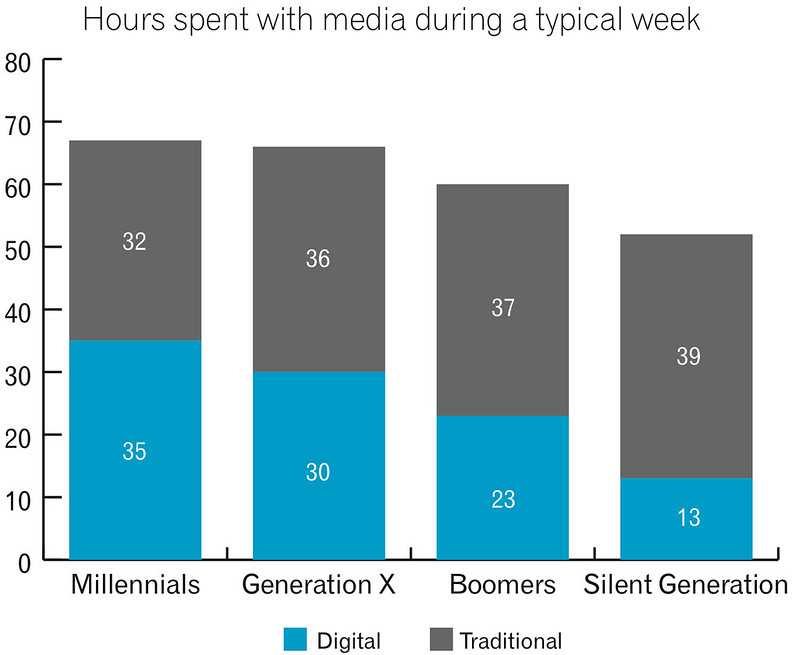
    Experian Marketing Services put out a really nice whitepaper out in June as part of their ConsumerSpeak series called Millennials come of age. One graph stood out to me; the split across generations between traditional and digital media consumption.
    media diet
    On the face of it, two things struck me, consumption of online media increased between millenials and generation X – but not in a way that makes them radically different – . There was also a marginal increase in overall consumption between generation Y and generation X. Is this due to media literacy, less commitments or they were having to work harder to get a similar amount of value from their media consumption?

    We had a focus group in the office looking at the personal media consumption habits of 18 – 24 year olds with an interest in sport. One of the things that came out of this was that they would only buy a magazine about their favourite sport if they were getting on a long plane journey. They thought it was ‘too expensive’ to spend £4 on a magazine. A colleague who sits near me loves the magazine and gets a lot out of the long form articles published in it. He uses these articles as social currency, in the office and with friends. However the panelists that we met felt that they could get everything they needed from sources that they perceived to be of equal quality via free online media.

    This stuck with me for a few days, then I realised why I kept churning it around in my mind. It reminded me of the kind of dialogue and decision-making process that was made by poorer people around food and nutrition. A mix of skewed value systems and economics brought a food desert into these areas.

    I wonder if we aren’t seeing the same thing in the media industry, whilst we know that Buzzfeed and their ilk provide easily-consumed low-quality content usually about first world problems or childhood nostalgia – are generation Y merely getting the media that they deserve? Will there be a content desert? How would a content desert impact brands and perceptions of value?

    A few things give me hope that there may not be; Vice Media is building the global news network that is defining the 2010s in the same way that Aljazeera defined the post-9/11 world and CNN defined the end of the cold war. Although you could argue that with Vice the bill is paid by branded entertainment on behalf of sponsors like Nike and Intel.

    Television has entered a new golden era in dramas; will media companies take the opportunity to reinvigorate factual programming? More related content here.

  • Modified android phones & other news

    Google Under Pressure as Modified Android Phones Take Off | TheNextWeb – 20 per cent sounds on the low side to me for modified Android phones. Why would you need modified Android variants?  You have modified Android phones because Google services are basically unuseable in China and North Korea. Amazon’s Fire phone and tablets are essentially modified Android variants. Finally the Yandex app store in Russia which I suspect is part of a wider fork of Android there, with yet more modified Android variants using it. More  content that is similar to this story here.

    Social Media, Indonesia’s election, and the growth of e-commerce | CampaignAsia – E-commerce has taken off in Indonesia. This has been a mix of traditional e-commerce and services like taxi rides and food delivery. Indonesia has managed to build up its own national champions in these fields. Social media has been used to fight a ferocious election campaign (paywall)

    Service activity at worst level in nearly years, HSBC says | Shanghai Daily – HSBC’s PMI index skews towards medium sized businesses and includes no state owned enterprises. But the data is probably more honest and has less harmonisation going on than official Chinese government data

    Apple Hires Former Social Media Director Of Nike And Burberry | Fast Company – but his job title is digital marketing director of Apple Retail. It will be interesting to see how this story develops over time.

    Procter and Gamble to Divest 100 Brands – Analyst Insight from Euromonitor International – interesting analysis. I was a bit surprised. Procter & Gamble hasn’t treated its brands as a portfolio in the same that Unilever has historically and has been known to market products alongside each other in ads to build up to a P&G story.

    McDonald’s hit by social media disaster on Instagram | Marketing Interactive – live and learn I guess, though disaster is a bit strong

    Why Coke’s experiment with vitaminwater turned sour | Quartz – interesting to see Coke acknowledging the change on its blog

  • Digital China

    I was looking for data on Digital China. wearesocial put together some of the best slideware together in terms of macro-dgital numbers country-by-country.

    Slides and numbers only tell some of the story, so I wanted to reflect on some of the data points in the slides.

    • China boasts a mobile penetration of 91%, however many people have two or more phones which means that mobile phones aren’t quite as ubiquitous as the number appears
    • Desktop internet usage still occurs in internet cafes, often inside a factory complex like Foxconn’s facility in Shenzhen or off the high street of major cities where gaming is a popular pastime, this puts a slightly different complexion on the European-looking numbers for Shanghai and Beijing
    • One thing that is noticeable about Chinese broadband internet connections is that whilst they have bandwidth (which averages just over 3.45MB/s according to the slides), it also has a lot of latency – due to the systems put in for local legal and regulatory compliance. Latency is important because even a small amount (just 0.025s) can adversely affect the call quality on a voice over IP call
    • Mobile internet is very popular, partly because it is the only internet access that a lot of people have. The popularity has come at a price for mobile operators including infrastructure costs (so they have banded together to build a joint network of base stations) and reduced SMS traffic (WeChat’s rise has reduced SMS to just 2% of its former value)
    • QQ has 808,000,000 accounts, at least some of these are actually business accounts. A Chinese business operating on e-commerce will have a QQ IM account for synchronous communications and file transfers, alongside an email address (which will get checked less frequently) and a phone number
    • The search market statistics quoted show user promiscuity in their search habits, partly due to the fact Baidu had taken a more measured approach to mobile search
    • The e-commerce numbers fail to show the market dominance of Alibaba with its TaoBao and TMall retail platforms as digital China shops. TaoBao alone has half a billion registered users, the vast majority of which would be in China
    • WeChat has some 600M domestic registered users. Again some of these accounts will be corporate accounts, there are many inactive accounts if these numbers are to be believed. Each account will be attached to a mobile phone number

    More China related content here.