Category: branding | 品牌推廣 | 브랜드 마케팅 | ブランディング

The dictionary definition of branding is the promotion of a particular product or company by means of advertising and distinctive design.

I have covered many different things in branding including:

  • Genesis – the luxury Korean automotive brand
  • Life Bread – the iconic Hong Kong bread brand that would be equivalent of wonder loaf in the US
  • Virgil Abloh and the brand collaborations that he was involved in
  • Luxury streetwear brands
  • Burger King campaigns with Crispin Porter Bogusky
  • Dettol #washtocare and ‘back to work’ campaigns
  • Volkswagen ‘see the unseen’ campaign for its Taureg off road vehicle
  • SAS Airline – What is truly Scandinavian?
  • Brand advertising during Chinese New Year (across China, Hong Kong, Singapore and Malaysia)
  • Lovemarks as a perspective on branding
  • BMW NEXTGen event and Legend of Old McLanden campaign
  • Procter & Gamble’s Gillette toxic masculinity ads
  • Kraft Mother’s Day campaign
  • Kraft Heinz brand destruction
  • Porsche Design in the smartphone space
  • Ermenegildo Zegna
  • Nike’s work with Colin Kaepernick
  • Counterfeit brands on Instagram, Alibaba and Amazon
  • Gaytime Indonesian ice cream
  • Western Digital
  • Louis Vuitton collaboration with Supreme
  • Nokia
  • Nike Korea’s ‘Be Heard’ campaign
  • Mercedes SLS coupe campaign
  • Brand collaborations in Hong Kong
  • Beats headphones
  • Apple
  • Henrion Ludlow Schmidt’s considerations of branding
  • Cathay Pacific
  • Bosch
  • Mitt Romney’s failed presidential bid
  • Microsoft Surface launch
  • Oreo Korean campaign
  • Chain coffee shop brands and branding
  • Samsung’s corporate brand
  • North Face’s brand overeach in South Korea
  • Mr Pizza Korean pizza restaurant and delivery service brand
  • Amoy Hong Kong food brand
  • Chevrolet Corvette ‘roar’ campaign promoting a build your own car service
  • Made in China brand thoughts

    Made in China tends to mean cheap, and possibly nasty. But that doesn’t mean that it will always be the case. Companies like Apple go Made in China because there are manufacturing capabilities in Taiwanese owned factories that aren’t anywhere else.

    Thinking about the future of Made In China; it makes sense to go back into industrial history.

    Its hard to think now that ‘Made in Germany‘ did not stand for excellence, especially when we think about brands like Zeiss, Leica, Miele, Siemens and Daimler-Benz. But at the beginning of the 20th century ‘Made in Germany‘ stood for cheap and tasteless products.

    China is in a similar situation, despite being the workshop of the world for all intends and purposes and coming out with some of the world’s most iconic and innovative devices ‘Made in China‘ is still perceived as poor-quality and cheap. All of Apple’s products are made in China but proclaim ‘Designed by Apple in California‘. So maybe China could learn something from early-20th century Germany?

    Germany got out of its low quality reputation over a few decades (about the length of the Chinese economic miracle) by forming an organisation with a mix of members drawn from artists, designers and big industry called Deutscher Werkbund.  The Deutscher Werkbund was originally a combination of a lobby group, standards body and catalyst for good design across all disciplines. It encompassed product design, factories, typography and industrial standards. Their members did landmark work for industrial titans like AEG, Bosch and Volkswagen.

    Quality was at the centre of everything that they did. Products became sophisticated in their design. They put a lot of thought into how an identity was instilled through design into the most boring of objects.

    An unintended side-effect of the  effort of the Deutsche Werkbund was that Germany had a sound industrial infrastructure that the national socialist government took advantage of. The German government closed down the Werkbund in 1938. But it also laid the foundation of the German post-war miracle, the government reinstated the Werkbund in 1949.

    China has a government that can make things happen, the companies, the engineering talent, legions of artists and many great designers – it is just a matter of putting these groups together and giving them the permission to do something really great. More on design here.
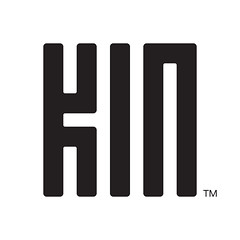
  • Kin logo

    Whilst I won’t be dashing out and getting myself one of the Microsoft | Sharp Kin phones. I did like the Kin logo. The logo seems to be completely unrelated to the devices. It’s an atemporal brand design it would be easy to produce on screen, as an app icon or in print and also looks as if it draws heavily on Asian influence. 

    You wouldn’t need to be able to read the characters to at least recognise the brand. With that in mind it would work in markets around the world. 

    All of that is makes for a really challenging design brief and the work done on the Kin logo is very impressive. 

    I’d go as far as to say that the Kin brand and products are unworthy of the Kin logo design 

    Microsoft Kin logo

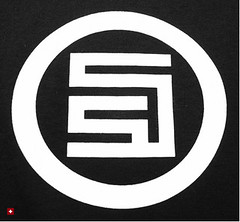
    There is a noticeable stylistic similarity to the S|Double Studio logo from Shawn Stussy’s new clothing label.

    s|double

    And the S|Double logo reminds me of Asian seal designs used to sign documents and mark the ownership of artworks. 

    seal

    This is roughly what my given name would look like on a seal or chop in Chinese characters. 

    There is also a resemblance to Chinese design motifs in Chinese new year and wedding decorations. The one that immediately comes to mind for me is the double happiness character set that is incorporated into designs. 

    Such motifs are used in a repeated pattern across fabric weave, interior design prints and carvings. There is a certain irony in that the Kin logo: one of the most modern of graphic design assignments going back designs and principles that are millennia old. 

    I am curious to know if the Kin logo harking back to those designs was intentional, based on design research, or if it was happenstance. Both are probable likelihoods for this project. 

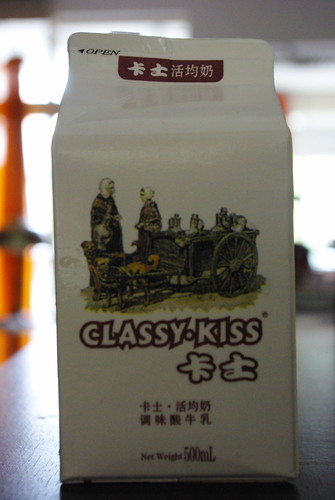
  • Classy Kiss yoghurt drink

    While staying in Shenzhen, I came across Classy Kiss yoghurt drink. At first I was a bit thrown, the European Dickensian vintage illustration was at odds with the product name.

    The name was the only English apart from <- Open on the package.

    Classy Kiss yoghurt drink, originally uploaded by renaissancechambara.

    So why have the name in English and why European people on the packaging? Here are a few likely factors:

    • Chinese people up until recently generally didn’t consume dairy products, so a ‘foreign looking’ brand might make more sense. It came into vogue when they wanted taller stronger kids and had the economic purchasing power to buy a higher protein diet. The old illustration likely conveys heritage (and so trust) of some sort
    • Most Chinese people wouldn’t know what the packaging was saying in English. They also wouldn’t appreciate the odd typography. It would probably feel balanced to a Chinese eye and not too out of step with the feel of the Chinese ideograms
    • It will contrast on the shelf against the clean modernist packaging of western brands like Danone, or General Mills’ Yoplait

    As for the ‘Open’; that was likely on the InDesign file template for the TetraPak packaging. I wouldn’t say that the product is like a classy kiss, but it is a perfectly passable yoghurt drink. More FMCG related posts here.

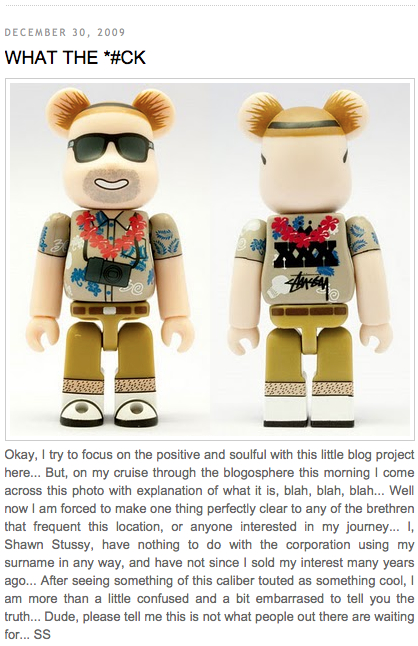
  • Stussy Bearbrick

    Shawn Stussy just threw down on a Stussy Bearbrick. Admitted the Stussy Bearbrick looks pretty lame. Imagine if you set up your own company and you named after yourself because you signed all your work. Over time your signature became the most valuable design asset of the company. Over time you decide that you want to take some of your hard earned cash, take time out and do the stuff that you actually enjoy. You leave your business, having been bought out.

    However, you then have the problem of seeing your name plastered over absolute tat.

    taking your name in vain

    Welcome to Shawn Stussy’s world. They guy invented streetwear as we know it. He mixed American classics like the oxford cotton button down, denim and t-shirts together. On top of that he added American workwear beloved of surfers.  Shawn also got Japan and what they could bring to the table back when everyone else was just thinking about Sony.

    And then the copy and paste aspects of punk culture. There is a reason why Stussy designs come off like old school fanzines. They both come from a common cultural route. The backward SS was a homage to Chanel. The repeating pattern a nod to the luxury brands from Gucci and Louis Vuitton to MCM.

    Supreme, Palace, Neighborhood, Off-White all are following in his footsteps.

    I am a big Stussy fan and it is a rare season where I don’t buy something from their collection. It is hard to keep banging out new streetwear, season after season, even when you’re delving into an archive like Stussy has.  But some of the stuff ends up being pretty ropey and I sympathise with Shawn Stussy’s predicament. Which is why I look forward to seeing what his long-awaited new venture S-Double Studios will come out of the trap with. More on luxury here.

  • Black precious resin & Montblanc

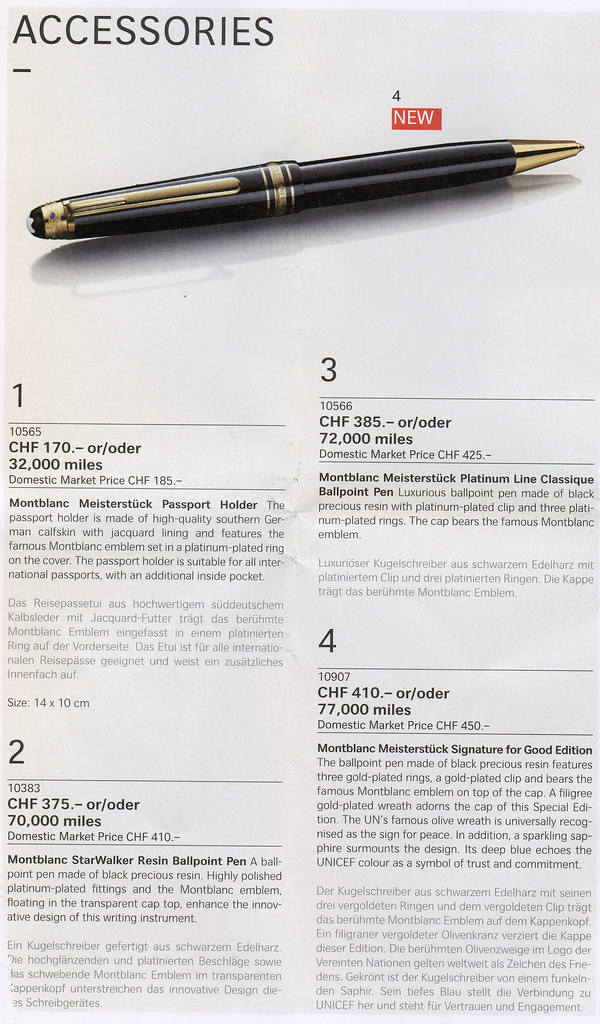
    I had a short haul flight and went over the duty free catalogue on Swiss Airlines. This section on Montblanc pens stuck out at me because of its wording. Each pen was described as being made of ‘black precious resin’. Click on the image if you want to see a larger version.

    Precious Resin Montblanc spiel

    So what does black precious resin actually mean? One would presume some form of black shiny plastic, which doesn’t seem quite so precious. Now the use of plastic isn’t a bad thing in pen manufacture. For instance fellow German writing instrument manufacturers Pelikan and Kaweco both make writing instruments out of plastic, but they also don’t charge over 300 pounds for a ballpoint pen.

    Plastic feels thoroughly modern. It defined the post-war world and accelerated further with globalisation. Black precious resin isn’t particularly rare in itself like ebony wood or precious metals. 

    What the black precious resin explanation misses is the real elements at the heart of Montblanc’s authenticity:

    • History: Montblanc is actually over a century old as a firm
    • Country brand: It’s pens are still made in Germany, so it can take advantage of the German country brand: precision manufacturing excellence and craftsmanship
    • Craftsmanship: making a pen write smoothly is an art, too much ink and you will get splodges. A badly designed nib or ballpoint mechanism will scratch the paper, deliver the ink unevenly and even stain the writer
    • Design: One of the reasons why Montblanc managed to upset A.T. Cross in the market for luxury pens because their pen design feels much better in the hand because of its fuller barrel size

    But none of these factors are reflected in the description of the Montblanc pens featured in the duty-free catalogue, instead we get smoke-and-mirrors which engenders distrust and makes for an authenticity FAIL.