Category: consumer behaviour | 消費者行為 | 소비자 행동

Consumer behaviour is central to my role as an account planner and about how I look at the world.

Being from an Irish household growing up in the North West of England, everything was alien. I felt that I was interloping observer who was eternally curious.

The same traits stand today, I just get paid for them. Consumer behaviour and its interactions with the environment and societal structures are fascinating to me.

The hive mind of Wikipedia defines it as

‘the study of individuals, groups, or organizations and all the activities associated with the purchase, use and disposal of goods and services.’

It is considered to consist of how the consumer’s emotions, attitudes and preferences affect buying behaviour. Consumer behaviour emerged in the 1940–1950s as a distinct sub-discipline of marketing, but has become an interdisciplinary social science that blends elements from psychology, sociology, social anthropology, anthropology, ethnography, marketing and economics (especially behavioural economics or nudge theory as its often known).

I tend to store a mix of third party insights and links to research papers here. If you were to read one thing on this blog about consumer behaviour, I would recommend this post I wrote on generations. This points out different ways that consumer behaviour can be misattributed, missed or misinterpreted.

Often the devil is in the context, which goes back to the wide ranging nature of this blog hinted at by the ‘renaissance’ in renaissance chambara. Back then I knew that I needed to have wide interests but hadn’t worked on defining the ‘why’ of having spread such a wide net in terms of subject matter.

  • The influence post

    Mark Ritson wrote an op-ed over at Marketing Week on influence and influencers. Whilst it lacked nuance on the subject area, a lot of what it said is true. Go over and have a read; I’ll be waiting for when you come back.

    Whilst I disagree on the finer points, what Ritson wrote needed to be said. There needed to be a turning of the tide on influencers from boundless optimism to a greater degree of sobriety and critical analysis of the influencer opportunity.

    I first noticed this boundless optimism when I attended the In2 Innovation Summit in May last year.  Heather Mitchell on a panel. Mitchell worked at the time in Unilever’s haircare division where she is director, head of global PR, digital engagement and entertainment marketing. I asked the panel discussing influencer marketing about the impact of zero-based budgeting (ZBB) and the answer was ducked. ZBB requires a particular ROI on activity, something that (even paid for) influence marketing still struggles to do well.

    This was surprising given the scrutiny that other marketing channels were coming under, I couldn’t understand how influencer marketing merited that leap of faith.

    This time last year I noted:

    Substitute ‘buzz marketing’ for ‘influencer marketing’ and this could be 15 years ago. Don’t get me wrong I had great fun doing things like hijacking Harry Potter book launches when I worked at Yahoo!, but no idea how it really impacted brand or delivered in terms of RoI. Influencer marketing seems to be in a similar place.

    Just five years ago we had managed to get past the hype bubble of social and senior executives were prepared to critically examine social’s worth. In the meantime we have had a decline in organic reach and massive inflation in both ad inventory and influencer costs. What had changed in the marketers mentality?

    Onward with Mark Ritson’s main points.

    Ritson’s Three Circles of Bullshit

    A very loose reference to Dante Alighieri’s Divine Comedy trilogy; but for modern marketers

    The First Circle of Bullshit: Are the followers real?

    • Are they bots?
    • Are they stolen accounts?
    • Are the user accounts active any more?
    • Has the account holder padded their account with bought followers and engagement. Disclosure – I ran an experiment on my Twitter account and still have a substantial amount of fake followers. More on this experiment here.

    The Second Circle of Bullshit: Are influencers trusted?

    • Ritson did an unscientific test that showed (some) influencers would post anything for a bit of money

    The Final Circle of Bullshit: Do they have influence?

    • Some influencers are genuinely authoritative; but this is a minority of influencers out there
    • Ritson alludes to the lack of organic reach amongst an ‘influencers’ followers which is likely to be 2% reach or less
    Trends in influence

    I looked at Google Trends to see what could be learned in the rate of change in searches over time. Consider Google Trends to be an inexact but accessible measure of changes in interest over time.

    Global interest in influencers have been accelerating
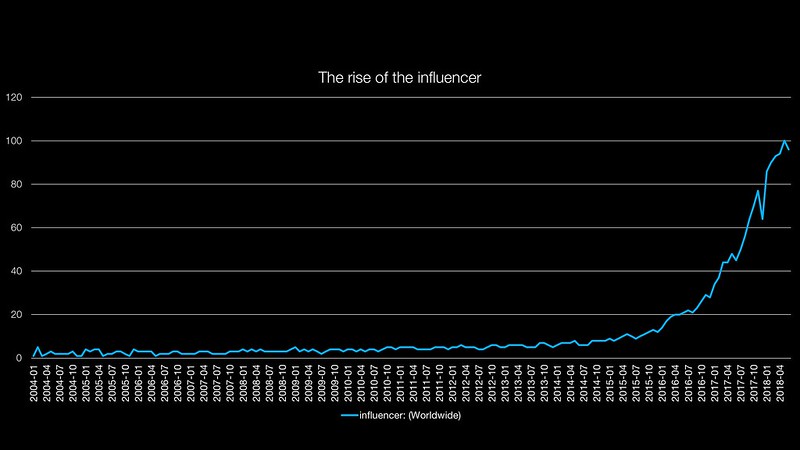
    Influence: Google Trends

    There has been a corresponding rises in interest around paid influencer marketing
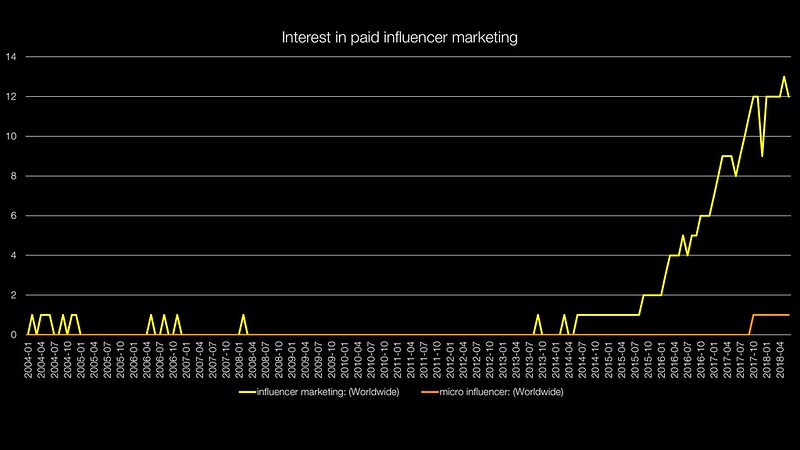
    Influence: Google Trends

    There hasn’t been the same interest peak in organic (PR-driven) influencer work
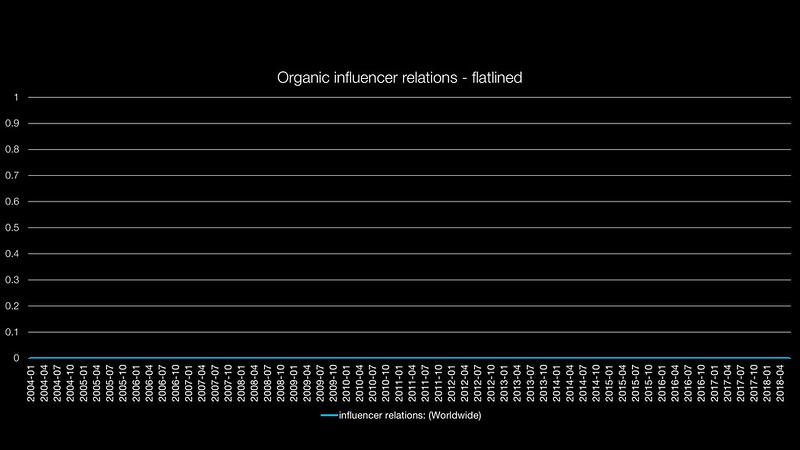
    Influence: Google Trends

    All of which supports the following hypotheses:

    • it’s become on-trend from the perspective of marketers, agencies and ‘influencers’
    • A significant amount of influencers are in it for the money – which brings into question their (long term authority and consumer trust)
    • A significant amount of influencers have an exceedingly good idea of their value (more likely overly-inflated)
    • Ego is less of a motivator for becoming an influencer than material gains
    What would influence look like?

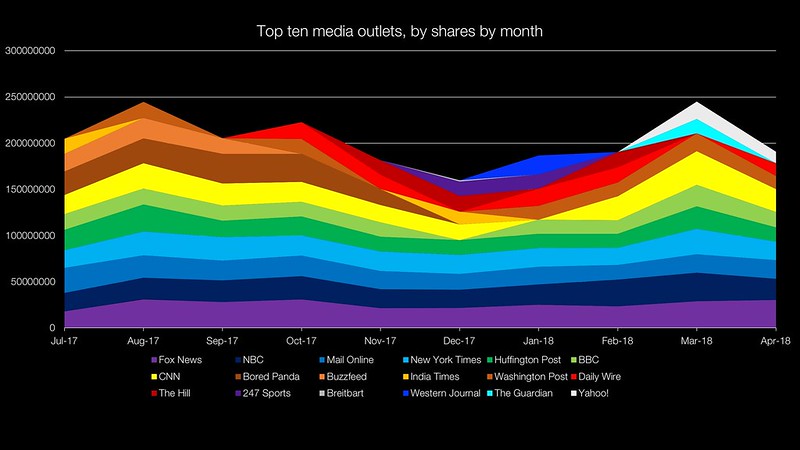
    Propagation of the content by real people. Instagram, a particularly popular influencer channel, has made sharing posts difficult for followers historically. Re-gramming was a pain in the arse for the average Instagram user.
    Slide4

    If we look at the mainstream media and how it is shared on Facebook we see that only five media brands are consistently in the top ten most shared media properties. ‘Traditional’ influencer status isn’t necessarily a garrantor of consistent successful propagation either, if Newship’s data is to be believed.

    Attributed sales. Some luxury brands in China have had success collaborating with influencers and selling through their channels; the post child being Mr Bags collaboration with Longchamps.

    How is the best way to use influencers in marketing?

    Assuming that you are using influencers in the widest possible sense at the moment.

    Treat the majority of influencers as yet another advertising format

    That means that reach, the way the brand is presented, and repetition are all important – smart mass marketing following the playbook of Byron Sharp.

    • Viewing your influencer mention in that prism, it means estimating what the real reach would be (lets say 2% of the follower number as an estimate) and paying no more on a CPM rate than you would pay for a display advertising advert
    • Ensure that the brand is covered in the way that you want. Some luxury brands have managed to get around this by keeping control of the content; a good example of this is De Grisogono – a family-run high jewellery and luxury watch brand. They work with fashion bloggers that meet their high standards and invite them to events. De Grisogono provides them with high-quality photography of its pieces and the event. They get the  high standard of brand presentation which raises the quality of the placement
    • Get repetition with the audience by repeating the placement with other content that delivers the same message with the same high standard of production

    All of this might work for a luxury brand, IF you found that the amount of agency time and creative work made commercial sense. It is less likely to work for normal FMCG brands. What self-respecting influencer is going to be bossed around by a breakfast cereal?

    Thinking about micro influencers, probably the area that has had the most interest from marketers recently due to them appearing to be better value than macro influencers.

    Brown & Fiorella (2013) explanation of micro-influencers:

    Adequately identifying prospective customers, and further segmenting them based on situations and situational factors enables us to identify the people and businesses – or technologies an channels that are closest to them in each scenario. We call these micro-influencers and see them as the business’s opportunity to exert true influence over the customer’s decision-making process as opposed to macro-influencers who simply broadcast to a wider, more general audience.

    Brown & Fiorella focus on formal prospect detail capture and conversion.

    This approach is more likely to work in certain circumstances; where there is low friction to conversion (e-tailing for discretionary value items).

    It starts to fall apart when you deploy their approach to:

    • Consumer marketing
    • Mature product sectors
    • Mature brands

    You would also struggle with many B2B segments where social provides a small reach and little social interaction.

    Work with real influencers on long term collaborations
    • There is more likelihood of having audience trust if they can see and understand the long term relationship between a brand and its influencers
    • Better brand placement easier, with an influencer that ‘gets’ the brand
    • You’ve got a better chance of being able to get access and fully understand the underlying analytics of their accounts (which should be a prerequisite for long term relationship)
    • You can look at collaborations and attribution payment models that raise all boats
    • You can lock out rivals out of relationships
    More information

    Mark Ritson: How ‘influencers’ made my arse a work of art | Marketing Week
    Edelman Digital Trends Report – (PDF) makes some interesting reading
    Instagram Marketing: Does Influencer Size Matter? | Markerly Blog
    Influence Marketing: How to Create, Manage and Measure Brand Influencers in Social Media Marketing by Danny Brown & Sam Fiorella ISBN-13: 978-0789751041 (2013)
    Facebook Zero: Considering Life After the Demise of Organic Reach
    Quantifying the Invisible Audience in Social Networks – Stanford University and Facebook Data Science
    PLOS ONE: Detecting Emotional Contagion in Massive Social Networks by Lorenzo Coviello,Yunkyu Sohn, Adam D. I. Kramer,Cameron Marlow, Massimo Franceschetti, Nicholas A. Christakis, James H. Fowler
    Senior Execs Not Convinced About Social’s Worth | Marketing Charts
    Measuring User Influence in Twitter: The Million Follower Fallacy – Cha et al (2010) – (PDF)
    Visualizing Media Bias through Twitter. Jisun An. University of Cambridge. Meeyoung Cha. KAIST. Krishna P. Gummadi. MPI-SWS et al – (PDF)
    Mr. Bags x Longchamp: How to Make 5 Million RMB in Just Two Hours | Jing Daily
    It’s time that we talk about micro-influencers

  • H1, 2018 most popular posts

    Happy Back to the Future Day

    I took a little bit of time to reflect on the content that I have been writing, what can I learn from it and how I can reuse these learnings? Specifically what are people finding of interest? This couldn’t happen without people actually reading the content, so thank you for reading; feel free to come back on a regular basis. Over the past six months readers like you have found the following articles of most interest. In reverse order

    Reuse, Re-edit, Remix and Recycle – if you read the industry publications we here about personalised ad creative driven by ad targeting. But often the core creative and is created unnecessarily. Instead, what’s the minimum viable creative tweak that can be used? How do we extend the smart processes of reuse, re-edit, remix and recycling into this world?

    This Wasn’t The Internet We Envisaged – in the word’s of Terry Pratchet:

    “If you do not know where you come from, then you don’t know where you are, and if you don’t know where you are, then you don’t know where you’re going. And if you don’t know where you’re going, you’re probably going wrong.”

    So it was time for reflection in order to get a perspective as the regulators and media discovered Facebook, Google and Amazon where not models of virtuous conduct.

    The Biggest Public Relations Agencies Stuckness and Market Dynamics – The Holmes Report came out with their top 250 (biggest) PR agencies around the world in terms of billings. I decided to delve into the numbers for financial years 2014 – 2017.

    This supports a hypothesis of slowing market growth and solidifying market dynamics at a macro level. Strategic acquisitions start to make less sense compared to improving efficiences and effectiveness.

    Throwback Gadget: Bose Wave System – usually my gadget reviews tend to be some of the better performing content. The Bose Wave review was the only one that appears this time around.

    Social Networks 10 Years Ago – a reflection on what a more diverse social media eco-system looked like.

    The Advertising Industry Post – the macro effects buffeting the world’s largest marketing services conglomerates.

    Mercedes China Syndrome – Chinese netizens are jumping the Great Firewall to vilify western brands who reflect views that ‘offend the Chinese people’ – even when this content is aimed at non-Chinese audiences. Mercedes’ offence was an Instagram image with one of their cars and a quote from the exiled Dalai Lama

    Personal online brand – at a time when we’re seeing social media turning into walled gardens. David Gallagher asked the Twitterverse if he should have his own site?

    Twitterverse: @wadds says I need a proper blog. I say I can do it on LinkedIn or Facebook. What say you? Build my own?

    I weighed in on why he should and how I manage the process.

    Chinese smartphone eco-system for beginners – Winston Sterzel did a good video for the average bystander on the Chinese smartphone eco-system. I thought it was a good film to share with marketers  – with a bit more background information answering some of the ‘why’ in terms of market dynamics.

    App constellations 2018  research – I built on work that I had done in 2014 and 2016, comparing the rate of growth across different companies apps based on Fred Wilson’s definition of app constellations. This was also the post that took me the longest to research!

    SaveSave

  • Income and wealth inequality + more

    Income and Wealth Inequality in America, 1949-2016 by Kuhn, Schularick and Steins (University of Bonn) – We expose the central importance of portfolio composition and asset prices for wealth dynamics in postwar America. Asset prices shift the wealth distribution because the composition and leverage of household portfolios differ systematically along the wealth distribution. Middle-class portfolios are dominated by housing, while rich households predominantly own equity. An important consequence is that the top and the middle of the distribution are affected differentially by changes in equity and house prices. Housing booms lead to substantial wealth gains for leveraged middle-class households and tend to decrease wealth inequality, all else equal. Stock market booms primarily boost the wealth of households at the top of the distribution. This race between the equity market and the housing market shaped wealth dynamics in postwar America and decoupled the income and wealth distribution over extended periods. The historical data also reveal that no progress has been made in reducing income and wealth inequalities between black and white households over the past 70 years, and that close to half of all American households have less wealth today in real terms than the median household had in 1970. – long read but very worthwhile study on historic US income and wealth inequality. More related content here. (pdf)

    Yahoo Messenger is shutting down on July 17, redirects users to group messaging app Squirrel | TechCrunch – end of an era

    New Ways for Gaming Creators to Get Started and Get Discovered on Facebook | Facebook Newsroom – in app ad bidding

    New Ways to Enjoy Music on Facebook | Facebook Newsroom – rip off of musicia.ly

    Apple Ignores What’s Wrong With the Mac | Sascha Segan | PCMag.com – a pretty fair critique of Mac industrial design

    Apple, where’s the smarter Siri in iOS 12? USA Today – it would be more interesting if one could use the workflows created by others a la IFTTT

    Meet the people who still use Myspace: ‘It’s given me so much joy’ | The Guardian – something to be said for smaller communities

    Facebook Gave Data Access to Chinese Firm Flagged by U.S. Intelligence – The New York Times – it gave access to a number of vendors including the main Chinese players

    The Chinese “gang” manipulating the market — now in EOS?

  • The limits of the IPA’s The Long And The Short Of It

    The IPA’s The Long And The Short Of It (TLATSOI) has been a north star for agency strategists since it was published in 2013. It’s now been out there long enough to understand the limits of its approach.  This post started with a blog post that talked about the IPA’s The Long And The Short Of It (TLATSOI) role in the planning and strategy process of the ad industry.

    Thermometer

    The Long And The Short Of It Needs The Wrong And The Shit Of It. Feel free to go and have a read and come back.

    The Limits

    The IPA’s original research had flaws that dictated the limits in the methodology:

    • Focusing purely on successes brings in biases due to the research being taken out of context. Context provided by the ‘complete’ population of good, mediocre and awful campaigns rather than award winners
    • There aren’t any lessons on how not to truly mess up

    TLATSOI isn’t a LinkedIn article

    Its easy to throw shots over the table when someone has done a lot of work. TLATSOI isn’t an article on the ‘five morning habits of Warren Buffet’ to make you successful.

    Les Binet and Peter Field analysed 996 campaigns entered in the IPA Effectiveness awards (1980 – 2010). That would have taken them a considerable amount of time to do. They then managed to write it all up and distill it down into a very slim volume on my bookshelf.

    The work is an achievement and Binet & Field deserve our gratitude and respect. Secondly, other marketing disciplines don’t have their version of TLATSOI. We couldn’t critique TLATSOI if it didn’t exist.

    Let’s say we want to stand on their shoulders and build something more comprehensive than TLATSOI. Just what would it take?

    The limits of working with what you have

    Binet and Field worked with what they have. If you’ve ever written an award entry you’ll know pulling it together is a pain in the arse. 996 award entries represents thousands of weeks of non-billable agency time. This was also strained through their empirical experience in the business, which adds a ‘welcome’ bias.

    Now imagine if that kind of rigor in terms of documentation and analysis was put into mediocre campaigns. The kind of campaign where the client logo barely makes into the agency credentials deck.

    Without a major agency (nudge, nudge, wink, wink BBH) providing all their warts-and-all data, the initative won’t start.

    It will be hard to get what is needed. Agency functions aren’t geared up to deliver the information. A technological solution would take a good while to put in place; and like all IT projects would have a 70% failure rate.

    In an industry where careers are made and talent attracted on ‘hits’; theres a big chunk of realpolitik to address.

    How would you keep a lid on the dirty laundry?

    We live in a connected world. To the point that there are now likely to be four certainties. Birth, death, taxes and data breaches. Imagine a data dump, some Excel skills and what was a bit of snark would do to an agency’s reputation? The stain of an ad agency equivalent of the movie industry Gold Raspberries would likely bury careers.

    What do we measure?

    My friend Rob Blackie started some of the thinking on effectiveness data SLA tiers

    A = Tests the objective directly using a Randomised Control Test (RCT) in a real world environment (e.g. measured at point of sale).
    B = RCT tests of proximate objective (e.g. brand), direct measurement of impacts without correction for population bias or confounding factors (e.g. a sunny week drives a lot of ice cream consumption). Or case studies (independent), quality survey data on changes in behaviour, testing in an artificial environment. For instance a Nielsen Brand Lift study
    C = Case studies (non-independent), data sources that may contain significant bias compared to the underlying population. For instance: Award entries.
    D = Indicative data such as PR coverage, social media Likes and similar.
    E = Anecdotes. Extra points for quality, and reproducibility across different suppliers / evaluators.

    There are challenges capturing long-term branding factors such as advertising ‘ad stock’ or ‘carryover‘. That then takes you into fundemental questions:

    How long is the minimum viable time of campaign duration to be considered for assessment?

    How long should we be measuring long term branding effects? How do you measure ‘clientside’ quality issues:

    • Resourcing / budgets
    • Product
    • Ambience in the case of client-owned channels
    • Adequate quality briefs. Are the objectives written well? Are they relevant to the business
    • Mission creep or changing company agendas

    All of this means that getting to the greater volume of poor campaigns as well as the best is easier said than done. The best way to kick it off would be having large agencies to work together on putting together data sets.

  • Re-Tros & things from this week

    This documentary on genre defying Chinese group Re-Tros and their first European tour in support of Depeche Mode. People often use the descriptor post-punk for Re-Tros, but Re-Tros come out of a different historical context to the post-punk movement in the west. Their style definitely has a jazz or progressive rock-style improvisation feel to it. The 1980s descriptor ‘electronic body music’ applied to the likes of Front 242 seems to be as good a descriptor as any.

    In what has become an internet tradition, Mary Meeker presents her annual trends presentation

    And here are the slides

    If Mary Meeker hadn’t convinced you about the robust state of innovation in the Chinese technology eco-system then this presentation by George S Yip may do the trick.

    I started using the Usenet for the first time in years for a research project. I wanted to go back and understand longer term trends. The Usenet archives were a handy primer. The Usenet served a similar purpose to the likes of Reddit. I wanted a native application and this was the best Usenet client that I found. NZBVortex | Simply the best Usenet client for Mac. Many old favourites were no longer in development or supported by the latest version of macOS.

    The top thing would be catching up with old friends. ‘Old is gold’ as they say. I got to go to the Bicester Village outlet centre (as guide rather than shopper) and the contrast between the restaurants just outside the village was an eye-opener to my foreign guests.

    My key take away on their reaction: China isn’t going to be jumping up and down to invest in a post-Brexit UK. Bicester Village’s owner has already hedged its bets; it has twin outlet villages in Barcelona, Dublin, Madrid, Milan, Paris Shuzhou and Shanghai – all competing for global luxury buyer spending. They are either in nicer climes or more convenient for East Asian shoppers. They’ve been changing the way Chinese consumers buy luxury and Bicester may not reap the full rewards now. More luxury related content here.