Category: design | 設計 | 예술과 디자인 | デザイン

Design was something that was important to me from the start of this blog, over different incarnations of the blog, I featured interesting design related news. Design is defined as a plan or drawing produced to show the look and function or workings of a building, garment, interfaces or other object before it is made.

But none of the definition really talks about what design really is in the way that Dieter Rams principles of good design do. His principles are:

  1. It is innovative
  2. It makes a product useful
  3. It is aesthetic
  4. It makes a product understandable
  5. It is unobtrusive
  6. It is honest
  7. It is long-lasting
  8. It is thorough down to the last detail
  9. It is environmentally-friendly – it can and must maintain its contribution towards protecting and sustaining the environment.
  10. It is as little design as possible

Bitcoin isn’t long lasting as a network, which is why people found the need to fork the blockchain and build other cryptocurrencies.

Bitcoin uses 91 terawatts of energy annually or about the entire energy consumption of Finland.

The Bitcoin network relies on thousands of miners running energy intensive machines 24/7 to verify and add transactions to the blockchain. This system is known as “proof-of-work.” Bitcoin’s energy usage depends on how many miners are operating on its network at any given time. – So Bitcoin is environmentally unfriendly by design.

On the other hand, Apple products, which are often claimed to be also influenced by Dieter Rams also fail his principles. They aren’t necessarily environmentally friendly as some like AirPods are impossible to repair or recycle.

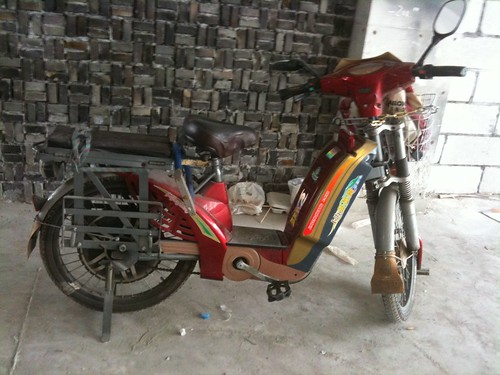
  • The electric scooter

    One of the first things that I noticed about the Shenzhen streets was the prevalence of the electric scooter. They are ridden by young people and old people. They’re used for delivery services, commuting to and from work and going to the buy the groceries.

    They aren’t slick looking Tron light bike type conveyances, or Something worthy of Shotaro Kaneda’s bike that would fit into the Neo Tokyo-like streets of central Shenzhen. Instead the electric scooter looks like an emaciated Honda Cub. It all comes across a bit half-arsed.

    Electric scooter, originally uploaded by renaissancechambara.

    They represent the cheapest form of powered transport in urban China.

    These are probably the scariest things that you are likely to encounter in China, short of being invited to drink tea with the authorities. They are fast enough to be dangerous, but slow enough to be annoying for other road users. They make no sound, not even the rushing of tires on road surface.

    The riders tend to have little skill and view fellow road users as potential targets. They are also not ridden only ridden on the road, but on the pavements and pedestrians have to be constantly in a high state of vigilance watching out for errant electric scooter riders. This being China, no fucks are given. If you wipe out on the pavement, they’ll just ride on. They’re absurdly dangerous.

    Finally, given that most of China’s electricity supply comes from coal fired power stations; and your scooter will last a few years at best – their green credentials are somewhat lacking. More design related content here.

  • Classy Kiss yoghurt drink

    While staying in Shenzhen, I came across Classy Kiss yoghurt drink. At first I was a bit thrown, the European Dickensian vintage illustration was at odds with the product name.

    The name was the only English apart from <- Open on the package.

    Classy Kiss yoghurt drink, originally uploaded by renaissancechambara.

    So why have the name in English and why European people on the packaging? Here are a few likely factors:

    • Chinese people up until recently generally didn’t consume dairy products, so a ‘foreign looking’ brand might make more sense. It came into vogue when they wanted taller stronger kids and had the economic purchasing power to buy a higher protein diet. The old illustration likely conveys heritage (and so trust) of some sort
    • Most Chinese people wouldn’t know what the packaging was saying in English. They also wouldn’t appreciate the odd typography. It would probably feel balanced to a Chinese eye and not too out of step with the feel of the Chinese ideograms
    • It will contrast on the shelf against the clean modernist packaging of western brands like Danone, or General Mills’ Yoplait

    As for the ‘Open’; that was likely on the InDesign file template for the TetraPak packaging. I wouldn’t say that the product is like a classy kiss, but it is a perfectly passable yoghurt drink. More FMCG related posts here.

  • Heirloom Design

    Saul Griffith in a presentation he gave as part of the Long Now Foundation talked about the environmental impact of our stuff. The possessions that we own make up about a quarter of our lifetime carbon footprint. The way to reduce this is to have stuff that lasts longer, and that we want to keep longer. From this came the idea of heirloom design.

    IMGP0699.JPG

    It isn’t new, Sotherby’s and Christies have made very good businesses selling old stuff, Patek Phillipe talks in advertisements as the watch-owner not actually being the owner but the custodian to pass the timepiece on to the next generation and Rolex has an excellent reputation for taking lifelong care of watches it sells.

    1.JPG

    So its a new framing of an old idea, it has been adopted by some eco-conscious businesses such as Howie’s Hand-Me-Down range: a set of bags and a jacket that are so well made and so durable that you want to keep them for their natural life. The examples that are given are a Montblanc pen and a Rolex watch; both of which require considerable upfront investment as well.

    Dieter Rams

    However design also has a case to play in this: look at the prices on eBay for a genuine Charles Eames recliner, or any of Braun’s consumer electronics offerings; classic cars fetch a far higher premium than their newer, more sophisticated cousins because of their styling.

    A second factor comes into heirloom design: design for servicing. Pretty much every part on my Technics turntables are replaceable, contrast this with the Denon DVD player I had which I had spent similar money on, yet the manufacturers couldn’t repair as they didn’t have the parts; or my Nokia E90 communicator which would have cost more to repair than two new Nokia E-series phones. Nokia’s Vertu phone range with their over-engineered cases and dealer-replaceable future proof guts may be the way forward.

    The personally most ironic thing for me is that my Dad has bemoaned the quality with which things have been made for the past 30 years and is a staunch believer in progress through industry may finally have something to agree with the environmentalists on.

    A number of brands practice heirloom design already but don’t shout about it:

    Suggestions from a quick poll I did on Twitter included

    • Bialetti with their user serviceable coffee pots
    • Caterpillar
    • Timberland
    • BMW – they certainly have the service network and they have built up a reputation for having a good build quality
    • Kenwood – the shortwave radio and communications manufacturers
    • TAG (presume they meant TAG Heuer) – not too sure that I would agree with this one, or some others suggested such as Apple, Panasonic and Sony; at least in their consumer goods especially with Panasonic doing away with the 1200 series of turntables
    • DEWALT
    • Dyson
    • Le Creuset
    • Mag Instrument Inc. (Maglite torches)
    • The North Face
    • Stanley Hand Tools
    • Aga
    • Herman Miller – particularly the Aeron chair
    • Cyrus Audio
    • Stokke prams, car seats and other stuff for early childhood
    • Tumi luggage

    Kudos in no particular order to Ruby Quince, Ana Mangahas, Becky McMichael, Stephen Holmes, Tom Wynne-Morgan, Robin Clark and Abigail Harrison for their heirloom design suggestions.

    Which brands do you think represent great heirloom design? Feel free to leave a comment. More design related posts here.

  • Black precious resin & Montblanc

    I had a short haul flight and went over the duty free catalogue on Swiss Airlines. This section on Montblanc pens stuck out at me because of its wording. Each pen was described as being made of ‘black precious resin’. Click on the image if you want to see a larger version.

    Precious Resin Montblanc spiel

    So what does black precious resin actually mean? One would presume some form of black shiny plastic, which doesn’t seem quite so precious. Now the use of plastic isn’t a bad thing in pen manufacture. For instance fellow German writing instrument manufacturers Pelikan and Kaweco both make writing instruments out of plastic, but they also don’t charge over 300 pounds for a ballpoint pen.

    Plastic feels thoroughly modern. It defined the post-war world and accelerated further with globalisation. Black precious resin isn’t particularly rare in itself like ebony wood or precious metals. 

    What the black precious resin explanation misses is the real elements at the heart of Montblanc’s authenticity:

    • History: Montblanc is actually over a century old as a firm
    • Country brand: It’s pens are still made in Germany, so it can take advantage of the German country brand: precision manufacturing excellence and craftsmanship
    • Craftsmanship: making a pen write smoothly is an art, too much ink and you will get splodges. A badly designed nib or ballpoint mechanism will scratch the paper, deliver the ink unevenly and even stain the writer
    • Design: One of the reasons why Montblanc managed to upset A.T. Cross in the market for luxury pens because their pen design feels much better in the hand because of its fuller barrel size

    But none of these factors are reflected in the description of the Montblanc pens featured in the duty-free catalogue, instead we get smoke-and-mirrors which engenders distrust and makes for an authenticity FAIL.

  • New approach to China + more

    New approach to China

    Official Google Blog: A new approach to China – According to Google, IP theft from Google and Gmail being hacked prompted a new approach to China. That’s very reasonable on the face of it, especially given that the IP theft also affected several other companies as well. However Google is uniquely placed to take a new approach to China because it has lots of rewards and few downsides. Such as the fact that Google is under pressure in the US and not doing terribly well in the Chinese market due to credible local competition. Or as another outlet put it Google: Revenues From China Are ‘Immaterial’ | paidContent

    Consumer behaviour

    A Few Good Kids? | Mother Jones – interesting how marketing data is being used. It seems that more work needs to be done on the creative and the approach

    If Your 9-Year-Old Doesn’t Have a Cell Phone, He’s Not Socializing Enough – Fast Company

    What Do Baby Boomers Want From Technology? – Bits Blog – NYTimes.com – some interesting progmatic attitudes to tech

    Media Cache – TV Still Has a Hold on Teenagers – NYTimes.com – Forrester survey of European teens. Conventional media still consumed

    Design

    Snow Peak Official Website – cool Japanese over-engineered camping stuff, love their Baja table out of solid aluminium and titanium cooking ware.

    Hacking with Style: TrueType VT220 Font – I remember this font from my time at Corning Optical Fibres using the plant DEC VAX which provided my first email account

    Economics

    Superfusion: How China and America Became One Economy. – By Daniel Gross and Win Rosenfeld – Slate Magazine

    Asia leading the way | Economist.com

    FT.com / World / Comment – Washington adapts to eastwards power shift

    FMCG

    Taste the Rainbow: Cigarette Makers’ Colorful Answer to FDA Packaging Regs | Advertising, Branding, and Marketing | Fast Company – tobacco companies use visual cues to make up for not being able to bill cigarettes as light, mild or low tar.

    How to

    Sleep success: How to make ZZZs = memory – life – 26 November 2009 – New Scientist

    Ideas

    Edge In Frankfurt: THE AGE OF THE INFORMAVORE by Frank Schirrmacher

    How reputation could save the Earth – opinion – 15 November 2009 – New Scientist – at first when I read this headline I thought someone in corporate communications had been going full belt at the magic mushrooms again. Instead the concept is a kind of green whuffie

    FT.com | Warfighting: The US Marine Corps on agility – interesting take on dealing with chaotic times

    Innovation

    Apple Patent Application Could Presage Thinner Devices – Bits Blog – NYTimes.com

    London

    FT.com | Olympics likely to harm UK tourism

    Luxury

    Cartier drops prices to woo young | The Japan Times Online – interesting move. I remember Armani doing a similar kind of thing with Armani Xchange in the early 1990s, it will be interesting to see the effect that it may have on the Cartier brand

    Media

    FT.com / Media – Disney boss tells Hollywood to rewrite script – internationalise content rather than assume a global media culture, develop online delivery platforms, cut costs, consolidate media franchises

    Online

    FT.com / China – Beijing tightens internet controls“The internet is developing quickly, there are many loopholes in social management and maintaining social stability faces unprecedented new challenges,” said Meng Jianzhu, public security minister. “We must establish a comprehensive prevention and control social security system that covers the internet and the real world.”

    Retailing

    Retail outlook: Discounters best poised to thrive – USATODAY.com – US is seeing discounters thrive as well

    Security

    FT.com / UK – Watchdog probes sale of mobile phone records – take T-mobile’s licence away and shut them down

    Software

    Microsoft’s Future, Beyond Windows 7 and the PC – NYTimes.com – I can’t believe that the New York Times published this piece on Microsoft. Waggener Edstrom and Frank Shaw must have hit the roof when it came out. The mantra for Microsoft as a client is no surprises, I would be surprised if anyone walked willingly into this piece which eviscerates the corporate reputation

    Apocalypse Then: a two-part series on the lessons of Y2K. (1) – By Farhad Manjoo – Slate Magazine

    FT.com / Technology – Chinese court rules against Microsoft – infringed Zhongyi Electronics property rights.

    Technology

    The BBC is encrypting its HD signal by the back door | Technology | guardian.co.uk

    Cloud computing: Clash of the clouds | The Economist

    E.U. Takes More Time to Review Oracle-Sun Deal – DealBook Blog – NYTimes.com – I hope that Sun Microsystems finds a safe harbour at Oracle

    The Digital Economy Bill is legislatively flawed | Left Foot Forward – piece that I co-authored with my pod neighbour Nick

    Web of no web

    AR to Realize World of Science Fiction — Nikkei Electronics Asia — November 2009 – good overview of augmented reality

    Wireless

    Daring Fireball: Oh Joe You Didn’t – interesting take on is or isn’t Apple earning more money on handsets than Nokia story that been doing the rounds on Twitter over the weekend