Ideas were at the at the heart of why I started this blog. One of the first posts that I wrote there being a sweet spot in the complexity of products based on the ideas of Dan Greer. I wrote about the first online election fought by Howard Dean, which now looks like a precursor to the Obama and Trump presidential bids.
I articulated a belief I still have in the benefits of USB thumb drives as the Thumb Drive Gospel. The odd rant about IT, a reflection on the power of loose social networks, thoughts on internet freedom – an idea that that I have come back to touch on numerous times over the years as the online environment has changed.
Many of the ideas that I discussed came from books like Kim and Mauborgne’s Blue Ocean Strategy.
I was able to provide an insider perspective on Brad Garlinghouse’s infamous Peanut Butter-gate debacle. It says a lot about the lack of leadership that Garlinghouse didn’t get fired for what was a power play. Garlinghouse has gone on to become CEO of Ripple.
I built on initial thoughts by Stephen Davies on the intersection between online and public relations with a particular focus on definition to try and come up with unifying ideas.
Or why thought leadership is a less useful idea than demonstrating authority of a particular subject.
I touched on various retailing ideas including the massive expansion in private label products with grades of ‘premiumness’.
I’ve also spent a good deal of time thinking about the role of technology to separate us from the hoi polloi. But this was about active choice rather than an algorithmic filter bubble.
Hermès MANifeste is a short motion graphics based video aimed at their menswear collection
Hermès MANifeste has got an Eames or Rand feel to it. It is full of clean mid-century modern imagery with icons that would have been in the library of every letterpress and hot metal print works prior to digitisation. This gives the animation a clean masculine feel, that doesn’t feel too old world or conservative. Which is different to the way many male consumers might see Hermès.
The Project Apollo archive on Flickr gives us access to all the NASA photography from the project. What people don’t appreciate is how comprehensively Project Apollo and the moon landings were documented
The Spirit of Buffalo video by Dazed Digital featuring Jamie Morgan and Neneh Cherry is a documentary about the Buffalo Collective who influenced the way modern streetwear is styled. The centre of the Buffalo Collective was Ray Petri, who pretty much invented the stylist as a modern concept in the fashion industry. Petri partnered with photogaphers Jamie Morgan, Mark Lebon and Cameron McVey. Models included Barry and Nick Kamen, Naomi Campbell and 13 year old Felix Howard in the iconic Killer picture taken by Jamie Morgan. You can blame Buffalo for the whole Pharrell Williams look which borrows from late 1980s London.
(1) 香港警察 Hong Kong Police | Facebook – acts as lightning rod for the divisions in society made apparent during the Occupy protests, but its also very surreal. Full disclosure: I ran training on social media for the Hong Kong civil service including what they call the disciplined services (this included the police, government flying service, emergency ambulance service, prison service, customs and immigration). The people that I came across were smarter than whoever is managing this page.
A great remix by The Avalanches which has been on heavy rotation during my dipping into Soundcloud
I decided to write this post to reflect on the very different visions of digital retailing that consumers are currently experiencing. I’ve labelled these two visions mobile OS and Shop OS respectively.
The Mobile OS
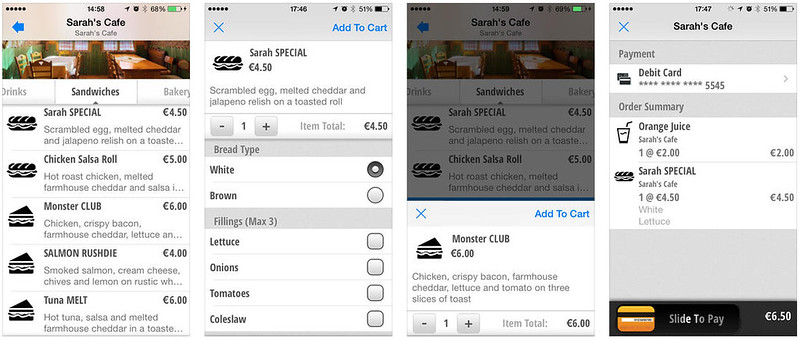
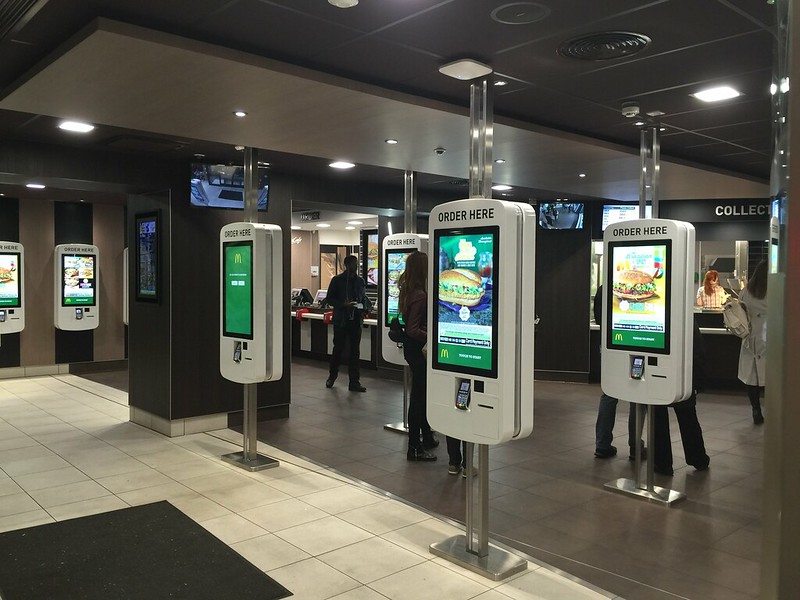
I went to Wagamama with some colleagues from Racepoint where we were encouraged to all download Qkr!. Qkr! is an application that was developed by MasterCard rather than the restaurant, it isn’t exclusive to Wagamama either. MasterCard has built the application with a view to building a wide eco-system merchants. It is notable that the application is actually card issuer agnostic, so I was able to set up an account with a Visa card. Wagamama bribed us with free desserts to download the application, so they clearly have some skin in the game. We downloaded it, set up our account with at least one mode of payment, our email address and a password. One of us became the host and gave us all a number which was our common bill. We could order straight from the app and food was supposed to arrive. When we wanted to pay we selected our items and paid our share of the bill. A couple of us only had cash, so they paid a friend and the friend paid on the app. If I am absolutely honest with you, it was a lot of work for casual dining and but for everyone around the table working in technology marketing (and so having a modicum of curiosity about things app-related) – it probably wouldn’t have had us all on board. Now that we have the app on our phone, I could see Qkr! hoping that we use it regularly and likely try and steer us to its merchant network though notifications and special offers. From Wagamama’s point-of-view it saves them from building, testing and maintaining a bespoke application. There are also presumably productivity benefits from reducing the order taking staff required. Qkr! didn’t prevent Wagamama from making mistakes with our order and we ended up one chocolate cake down. Contrast this with the approach that McDonalds have rolled out in their new (to me) Cambridge Circus branch. The area between the counter and the entrance is dominated by a series of vertical kiosks.
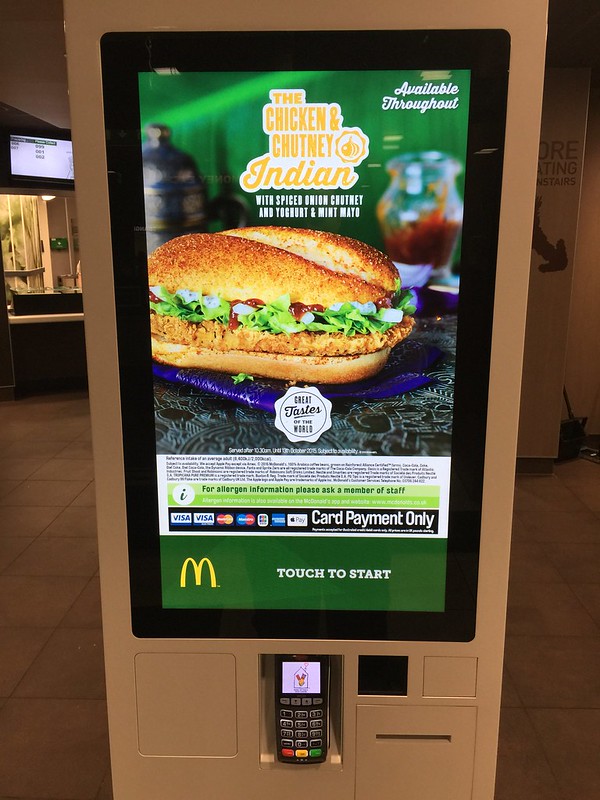
These kiosks contain an identical touch screen interface
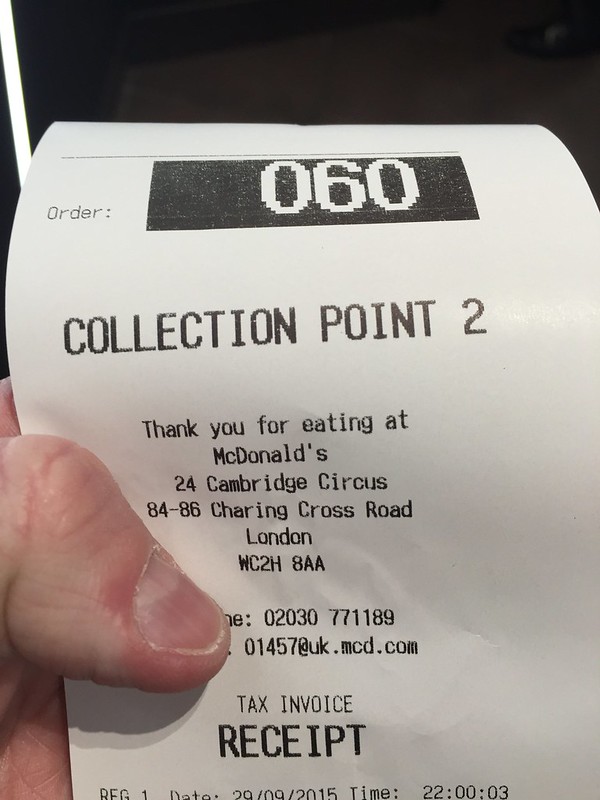
With a basic card reader on the bottom, there is no Apple Pay or NFC facilities, just a chip and PIN reader. The touch screen menu takes you through a smartphone app like experience, if smartphones came with 27 inch screens. Once payment was successfully received, you then received a deli counter style receipt
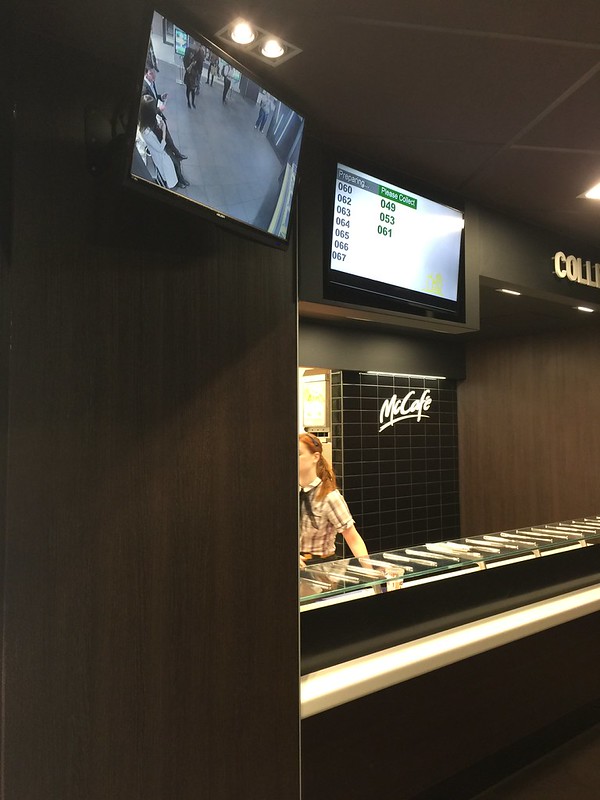
And collected from a counter when your number appeared on the screen
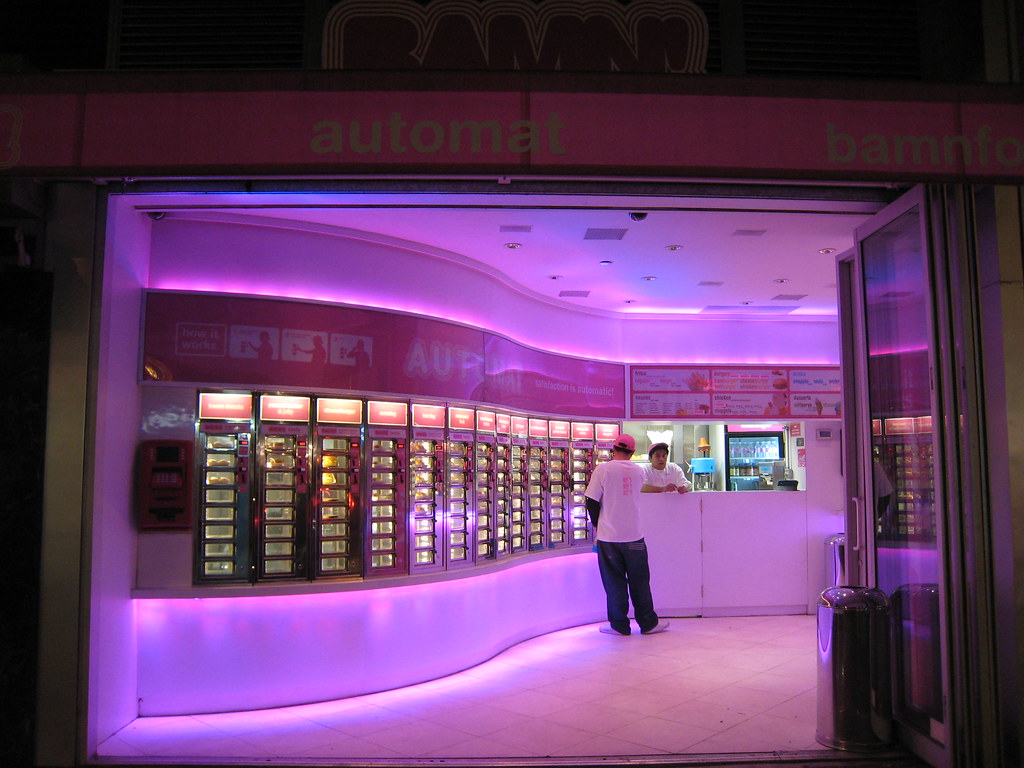
This is all designed to reduce consumer interaction and improve efficiency in the restaurant, if there was any way to cheapen the McDonalds’ experience making you queue like an Argos seems like the ideal way to go. The logical progression for this would be to move back to the Automat format (presumably this time using some sort of algorithm to optimise production.
The irony of it all is that the rise of fast food restaurants like McDonalds killed off the Automat as a trend in North America and many Automats were converted into Burger King franchises.
Both Wagamama and McDonalds may have had some efficiency gains but lost out in terms of brand experience, they moved a bit further towards commoditised casual dining and fast food respectively – which goes against the brand equity that they have striven hard to build over decades.
Shop OS offers some advantages over Mobile OS, you can standardise on the hardware to reduce coding and testing requirements. It is ideal for tourists who may not want to roam on foreign mobile networks, nor be able to navigate free wi-fi offerings. The flip side is that there isn’t the same opportunity to capture customer data and behaviour, the notification screen on the smartphone is a key place for brands to intercept the customer using geofencing.
Fairphone 2 – a pre-production review of the new modular smartphone – Computing – a review of a Project Aria-esque device. The Fairphone 2 is similar to Jolla, which also experimented with their ‘other half’ concept but no eco-system built up around it. It will be interesting to see if Fairphone 2 can be any more successful
16 Deals Feeding Chip Biz’s Merger Fever | EE Times – the flurry of M&A activity is the product of Wall Street’s relentless pressure on chip companies to show revenue growth that cannot be achieved organically
Will digital books ever replace print? – Craig Mod – Aeon – Digital books stagnate in closed, dull systems, while printed books are shareable, lovely and enduring. What comes next? – which is usually the kind of problem digital solves….
How Steve Jobs Fleeced Carly Fiorina — Backchannel — Medium – something that Steven Levy doesn’t not but in an added piece of irony of this is that Compaq had one of the first hard disk based MP3 players that no one remembers any more. It was a product licensed to Hango Electronics and sold as the Personal Jukebox
Strictly speaking this is a bit different from when I have written about books. This is the second time that I read Being Digital, the first time was during my final year in college.
I was curious to know how the book would hold up in the space of 20 years since it was first published. In twenty years we’ve seen televisions shrink as we moved from cathode ray tubes to plasma and LCD displays. The cost of telephone calls has declined, cellphones are really no longer phones but a type of mobile computer that happens to do voice calls poorly. The dominant form of personal computing is Android rather than Windows. The internet has facilitated a raft of services that used to exist in the real world or didn’t exist previously.
In the subsequent 20 years Negroponte has gone from being one of digital’s poster children with a column in Wired and his leading role at MIT Media Lab to a more obscure position in digital history. His biography over at MIT has him listed as sitting on the board of Motorola Inc.
It is easy to dismiss his showmanship and bluster, but the Negroponte did work that foreshadowed in-car sat navigation devices, Google Street View and the modern stylus-less touch screen.
The book first of all emphasises how far we have come when it talks about 9600 baud connections, I am writing this post sat on the end of an internet connection that provides 50mbps download and 10mbps upload – and that’s slow compared to the speeds that I enjoyed in Hong Kong. Negroponte envisioned that satellites would have a greater role in internet access than it seems to currently have, cellular networks seem to have brought that disruption instead.
It has the tone of boundless optimism that seemed to exemplify technology writing in the mid-to-late 1990s but with not quite the messianic feel of peer George Gilder. Negroponte smartly hedges his bets for where the ‘rubber hits the road’ as society brings some odd effects in on technology usage.
Online media
Negroponte grasped the importance of digital and the internet as a medium for the provision of media content. That sounds like a no brainer but back in the day the record industry didn’t get it. In fact record industry went on to make blockbuster profits for another five years, N’Sync was the best selling artist of the year in 2000 with No Strings Attached selling 9.94 million copies. Over the next decade or so profits halved in the face of determined record label countermeasures including suing their customers.
OTT and cord cutting
Negroponte was dismissive of high definition video and television considering it wasteful of bandwidth. On this I get the sense that he is both right and wrong. We are surrounded by high definition screens (even 4K mobile screens – where their size doesn’t allow you to appreciate the full clarity of the image). But this doesn’t mean that our entertainment has to come in high definition, much YouTube isn’t watched on full screen for instance.
Disruption of publishing
Negroponte grasped that it would also shake up the book industry and Being Digital has been published in a number of e-book reader formats, but at the moment the experience of digital books leaves something to be desired compared to traditional books.
Tablets
Negroponte labours a surprising amount of copy on tablet devices. At the time that he published his book GO was in competition with Microsoft with pen computing devices and software, EO had launched their personal communicator – a phablet sized cellular network connected pen tablet and the first Apple Newton had launched in 1993. Negroponte goes on to insist that the finger is the best stylus. MIT Media Lab had done research on the stylus-less touch experience, but reading the article reminded me of the points Steve Jobs had made about touch on the original iPhone and iPad. It is also mirrored in the Ron Arad concepts I mentioned in an earlier blog post.
Agents
Negroponte considered that we would be supported in our online lives with agents that would provide contextual content and do tasks, which is where Google Now, Siri and Cortana have tried to go. However his writing implies an agent that is less ‘visible’ and in the face of the user.
Negroponte’s critique of virtual reality at the time provides good insight as to how much progress Oculus Rift and other similar products have made. He points out the technical and user experience challenges really well. If anyone is thinking about immersive experiences, it is well worth a read.
Going back and reading the book provided me an opportunity reflect on where we have come to in the past twenty years and Negroponte’s instincts where mostly right.
Ron Arad is more famous for his architecture and art than product design. I went along to see him speak at an event that is part of London Design Festival last week thanks to the China-Britain Cultural Exchange Association. Arad’s presentation felt largely unplanned as the curator of the talk asked him to jump around from project to project rather than a clear narrative being presented. Arad showed imagery or video that he then talked around.
During the presentation he showed off the design concept that he did for LG that pre-dated the iPad. It sounded at the event like Ron Arad had started his thinking in 1997, but the sources I looked at online stated that this project was done in 2002 and the video copy I found on YouTube states that the copyright is 2003.
The video is quite prescient in a number of ways
The device was primarily about content consumption and messaging
He nailed the in-home use case, with the exception of realising that the iPad may be a communal shared device rather than belonging to an individual
It has a flat design interface (though this might be a limitation of their ability to create it on video and a spin on the circular LG logo)
The soft keyboard on screen
There is no stylus
There was auto-rotation of the screen
It has no user serviceable parts (this was at the time when cellphones and laptops came with detachable batteries)
Inductive charging with a table rather than the small pad used by the like of the Microsoft/Nokia Lumia devices
The way the controls where superimposed on footage of the user working with the device is reminiscent of the way TV and films are now treating parts of a plot that involves messaging
There were a few things that it got wrong:
Arad clearly didn’t understand the significance of the iPod, so the device had an optical drive rather than side loaded video content
The device is really big, more like a laptop screen than a phablet, a la the iPad Mini or Galaxy Tab
The form factor was too thick, understandably so when they are trying to squeeze a battery and optical drive in the device, the thickness had a benefit in that the device was self-standing. Apple relied on covers and cases to provide the standing mechanism