Ideas were at the at the heart of why I started this blog. One of the first posts that I wrote there being a sweet spot in the complexity of products based on the ideas of Dan Greer. I wrote about the first online election fought by Howard Dean, which now looks like a precursor to the Obama and Trump presidential bids.
I articulated a belief I still have in the benefits of USB thumb drives as the Thumb Drive Gospel. The odd rant about IT, a reflection on the power of loose social networks, thoughts on internet freedom – an idea that that I have come back to touch on numerous times over the years as the online environment has changed.
Many of the ideas that I discussed came from books like Kim and Mauborgne’s Blue Ocean Strategy.
I was able to provide an insider perspective on Brad Garlinghouse’s infamous Peanut Butter-gate debacle. It says a lot about the lack of leadership that Garlinghouse didn’t get fired for what was a power play. Garlinghouse has gone on to become CEO of Ripple.
I built on initial thoughts by Stephen Davies on the intersection between online and public relations with a particular focus on definition to try and come up with unifying ideas.
Or why thought leadership is a less useful idea than demonstrating authority of a particular subject.
I touched on various retailing ideas including the massive expansion in private label products with grades of ‘premiumness’.
I’ve also spent a good deal of time thinking about the role of technology to separate us from the hoi polloi. But this was about active choice rather than an algorithmic filter bubble.
Indonesia is a fascinating place in and of itself and comes up with all kinds of cultural nuggets. The latest one that I came across was the Vespa Extreme moped sub-culture. Vespa scooters are plentiful in Indonesia, as is the desire to invent. Car tuning culture is big amongst the middle class. But for those who need something more affordable Vespa Extreme builds are a site to behold. The South China Morning Post put together this great documentary film on the Vespa Extreme culture and its riders.
Like car culture there are meet-ups, cruises and even festivals organised.
Vespa Extreme Culture.
About half of the mobile game developers on iOS are based in China, the country’s universities turn out more programmers each year than anywhere else (including India). Yet China has still lagged behind other countries games in terms of incorporating technology and art. That’s where Black Myth: Wukong is supposed to come in. Sun Wukong is one of the names of the Monkey King in the Chinese literary classic Journey To The West. This has been a staple of Chinese animation and film for years.
Black Myth: Wukong
Could it be popular in China? It’s hard to tell from this pre-Alpha release footage. The biggest issues are likely to come from Chinese regulators. But hopefully the game won’t have to undergo the lengthy rewrites and changes foreign games have to do to comply. Instead the Chinese developers should be able to bake compliance in from the start. However, its China; so nothing is guaranteed.
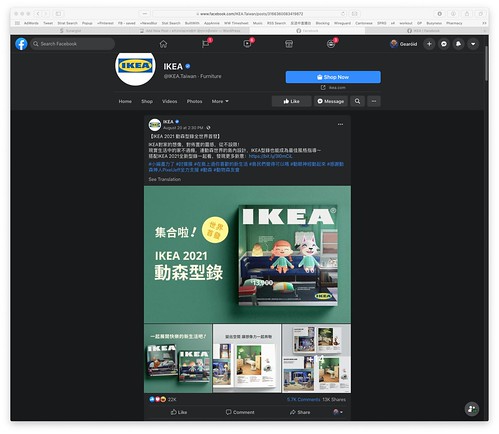
The Ikea Taiwan Facebook page faithfully created looks from their catalogue on Animal Crossing, much to the delight of their Taiwanese and Hong Kong based followers. The original post is here.
The original Facebook post
Front cover with Animal Crossing characters, but on Ikea furniture
Side-by-side comparison between the original catalogue and a recreation using sets dressed in Animal Crossing
Another example, all prices are in Taiwan dollars rather than Animal Crossing belles
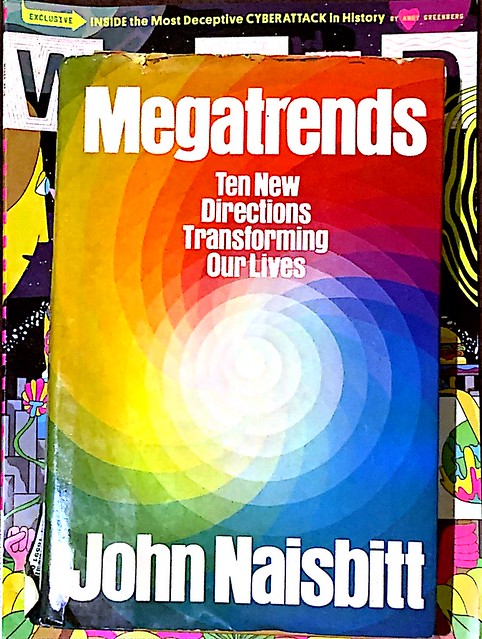
John Naisbitt’s Megatrends was on the New York Times bestseller list when it was first published in 1982. Naisbitt outlined some big long term trends that he’d found as part of a decade of research. Hence the mega in Megatrends; though one could argue that macro may have been a more accurate term to use.
I wasn’t that familiar with the work of Naisbitt; but came upon it by a circuitous route.
My circuitous route to Megatrends
I was introduced to the works of futurist Alvin Toffler in college reading Future Shock, The Third Wave and Power Shift. At the time these were cited on the technology degree courses my friends were on; as well as the marketing course I was studying.
My house mate and I would talk about Toffler’s books as much Robert Pirsig or Emmanuel Kant, on the sofa of an evening sipping really bad instant coffee. I wouldn’t say that those were particularly happy days for me, but they did give me the time to think and read. Something that is much more of a struggle now.
As I became more interested in Asia in the late 1990s; l read about how Toffler had influenced technocratic leaders from Singapore to China. I also started to read about John Naisbitt. Like Toffler, Naisbitt had done the Asian speaker circuits, met senior officials and conducted projects in-country through the 1990s. The management consultancy Toffler Associates eventually operated in China on government and private sector briefs.
Compared to Toffler; Naisbitt seems to have become much more personally committed to China and central Europe. He has alternately lived in Vienna and in Tianjin, China. As the dot com boom kicked off I was reading this book. It fitted right in with similar writings from publications like Gilder Technology Report, Wired and Upside.
Megatrends by John Naisbitt
Back to the Megatrends review
In Megatrends Naisbitt sets out X large scale long term trends that he sees in society
Information society and the rise of the knowledge worker
High tech / high touch – Naisbitt saw that roles would focus more on technology, or on ‘high touch’ sectors where humans aren’t easily replaceable like nursing care
Globalisation – a move in focus from the national economy to the world economy as the world becomes more interconnected
A move in strategic focus from short-term planning to long term planning.
Decentralisation of power and structures
A move from institutional help to self-help
Bottom-up governance across government and other organisations as a channel for public opinion
The move from hierarchies to networks
The population shift in the US from north to south
Increase in consumer choice
At the top line we can still see much of these changes. I can see how Naisbitt’s vision of globalisation would appeal to the likes of Singapore and China. I am less sure about how Chinese technocrats would have made of bottom up decision making or as Naisbitt puts it ‘participatory democracy’.
Naisbitt failed to take the next logical step; to look at the interactions between the trends. Instead the chapters remained siloed, rather than in context.
For instance that the decline of hierarchies and rise of knowledge workers saw layers of management shed by organisations. Or the link between consumer choice and the rise of globalisation.
Conclusion
Megatrends has value in the way that looks at trends without looking at the how (usually mentioning digitalisation or some similar vehicle of transformation). This is something that we probably wouldn’t be able to do now; given that our mindset is about big data and agile processes. More book reviews here.
Eat Your Greens is a selection of articles curated by Wiemer Snijders on all things that come up for discussion amongst account planners. Branding, marketing, some home truths about innovation and the value of creative. Much of it recycles the stuff that account planners know from reading Sharp or Field and Binet. In addition there are a few that specifically address diversity, inclusion – but excludes ageism in terms of the ways it talks about these as an issue.
Where’s the value in Eat Your Greens? The answer to that question depends on where you are in your career. As someone who is established in my career, I found it valuable in a few different ways.
Some of the essays from the likes of Phil Graves, Mark Ritson and Ryan Wallman, Rose and Faris Yakob, Byron Sharp and Amy Wilson are strong enough to make Eat Your Greens worthwhile in its own right. For instance here’s some of what Ritson had to say:
“The modern marketer has created an entirely stupid dichotomy between ‘digital communications’ and ‘traditional communications’… There are just tactical tools, and they can only be valued and selected once a target and a position and a strategy are in place. What’s more, it’s clear that most successful campaigns combine multiple channels for optimum success. Most studies suggest that the more channels a campaign includes, the better the ultimate ROI.”
Mark Ritson in Eat Your Greens
Going through the essays allowed me to come up with recommendations of new reading materials referenced in the essays – I have been using it to bulk up my Amazon list.
Essays that I would particularly recommend:
What Ails Marketing by Mark Ritson
Post-Truth Telly by Tess Alps
To Target Or Not To Target, That’s Not The Question by Shann Biglione
Everybody Lies – The Importance of Psychological Validity In Consumer Insight by Phil Graves
The Devaluation of Creativity by Bob Hoffman
Biting The Hand That Feeds Us? Why Advertising’s Love Of Novelty Is Doing Brands A Disservice by Kate Waters
Why Innovation Isn’t As Sexy As Business Books Promise by Costas Papaikonomou
For busy marketers or junior planners, Eat Your Greens is a nice introductory point for a number of issues in marketing, such as the corrosive digitisation of marketing.
I think it fulfils an important role. Particularly for junior planners as many agencies now rely on an army of freelance talent. Eat Your Greens isn’t a substitute for having senior staff developing younger account planning minds on the job. But given the current state of agencies, its probably one of the best options that we have. More book reviews here and my slowly updated bookshelf here.
Frank Miller – Ronin (often called Frank Miller’s Ronin) was a graphic novel written in the early 1990s. In the story Miller looks to combine is love of myth and legend a la 300, with cyberpunk.
The story leaps across time from medieval Japan to the distant future of New York. The Ronin of the title is looking to revenge his master against a demon. The New York that they fall into owes a lot to the dystopian vision of Mega City One in Judge Dredd. All the money has flowed to capital and most people are living at the edges of society.
Miller explores links between mysticism and technology as it relates to artificial intelligence.
Frank Miller has a grand vision in Ronin; full of interesting ideas, but it feels half-baked. The potential in the story isn’t fulfilled. The worlds that Miller has built in the book feel very one dimensional in nature. That means that the foundation that the story builds on feels insubstantial. Miller tries to paper over the cracks by moving the reader quickly from one ‘cell’ to another.
I think that Ronin isn’t something that fits neatly into a short comic run and a trade paperback, but needs its own franchise to breath and develop further. There is a richness in there waiting to be tapped.
The artwork isn’t as rich as other Frank Miller works such as 300, The Dark Knight Returns or Sin City. Instead it feels like concept sketches rather than a complete work, even the colour panels feel that way. Ronin feels like something it would be worthwhile for the author to revisit and develop further. But at the present time I can only recommend Frank Miller – Ronin for completists, who are fans of Miller’s other works and will overlook this story’s limitations. More book related posts here.
Why Protest Tactics Spread Like Memes – The New York Times – often, she noted, the images’ similarity was unwitting. In their spread, their simultaneity and their indirect influence on each other, the protest videos had all the characteristics of memes, those units of culture and behavior that spread rapidly online. The same cultural transfer that gives us uncanny cake-slicing memes and viral challenges also advances the language of protest. “We live in this world of attention dynamics so it makes sense that tactics start to converge,” Ms. Mina said. She called the images’ tendency to build on each other “memetic piggybacking,” and noted that everyday items that are subverted into objects of protest are “inherently charismatic.” – protest groups tactics as memes. Memes are a transmissible idea; whether its knowledge, humour or even cat gifs. Memes are something learnable and easily repeatable. The Hunger Games three finger salute or the LIHKG are deliberately chosen memes. Reciting lines from films or TV programmes like The Office are memes. Similarly protest slogans like “Liberate Hong Kong, Revolution Of Our Time’, ‘Five Demands, Not One Less’ (FDNOL) are memes. Other memes evolve due to pragmatism, such as the use of umbrellas during the 2014 protests. More meme related content here.
Apple Faces $1.4 Billion Lawsuit by Chinese AI Firm in Siri Patent Fight – WSJ – Conflicts over intellectual property, technology and trade are driving bilateral relations between the U.S. and China to their lowest point in decades. Last Friday, President Trump threatened to ban Chinese short-video app TikTok on national-security grounds. U.S. officials have been involved in talks over a potential sale of TikTok’s American business to Microsoft Corp.
Op-Ed: Never Trust Mark Zuckerberg Again- PingWest – a few things in this. 1/ Facebook probably didn’t get anything out of its reprochment with China. Yes China could stop advertising on Facebook, but A/ Chinese state owned companies not advertising on Facebook would be immaterial and probably benefit Facebook politically B/ Chinese private sector companies don’t have a lot of choice, so China would see a good deal of SME job destruction. 2/ The US government have more leverage. In this respect its like the embarrassing HSBC kowtowing in reverse. The Chinese author now realises how lame it looks when you’re on the other side of it
Pompeo the Maoist – SettimanaNews – Borrowing from the logic used by Mao Zedong in his On Contradiction, Pompeo tried to prove that CCP didn’t represent the Chinese people, and that actually the party is the enemy of the Chinese people. This point is fundamental because, as Mao put it, the crucial political element is to know who is with us and who is the enemy, and the party should always represent the people. Pompeo stated: “We must start by changing how our people and our partners perceive the Chinese Communist Party. We have to tell the truth.” What is the truth, according to the US secretary of state? It is that: “We know … that doing business with a CCP-backed company is not the same as doing business with, say, a Canadian company. They don’t answer to independent boards, and many of them are state-sponsored and so have no need to pursue profits… We know too that if our companies invest in China, they may wittingly or unwittingly support the Communist Party’s gross human rights violations… We know too too that not all Chinese students and employees are just normal students and workers that are coming here to make a little bit of money and to garner themselves some knowledge. Too many of them come here to steal our intellectual property and to take this back to their country.” Therefore, he argues that the US should de facto work as a new revolutionary party: “We must also engage and empower the Chinese people—a dynamic, freedom-loving people who are completely distinct from the Chinese Communist Party.”
ARM China Asks Beijing to Intervene in Row With U.K. Parent – Caixin Global – It is interesting that the ARM CEO thinks he has the political juice to go against Hopu and its head Fang Fenglei. Is there more than meets the eye going on here? More from Sina.com’s tech channel (via Google Translate): Sina.com Technology Channel ARM China debacle – the intention of Hopu Investment , which represents 36% of the investors of the central state-owned enterprise financial institution in the joint venture, to join hands with foreign shareholders this time? Hopu and Arm recently appointed Hopu Investment’s Teck Sien Lau (Singaporean) as Chairman of Amou China, and Arm President Graham Budd (British) as Vice Chairman. In addition, Arm and Hopu previously appointed two co-CEOs (one Singaporean and one Chinese) on the disputed board of directors, and the board dispute is currently being resolved in legal proceedings. It seems that Hopu hopes to help Arm replace the existing management team and actually control the operation of the joint venture company through this operation. However, under the premise that HOPU violated the Chinese party’s agreement to act in concert and joined hands with Arm, such an organizational structure obviously did not represent China’s national interests. In addition, can they lead the technical team to realize the original intention of the joint venture company and truly realize the vision of autonomous and controllable core technology that China needs? More on ARM here.
Upfield targets block butters with vegan Flora Plant range | News | The Grocer – repackaging to remove the negative connotations of margarine by creating ‘vegan butter’ in salted and unsalted variants. *Disclosure, I worked with Mullen Lowe and Phd to develop ‘Family Brands’ global digital strategy, prior to Flora et al being sold off to Upfield. My work covered Blue Band, Bonella, Country Crock, Doriana, Dorina, Flora, Imperial, La Perfecta, Maizena, Milda, Mirasol, Planta, Planta Fin, Primavera, Rama, Sana, Stork, Tulipan, and Vitam
Imint is the Swedish firm that gives Chinese smartphones an edge in video production | TechCrunch – The hyper-competitive nature of Chinese phone makers means they are easily sold on new technology that can help them stand out. The flipside is the intensity that comes with competition. The Chinese tech industry is both well-respected — and notorious — for its fast pace. Slow movers can be crushed in a matter of a few months.“In some aspects, it’s very U.S.-like. It’s very straight to the point and very opportunistic,” Lifvendahl reflected on his experience with Chinese clients. “You can get an offer even in the first or second meeting, like, ‘Okay, this is interesting, if you can show that this works in our next product launch, which is due in three months. Would you set up a contract now?’” “That’s a good side,” he continued. “The drawback for a Swedish company is the demand they have on suppliers. They want us to go on-site and offer support, and that’s hard for a small Swedish company. So we need to be really efficient, making good tools and have good support systems.” – Ok a few things. 1/ The hyper competition is a very Chinese phenomenon. Like when in someplace like the UK Chinese restaurant opens in a neighbourhood, another will move in next door. In China, you end up with clusters of barber shops, tea shops and restaurants right next to each other in; actively competing. It’s about rapid small iterative steps of innovation, or what Huawei used call ‘customer focus’. It’s not paradigm shifting stuff. 2/ Its interesting that Imint have taken the German middelstadt model to software. Historically, German companies have managed to focus on a niche and do it really well. There is a long-term focus, continuity, independence, flexibility innovation and customer focus. They are nimble by nature and design with lean hierarchies and a family-like corporate structure.
Aaron Toponce : The Physics of Brute Force – Why you should use encryption and why Moore’s Law’s limitations and physics indicate an optimal key size when using it against non-quantum computing.
Europe and AI: Leading, Lagging Behind, or Carving Its Own Way? – Carnegie Endowment for International Peace – Europe, meanwhile, despite having certain advantages such as a strong industrial base and leading AI research and talent, is punching far below its weight. This state of affairs is especially due to the fragmentation of the EU’s digital market, difficulties in attracting human capital and external investment, and the lack of commercial competitiveness. Fortunately, in recent years, European leaders have recognized the importance of not lagging behind on AI and have sought to raise their ambitions. Leaders such as German Chancellor Angela Merkel and French President Emmanuel Macron have stressed the need for Europe to become a leading global player on AI, and the new European Commission has made AI a top priority for the next five years. By declaring AI a major strategic priority, several member states and EU institutions are taking steps to advance the continent’s ambitions for AI leadership
COVID-19 and biopharma in China | McKinsey – fascinating read. In particular the growth of health insurance. Up to now, one of the reasons why Chinese consumption is so low the high amount of savings to cover health costs. (Yes, I know property and parent care are also huge areas for savings). But that is why Chinese people are generally lower in credit use in aggregate and have a large amount of savings. Private health insurance could have a huge impact on future consumption patterns and act as an economic driver
Dundrum Town Centre introduces a ‘Crowd Checker’ | RTE – interesting piece of service design to support opening up of retail. Dundrum shopping centre would be the Irish equivalent of Westfield in London. It is Ireland’s largest shopping centre. RTÉ has a broadcast studio there to capture the opinion of the average Irish person as needed.