Ideas were at the at the heart of why I started this blog. One of the first posts that I wrote there being a sweet spot in the complexity of products based on the ideas of Dan Greer. I wrote about the first online election fought by Howard Dean, which now looks like a precursor to the Obama and Trump presidential bids.
I articulated a belief I still have in the benefits of USB thumb drives as the Thumb Drive Gospel. The odd rant about IT, a reflection on the power of loose social networks, thoughts on internet freedom – an idea that that I have come back to touch on numerous times over the years as the online environment has changed.
Many of the ideas that I discussed came from books like Kim and Mauborgne’s Blue Ocean Strategy.
I was able to provide an insider perspective on Brad Garlinghouse’s infamous Peanut Butter-gate debacle. It says a lot about the lack of leadership that Garlinghouse didn’t get fired for what was a power play. Garlinghouse has gone on to become CEO of Ripple.
I built on initial thoughts by Stephen Davies on the intersection between online and public relations with a particular focus on definition to try and come up with unifying ideas.
Or why thought leadership is a less useful idea than demonstrating authority of a particular subject.
I touched on various retailing ideas including the massive expansion in private label products with grades of ‘premiumness’.
I’ve also spent a good deal of time thinking about the role of technology to separate us from the hoi polloi. But this was about active choice rather than an algorithmic filter bubble.
Lights out production lines reminded me of my childhood. If you are of a certain age, ‘hand made by robots’ brings to mind the Fiat Strada / Ritmo a thirtysomething year old hatchback design that was built in a factory with a high degree of automation for the time.
Fiat subsidiary Comau created Robogate, a highly automated system that speeds up body assembly. Robogate was eventually replaced in 2000. The reality is that ‘hand made by robots’ had a liberal amount of creative licence. Also it didn’t enable Fiat to shake off its rust bucket image. Beneath the skin, the car was essentially a Fiat 127. Car factories still aren’t fully automated.
Foxconn is looking to automate its own production lines and create products that truly are ‘hand-built by robots’. Like Fiat it has its own robots firm which is manufacturing 10,000 robots per year.
Foxconn has so far focused on production lines for larger product final assembly (like televisions) and workflow on automated machine lines: many consumer products use CNC (computer numeric control) machines. That’s how Apple iPhone and Macs chassis’ are made. These totally automated lines are called ‘lights out production lines’ by Foxconn.
Foxconn is looking to automate production because China is undergoing a labour shortfall as the population getting older. Foxconn uses a lot of manual workers for final assembly of devices Apple’s iPhone because the components are tightly packed together.
Forty years ago, Japanese manufacturers conquered high end and low end consumer electronics with pick-and-place machines to automate electronics production, Nokia went on to build its phone business on similar automated lines. Globalisation ironically facilitated hand assembly of exceptionally dense electronics devices.
It will be a while before Foxconn manages to automate this as robotic motor control isn’t fine enough to achieve this yet. In order for that to happen you need a major leap forward in harmonic gearing. This isn’t a problem that software or machine learning can solve easily. More related pieces of jargon can be found here.
Opportunities for brand communications – 2016 has been a watershed year in the western world. Political forces that were simmering, but previously untapped manifested themselves in populist victories. Political norms that were common currency for the past two decades have been brought into question and there will be societal impacts and changes in consumer tastes.
Businesses are being buffeted by these changes and so will their business. In the case of the UK; supply chains will be re-engineered over the next two years to address the country’s departure from the European economic bloc. It will mean recalibrating the values of some brand communications. Most companies that I have spoken to are working on the assumption of the hardest Brexit:
No trade agreement with the EU
No customs union with the EU
No passporting for services such as banking
No agreement on storage of EU or US personal data in the UK
No free movement of EU talent
Problems with the WTO as countries look to settle scores like ownership of the Falkland Islands and Gibraltar
This presents brand communications teams with opportunities and challenges:
There will be new regulatory and legal environments for companies to navigate
Corporate and social responsibility programmes will need to be recalibrated
There will be change management as jobs are moved abroad and facilities closed
Brands will have to work smarter with less
Consumer data based systems will need to be redesigned to meet the new legal and country boundaries imposed upon it
UK businesses will need to prepare for permanent handicap on their profits
There is also a wave of change for consumer businesses. Whole categories of products – carbonated drinks, cereals and spreads are losing market share to substitute products. This is hitting the large FMCG (fast-moving consumer goods) brands including:
Unilever
Coca-Cola
General Mills
Nestle
Kelloggs
Consumer brands have looked to counteract this in a number of ways:
Putting their spend where it will do the best work by using zero-based budgeting (ZBB)
Restructuring brand architectures – moving away from preventing brand damage through brand extension to brand consolidation to maximise the benefit of marketing spend. Coca-Cola is a prime example of this
Brand architecture will create a tension in the organisation. On the one hand the societal norm will be for local brands rather than global, on the other you have the corporate desire to cut and simplify to maintain margins. Whilst some companies may kill brands, others may sell them on to local companies, which will then try to squeeze as much value out of the brand equity as they can
Move away from micro-targeting to ‘smart’ mass-marketing – the key exponent of this is Byron Sharp at the Ehrenberg-Bass Institute at the University of South Australia
Opportunities in terms of new products that communications agencies can offer
Internal communications programme – site shutdown or company shutdown as a product
CSR audit as product
CRM (customer relationship management) audit as product
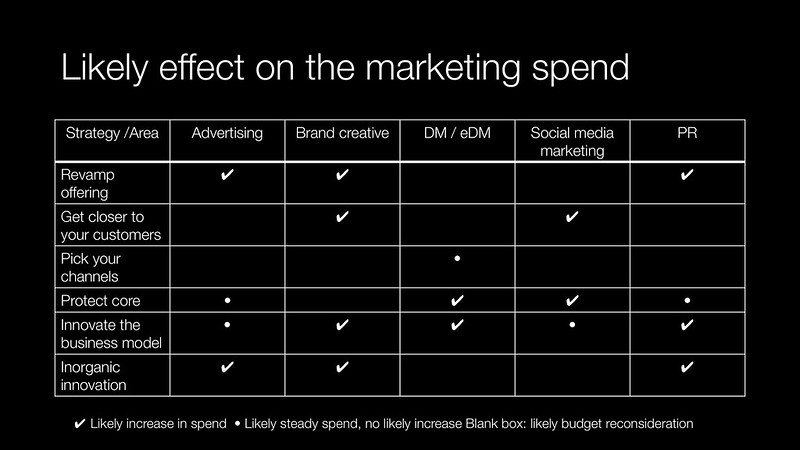
Brand communications vs. ZBB
Focus on clients based on their strategic intent if they are implementing ZBB, here’s a quick guide I did earlier this year.
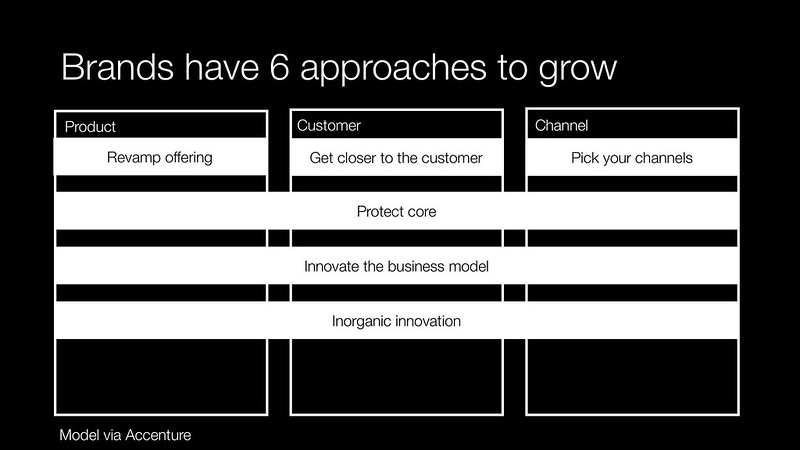
Businesses have six paths to growth
Path versus agency discipline
If your client programme lies in parts of the spectrum where you won’t benefit, then as an agency you have a few choices:
Identify and grow your business within other brands of a clients business
Look at rivals for opportunities
Treat the current business as a cash cow
Effect of agency consolidation on brand communications
A second aspect of risk analysis is brand consolidation. There is not much that an agency can do with the change in brand architecture like Coca-Cola. The clients are likely to cut costs.
A clearer source of risk will be ‘local gems’ this is a consumer brand that is only sold in one country (it may be known under a different name in other countries). These brands are likely to be closed down or sold on, particularly if they are in declining growth sectors such as margarine spreads, cereals or carbonated drinks.
If you have only started planning about looking for replacement brands in your portfolio, it may already be too late. Best case scenario is that the brand is bought by a local FMCG company.
Looking at previous brand sales like Radion washing powder as an example the acquirers will not support it with significant marketing spend. Instead, they will look to maximise their investment by mining existing brand loyalty and awareness. Depending on the product category and the target audience will depend on how fast inevitable brand decline will be.
Either way it is not a particularly attractive piece of business or large or medium-sized agencies. An incumbent agency will have to repitch for the work as it will fall outside the purview of existing contracts and business relationships.
Advertising agencies have a head start in terms of their planners having a clear grip on what Sharp’s concept of smart mass marketing means for their discipline. PR agencies need to articulate this and reflect it in their account planning. They are still struggling to get to grips with social and are championing concepts like ‘micro-influencers’; that don’t fit into Sharp’s world view. They are effectively burning client respect.
PR agencies need to think much more in terms of programme audience reach and repetition for audiences, rather than the current focus on influence. More marketing related content here.
Let’s Face It: Smartwatches Are Dead | Variety – interesting that Variety covered smartwatches. Apple is king of smartwatches. That market is at best immature, at worst dead in the water. Of course all this could change in an instant with a compelling use smartwatches case from a killer app – rather like Apple’s LaserWriter and Aldus’ PageMaker software completely changed things for the Apple Macintosh. Luxury as a sector has fallen down for smartwatches, health looks like a better candidate.
Apple Extends Discounts on USB-C Adapters and Accessories Until March 31 – Mac Rumors – the MacBook Pro disaster continues. Having blown fortune on dongles to make my laptop work. I am now faced with 10 years of battery chargers, power adaptors for planes and automobiles and a variety of connectors that are now up for the scrap heap. Not exactly environmentally friendly design. A second thing is that the MagSafe connector is far safer than the new USB C connectors.
Ideas
Perfecting Cross-Pollination | HBR – research on more than 17,000 patents suggests that the financial value of the innovations resulting from such cross-pollination is lower, on average, than the value of those that come out of more conventional, siloed approaches. In other words, as the distance between the team members’ fields or disciplines increases, the overall quality of their innovations falls. But my research also suggests that the breakthroughs that do arise from such multidisciplinary work, though extremely rare, are frequently of unusually high value—superior to the best innovations achieved by conventional approaches
AI Winter Isn’t Coming – Despite plenty of hype and frantic investment, a leading artificial intelligence expert says hardware advances will keep AI breakthroughs coming – hmmm not so convinced most of it is building on 1980s work rather than really moving things forward
The UK’s Investigatory Powers Act allows the State to tell lies in court • The Register – Section 56(1)(b) creates a legally guaranteed ability – nay, duty – to lie about even the potential for State hacking to take place, and to tell juries a wholly fictitious story about the true origins of hacked material used against defendants in order to secure criminal convictions. This is incredibly dangerous. Even if you know that the story being told in court is false, you and your legal representatives are now banned from being able to question those falsehoods and cast doubt upon the prosecution story.
Potentially, you could be legally bound to go along with lies told in court about your communications – lies told by people whose sole task is to weave a story that will get you sent to prison or fined thousands of pounds.
The Methbot operation | Whiteops – video ad fraud business worth $3-5m/day (PDF) Well worth reading despite the bot network name….
Europe Presses American Tech Companies to Tackle Hate Speech – The New York Times – only 40 percent of material flagged as possible hate speech online (albeit in a relatively small sample of 600 posts, videos and other online material) had been reviewed by the Silicon Valley companies within 24 hours. Of those 600 postings, just over a quarter was eventually taken down
Case study: 3 years, 5M WeChat followers, and 300M RMB valuation – Uncle Tongdao, a WeChat Official Account about astrology just had an exit at a RMB 300 million valuation – character licensing. LINE (Brown and Cony) and WeChat are the platforms for the new Hello Kitty or Mickey Mouse
China, new economies driving ad market growth: GroupM | Advertising | Campaign Asia – China continues to exceed expectations, with GroupM China revising upwards its initial forecast of 6.6 percent growth to 7.8 percent. This contrasts with the Magna report, released yesterday by IPG Mediabrands, which initially forecast China’s ad market growth at 8.4 percent and revised it down to 7.2 percent
Online
Vine Update – Medium – Vine becomes a feature (officially). Vine made the classic web 2.0 mistake of confusing being a feature with being a fully featured but minimal service for optimal user experience design. This is a hard line to walk during the web 2.0 era, let alone in the face of super-apps like WeChat that compress a whole operating environment into one app at a moderate sacrifice in usability
Security
OONI – urandom.pcap: Belarus (finally) bans Tor – double edged sword. On one hand good for a government that wants oversight like Investigatory Powers act; on the other Tor users flag themselves interesting by their use of it. I would expect an MP driven ban in the UK at some point
Congressional group says backdoor laws would do more harm than good – The Verge – smarter approach to cryptography than many politicians. There is a clear dichotomy between politicians desire for personal privacy and their clear advocacy against it in the name of national security. This sense of the other highlights the gap between politicians and the people. The congressional group conclusions are refreshing.
MacBook Pro Launch: Perplexing | MondayNote – quite shocking review by Jean-Louis Gassée of his experience with the new MacBook Pro – less than 5 hours of battery life, buggy peripherals and software glitches don’t inspire confidence
CNN Brings In the Social App Beme to Cultivate a Millennial Audience – The New York Times – major news site suffering from lack of consumer trust (election coverage, fake news environment etc) buys YouTube V-logger to get some baes – and people wonder why the news media appears broken. Beme was founded by Casey Neistat was one of the first generation of YouTube bloggers. Beme rolled out a mobile app to syndicate their content
Business
The taxi unicorn’s new clothes | FT Alphaville – is sadly symptomatic of the emperor’s new clothes groupthink dominating the sector. Though it does explain the sector’s obsession with popularising the idea that public transport can be done away with. (Less investment in public transport will lead to fewer competitively priced alternatives, empowering the Uber monopoly in the long run)
This Is What Happens When Millions Of People Suddenly Get The Internet – BuzzFeed News – Facebook’s influence in Myanmar is hard to quantify, but its domination is so complete that people in Myanmar use “internet” and “Facebook” interchangeably. According to Amara Digital, a Yangon-based marketing agency, Facebook has doubled its local base in the last year to 9.7 million monthly users. That number is likely to spike again, after Facebook launched its Free Basics program, a free, streamlined version of Facebook and a handful of other sites.
Apple expert panel on shift from a hit-driven to services business – Business Insider – “I’ll play both sides of it for you, Steve. On the one hand, they haven’t had innovation for a long time and it looks really bleak and it’s been six years [if you measure by the iPad, which was introduced in 2010]. On the other hand, if after eight years they do something as big as the iPhone or the iPad or the iPod, then we’ll forget about, we’ll forget about those doubts.”
The Macintosh Endgame | MondayNote – interesting analysis, the problem is that iOS doesn’t have a user experience conducive to knowledge work like typing all day long
What now for the working class? Following president Trump’s election and the British plebiscite on European Union membership there has been lots of hand wringing about workers who traditionally participated in legacy industries being outside society. Here is what we have to deal with:
The ‘traditional’ jobs aren’t coming back
Middle-class roles are already being disrupted
There is a declining return on investment in further education, yet lifelong learning is a compulsory requirement
Globalisation is working at an aggregate level, but isn’t working at a local level
Western society has fractured. It will become more fractious once the realisation takes hold that:
It can’t be resolved by simple measures, populists might listen – but can’t solve anything. Jobs are governed by a multiple factors that affect both cost and demand considerations
It can’t be solved in a relatively short time frame. You can’t build the necessary eco-system and supporting industries to bring the jobs back; even if the economics made sense
Governments don’t have their hands on the levers of control, the best governments can do is actively manage decline. Technological disruption puts the levers of control with a smaller group of people
There is a lack of willingness by those with the money and the power to solve it – primarily due to the pressures that drive their behaviour
Existing social welfare safety nets aren’t sustainable
The realisation that populism doesn’t deliver is likely to cause a further visible outburst of anger. Which should be good news for the private security industry. This could result in civil or international conflict. It has already happened. Factors that contributed to the Arab spring and the Syrian civil war included a large under-employed population living in stagnant economic conditions with no hope in sight. This probably sounds familiar.
I am ruling out some sort of positive ‘black swan’ event which changes the game completely and provides meaningful work with great wages across societal boundaries. If I could reliably predict these, I would be writing this from my private Airbus A380.
Instead I can see four broad categories of outcomes, all of which are ugly:
Carry on – carrying on isn’t likely to be sustainable as societal pressures go to breaking point
Managed decline – from a rational point-of-view the most ‘possible’ solution. Unpalatable from a voter perspective. It begs the question at what point would the UK economy bottom out? Managed decline makes the most sense as an interim measure whilst a country works out what its new place in the world is and charts a path towards it based on careful strategic investments with limited capital
Massive investment – presents a number of challenges that make it nearly impossible for western countries. It would require a long term view – unlikely without consensus driven politics with a high level of comity, huge access to credit – again unlikely with highly indebted economy and a slowly declining credit rating like the UK. Would take too long to satisfy angry voters
Massive disruption – the dice is thrown in the air as society tears itself apart and the strong gain control – think China’s Cultural Revolution. Wages and worker rights may drop to make them more cost competitive for low skilled manufacturing allowing for an employed but disgruntled workforce. Power is unlikely to shift too much, the corresponding upheaval in population numbers may provide some supply side pressure on wages when its all over. In all likelihood, it would just reduce pressure for change, increased willingness to work together on a longer term solution, but not provide much medium term economic benefit
Disruption
Here is a chart of numerous successful business, some of them are over a century old. AT&T and Verizon can trace their history back to 1877 and the Bell Telephone Company set up by Alexander Graham Bell’s father-in-law. General Electric goes back to work by Thomas Edison in 1880. These companies took from 117 – 137 years to become $200 billion businesses. Facebook took ten years requiring only 3% of the people AT&T needed.
It would be reasonable to assume that the future is going to create less jobs with given investments rather than more.
Company
#Employees
Year its market capitalisation became US$200 billion
Facebook
9,199
2014
Microsoft
27,000
1998
Apple
46,600
2010
Alphabet (Google)
46,600
2012
Amazon
165,000
2015
Verizon
176,800
2014
General Electric
239,000
1997
AT&T
302,000
2007
So large private enterprises will:
Employ less people which means less ancillary demand for services in the locale. Less restaurants, shops, artisanal coffee shops, micro breweries, nail bars, car valets, hotels and hair salons
Employ even less unskilled people – what unskilled labour is required will be employed on a flexible basis. Their roles will be competing on ‘total price’ with a global workforce and robotics
This hypothesis is supported by data from the MIT Technology review which showed that modern US manufacturing managed to increase productivity by 250% whilst reducing staff numbers by over 40%.
Win-Win to Winner Takes All
Technological progress and globalisation has resulted in a decline in the middle class in western countries. Pew Research claims that the US middle class declined from 61 per cent of the population in 1970 to 50 per cent by 2015.
Corresponding average ‘real wages’ for US ‘good producing’ workers peaked by the mid-1970s and have been broadly stagnant since. A pattern mirrored in other developed economies. Hong Kong saw a similar peak from 1967 riots through to the early 1990s until factories moved across the border.
Manufacturing productivity had grown steadily over that time. You can argue over the data points but the overall trend seems to hold true.
Owners of capital have enjoyed increased returns versus the providers of labour. Knowledge work, a key part of middle class roles could be easier to export than production lines. A classic example is the bank back office roles that have been exported to India.
Supply chain
At the moment UK manufacturing jobs operate as part of a complex supply chain that primarily addresses the European Union as a market. The supply chain is built around a number of factors:
The value of the product
The weight of the product
The volume of the product
The cost of shipping versus the cost of production
How well the product travels
Distribution of product demand
Proximity to suppliers
Proximity to talent
This is why companies may package a product in one country and manufacturer in others. Washing powder is a classic example of this. Chocolate travels well, so Cadbury could move production lines of internationally popular products to Poland. There is a greater incentive to move low skilled work out of areas that aren’t geographically central to a given supply chain. European freedom of movement may have kept jobs in the UK by allowing low and semi-skilled workers to move rather than the factories. This would be of little consolation to UK workers, but would benefit UK tax coffers.
This complex formula is the reason why jobs move in and out of the UK.
Cutting the UK out of this supply chain with a hard Brexit ensures that suppliers have to make complex choices. BMW will probably be wondering what UK presence it needs to maintain in order to keep the Mini brand values. It may decide its easier to evolve the quirky Britishness out of the brand over time and just keep it quirky. The Audi TT hasn’t been harmed by actually being assembled in Hungary.
The majority of components in the supply chain for the Mini production line is based in Germany.
A post-Brexit UK could be in the position of importing more rather than less products once companies take into account the bigger picture of the supply chains and the EU single market. This will lead to a net loss of working class livelihoods.
Role of eco-systems
Richard Florida is a Canadian professor who has spent much of his time looking at urban studies from the perspective of prosperity. He is known for is work around the creative class and urban regeneration (or gentrification). His work is controversial. One key concept he has of relevance to working-class communities is one of ‘clusters’ where eco-systems exist. When you apply it to traditional working class industries one can see how the jobs aren’t just going to come back. The UK has a series of traditional clusters that are in overall decline, this is best illustrated by the state of chemical, oil refinery and coal sectors which underpin a wide range of manufacturing industries.
Where new clusters spring up (Silicon Roundabout and the FinTech businesses within the Square Mile) they create employment that much of the UK population is ill-equipped to fulfil.
Let’s look in greater depth at traditional manufacturing industries that have provided the working class with good playing jobs.
Factories build on suppliers, who build on raw materials processors, who build on utilities and extractive industries. Take for example industrial revolution era Stoke-on-Trent which was close to high quality clay pits and coal that could be cheaply shipped in from mines in Lancashire or South Yorkshire. All of which required semi-skilled and unskilled jobs that gave the working class their livelihoods.
Unfortunately for Stoke-on-Trent; clay is readily available around the world, opening up the possibility of production in areas with cheap labour. Automation raised the quality of production and fashion can quickly dictate whether an ‘area’ brand is in demand.
If we look at the industrial landscape of the United Kingdom, the manufacturing industry has been hollowed away during the 1980s and 1990s. The UK lost 18% of its manufacturing capacity in the space of 18 months during the conservative government of Margaret Thatcher.
There has been a corresponding (likely terminal) decline in the necessary facilities to support an industrial economy. Now let’s look in-depth at three essential types of facilities that underpin manufacturing:
Oil refineries
Coal mines
Chemical plants
This base of the UK industrial eco-system is running on ‘life support’ in critical areas.
I was fortunate to have a great science teacher at school, he once said to me that you could measure the size and health of an industrial economy by the amount of sulphuric and hydrochloric acid it manufactured and consumed. In order to manufacture hydrochloric acid you need a chlorine gas plant – neither chemical is something you want to transport over long distances. The side effects of a leak would be catastrophic.
The UK currently has one plant to make chlorine gas that is government subsidised because there isn’t a sufficiently large industrial base to support continued profitable production. What industrial capacity is in the UK is perilously close to being snuffed out.
What is left of the UK chemical industry has consolidated in the North East of England Process Industry Cluster (NEEPIC). Some of the products created are intermediary chemicals for use elsewhere in the European Union. Brexit is likely to have a disruptive effect on some of these manufacturers. The cluster is a key reason why Nissan decided to build a manufacturing plant in Sunderland. NEEPIC is dependent on oil refining capacity for key chemical building blocks (feedstock).
Oil refineries
Oil refineries are considered by the public as providers of petrol (gasoline), diesel and jet fuel. The reality is that they provide feedstock (chemical building blocks) for most things in everyday life:
Foods
Medicines (or we can go back to leeches and blood letting)
Paints (containers, large manufactured goods, civil engineering)
Dyes to colour fabrics, plastics and other materials
Plastics (the modern world as we know it) – structural plastics, coatings, fibres including clothing textiles
As I write this is, it is easier to look around my desk and count the products that don’t have an oil-derived input – one item, the desk itself which is unpainted. Though I would put good money on it that the trees it was made from were felled with petrol chain saw and transported on a diesel-powered lorry to the saw mill.
Yet the UK has lost a huge amount of oil refining capacity. From 1974 – 2012 refining capacity almost halved from 148 million tonnes to 77 million tonnes (Energy Institute). This decline happened despite start of UK North sea oil production in 1975.
Peak production on North Sea oil occurring in 1985 and 1999 (two peaks due to technological innovation). There were 22 active oil refineries in 1974, at the time of writing there are now seven.
Part of this was driven by changing energy consumption such as the decline of home heating oil and more fuel efficient cars. But a good deal would be due to reduced ability to compete against foreign petro-chemical feedstocks and reduced industrial capacity.
Oil refining capacity has moved to closer to where the industry is.
Belgium and the Netherlands have oil refining capacity beyond their internal needs because of their ease of access to continental European markets. Germany as Europe’s industrial powerhouse has the largest refining capacity in the European Union – which matches its industrial economy.
Much of the capacity to provide chemical feedstocks for industrial use has moved to the Far East; notably Singapore, Japan, Korea, Jamnagar in India and China. Overall industrial production has moved to East and Southeast Asia.
Coal production
The working class found coal production as a source of working class jobs. Even coal production in the UK is roughly 10 percent of what it was in 1980. There are no deep coal mines active in the UK, only a handful of open cast mines. Coal is not only useful as a fuel but also a alternative supplier of feedstock for a diverse range of products including fertilisers, plastics and medicines. Even if coal comes back to prominence as oil reserves run out it would take a lot of effort to get UK production going again – perhaps too much effort.
Managed decline of traditional working class areas
The purpose of managed decline would be to concentrate efforts where they can make the most impact. London would draw in more people from the hinterlands. Cities like Liverpool would continue to decline in population. Low quality housing (think trailer parks or shanty towns) would cater for the internally displaced workers and there would be a likely increase in casual or gig economy roles in place of many working class roles.
So what would managed decline of working class areas look like? We have a clue from government discussions after the 1981 Toxteth riots. Lord Geoffrey Howe wrote a letter which was considered too controversial at the time
“I fear that Merseyside is going to be much the hardest nut to crack,”
“We do not want to find ourselves concentrating all the limited cash that may have to be made available into Liverpool and having nothing left for possibly more promising areas such as the West Midlands or, even, the North East.
“It would be even more regrettable if some of the brighter ideas for renewing economic activity were to be sown only on relatively stony ground on the banks of the Mersey.”
“I cannot help feeling that the option of managed decline is one which we should not forget altogether. We must not expend all our limited resources in trying to make water flow uphill.”
Howe realised that even discussing the concept at the time would be explosive.
Retrenchment to focus economically
In practical terms, it would mean:
Re-centralising government departments
Not spending on infrastructure beyond critical maintenance
Rationalising government support infrastructure: police, hospitals, social services
Re-zoning areas from a planning perspective to encourage development only in future clusters
Allowing local government to go into bankruptcy protection and under go US-style emergency management
Once population decline hits a critical mass, turning off the last services, rather like the city of Detroit has done
Focus infrastructure investment on ‘clusters’
Connecting benefits to re-location
This process would then give time for western countries; in particular the UK, to re-invent themselves and think about their economic purpose in the world beyond consumption.
The Chinese government have already started on this process whilst their economy is still in a high state of growth – looking to move up the manufacturing value chain, moving into the professional and financial services sectors that the west currently occupy. On the flip side they have not flinched from closing down excess capacity in the steel industry and low value industries. This is causing economic hardship amongst unskilled workers in Guongzhou and the steel towns of Hubei province.
Former clothing factories are being bulldozed to make way for corporate campuses. Small electronics factories in Shenzhen are making way for a financial services centre including a stock exchange.
If one thinks about the Chinese experience and their migration to higher value work, where would the UK go next and what does mean for the future of the British working class?