Category: jargon watch | 術語定義 | 용어의 정의 | 用語の定義

Jargon watch as an idea was something that came from my time reading Wired magazine. I found that in my work terms would quickly spring up and just as quickly disappear. So it made sense to capture them in the moment.

The best way of illustrating jargon watch is by example. I came across the term black technology through mainland Chinese friends. One of the key things that Chinese consumers think about technology products is the idea of ‘black technology’. This makes no sense to your average western reader. It equates to cool and innovative.

The term itself comes from a superior technology featured in a Japanese manga series plot. As an aside the relationship between Chinese and popular Japanese culture is becoming increasingly attenuated due to Chinese nationalism.

What might be black technology this year might be humdrum in six months as the companies quickly catch up. Black technology is a constant moving target, but generally its sophisticated and likely has a cyberpunk feeling to it.

I keep an eye out for jargon like this all the time, hence jargon watch. I find this content in my professional reading and in the sources that I follow online. What makes something worthwhile to appear here is purely subjective based about how I feel about it and how much I think it resonates with my ideas or grabs my attention. A lot of British youth culture doesn’t make it because it doesn’t have that much of an impact any more beyond the UK.

  • Context collapse

    Disclaimer on context collapse

    Years ago I wrote a series of posts with the link-baiting titles of ‘Facebook is a dead man walking’; the first post written in 2008. I say this so you can form an opinion up  front about my interpretation  around the idea of context collapse.
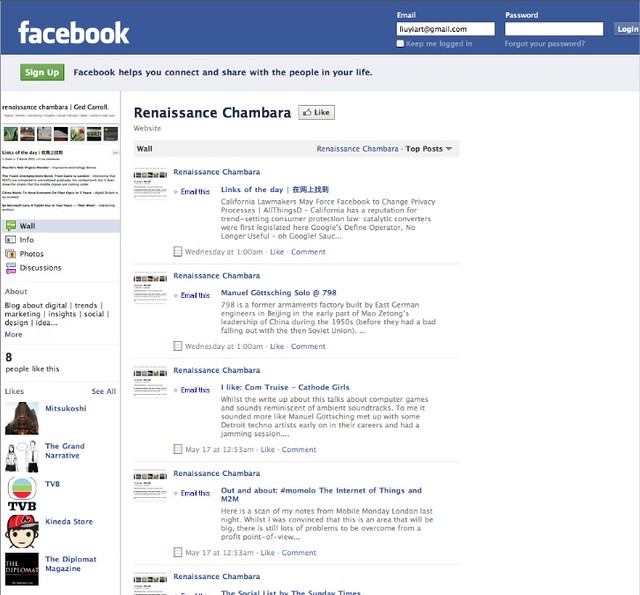
    Facebook page

    According to The Information, Facebook is worried about a drop in users sharing their own content.

    As of mid-2015, total sharing had declined by about 5.5% year over year while “original broadcast sharing” was down 21% year over year, the confidential data show.

    This loss is especially acute with under 30 year old users. This loss in sharing according to Bloomberg company staff have branded context collapse.

    Context collapse

    What are the likely causes of context collapse? Here my are my hypotheses.

    Negative network effects. Just five years ago ZDNet published research were respondents admitted that they were drunk in 75 per cent of their photos on Facebook. In 2016, when ‘friends’ means colleagues, superiors, clients, teachers or parents there will be a lot more self-censorship going on.  A more subtle form of self censorship will be also brought about in terms of societal norming.

    When Facebook initially arrived the volume of content that people shared was larger, now it isn’t only the nature of the content that people will consider but the volume of the content. Are they too noisy, do they overshare?

    Facebook lost a lot of trust with consumers with things likes Beacon. Consumers didn’t necessarily understand the nuances, they were told that it wasn’t good and their privacy settings are a major hassle to tweak – when you’re on edge about privacy, you are more likely to put a filter on your content.

    Just over five years ago, Netbase had released brand research that showed consumers had a stronger, negative feeling towards Facebook than brands like Microsoft, Google or Twitter. That left room for other services to creep in for self-expression, messaging and sharing to small groups. Facebook bought some of the major players Instagram and WhatsApp, but doesn’t own all the pieces.

    More information
    Facebook Struggles to Stop Decline in ‘Original’ Sharing | The Information (paywall)
    British Facebook users are drunk in 76% of their photos | ZDNet
    Facebook Wants You to Post More About Yourself – Bloomberg
    Why Facebook is a dead man walking | renaissance chambara
    Why Facebook is a dead man walking part II? | renaissance chambara
    Why Facebook is a dead man walking part 2.5? | 技术品牌的情绪 | renaissance chambara
    Facebook and advertising or why Facebook is a dead man walking part III? | renaissance chambara

  • McRefugees

    McDonalds and McRefugees

    McDonalds Restaurants in Hong Kong is famous to Economist readers for consistently providing the best value in the publication’s ‘tongue-in-cheek’ ‘Big Mac Index’. But it is also increasingly becoming a cheap source of social housing for what has become known as McRefugees. McDonalds Chinese sign

    The restaurants are ubiquitous, offering cheap consistent food. And many of them remain open 24 hours a day, which contributes to Hong Kong’s ‘up all night’ lifestyle alongside the ubiquitous convenience stores. They are a neighbourhood haven to office workers, students and those on shifts. Their relative low costs mean that they prove attractive to homeless people. McSleepers and McRefugees were the interchangeable labels given to the homeless people sleeping in McDonalds to escape the oppressive heat of summer or the cold around lunar new year. It became a thing in the media last year when a woman lay dead in a restaurant for 24 hours before being discovered. The tragedy masks the unintentional social role McDonalds is playing for the poorest in Hong Kong society. More Hong Kong related posts here.

    More information

    Hong Kong ‘McRefugees’ up sharply, study shows – Hong Kong Economic Journal Insights

    Save our McRefugees: Woman’s lonely unnoticed death in Hong Kong McDonald’s highlights need to help homeless | SCMP

    Hong’s Kong’s lack of affordable housing fuels ‘McSleeper’ trend, where the homeless sleep at McDonald’s | SCMP Homeless woman found dead at Hong Kong McDonald’s 24 hours after she sat down as unaware customers ate | SCMP

    ‘McRefugee’ reunites with son in Singapore through media report on Hong Kong’s McDonald’s sleepers | SCMP

    The lonely life of the McSleepers, the poor who call McDonald’s home | SCMP

  • Yiminjian

    Yiminjian

    Canada

    One of the most popular articles on the South China Morning Post website this year was about the phenomenon of yiminjian or ‘immigration jail’. Canada has been a popular destination for wealthy Chinese to set up their homes. The scions of the Huawei business had a couple of mansions in Vancouver. They were following a well trod path. Li Ka-shing had his family living in Canada since the early 1970s and the South China Morning Post had a permanent Vancouver correspondent for 25 years.

    I guess mainland Chinese are less enamoured with Vancouver and other Canadian cities than their Hong Kong counterparts, hence the phrase yiminjian.

    That anyone should immigrate to Canada while regarding living there as a burdensome task to be endured or avoided might sound weird, but the concept is so common among some Chinese immigrant circles that there is a word for it: yiminjian, or “immigration jail”. The term refers to the period of compulsory Canadian residency (now, four years out of the previous six) which one must suffer before applying for citizenship. Think of a Canadian passport as the get-out-of-jail card.

    It needs to be emphasised that this mindset does not apply to all Chinese immigrants – only that subset for whom greater opportunities exist back in China (and only a subset of those).

    The problem that confronts these migrants is that Canada promises safety from the pace of change that has swept across China since the start of the cultural revolution to the rise of Mr Xi’s ‘tigers & flies’ programme. But China offers an opportunity to make out like a proverbial bandit and accumulate fantastic amounts of wealth.

    But creating that much wealth means ties of an often murky nature with authority figures. If you need land to build a factory, only the local government can sell you that land. If you need permits (which you will), or utility services such as power and water – you need government cooperation.

    Government cooperation comes at a cost and is facilitated through layers of bribery. The system of bribery even extends into business disputes as powerful government friends are called upon to smite the opponents business. All you need is a shift in power, like the one that happened under Xi Jinping and you could find yourself on the run. This kind of collaboration and corruption at the highest levels was outlined in Desmond Shum’s autobiographical account Red Roulette.

    More jargon explained here.

    More information
    Immigration mega-fraud: The rich Chinese immigrants to Canada who don’t really want to live there | South China Morning Post  – paywall

  • Breakfastarians

    Marketers have a unique knack of mangling the English language to put labels on market segments, but breakfastarian isn’t one of them.
    The festive pie obsession continues
    Breakfastarian seems to be a self description rather than a market segment on this occasion. It’s people who like breakfast for dinner. Apparently, this is a segment of the population who appeals to McDonalds who is suffering from stagnating sales.

    On the face of it McDonalds might be setting themselves up for a failure.

    One of the reasons why breakfasts are only available for a certain amount of time is they are cooked on separate hotplates. Franchisees might not have the space or the inclination to redesign kitchens. If they were willing to go there, there is then the problem of double the work in back kitchen preparation and in-kitchen cooking.

    There is two ways to consider extending breakfast time. You can think of it as a new product, or you can consider it as an effort attract heavier consumption. McDonalds seems to think its the latter. Research by the Ehrensberg Bass found that most consumption was driven by light brand promiscuous consumption. It reminds me of efforts that Kelloggs made to try and get people to eat cereal at night, which tried to increase consumption at a different time.

    While McDonalds have some breakfast menu items on the menu in markets like Hong Kong and the US; they aren’t catering to UK breakfastarians yet. More marketing related content here.

    More information
    McDonald’s Is Now the Top Choice for ‘Breakfastarians’ | TIME

  • Seabasing

    In a tale of fact imitating fiction the US Navy is looking at ways to support the military in future conflicts by creating bases which allow ships to act as a combined space, which they call sea basing (or seabasing). The reason for this is in battles with the likes of China they may not have the luxury of a nearby land base like they have had in the Middle East, so they need to provide a flexible platform that will perform a similar function including floating docks and logistics.

    Being out at sea and operating in this way helps put the force out of range of enemy weapons as well, or what the US Marines describe as exploit the sea’s maneuver space.

    This includes ramps and sensors that would allow service men and equipment to exchanged from ship-to-ship with as much ease as moving around a base on land. Presumably this would have some sort of affect in terms of increasing the data network connections between ships to help them function better and more cohesively.
    140211-D-NI589-094
    The idea of seabasing echoes the carrier and lashed together boats of Neal Stephenson’s Snow Crash. Snow Crash is a classic work of cyberpunk fiction written in 1994. In the book refugees play a key part in the plot. The refugees have attached themselves to a privatised aircraft carrier owned by a media company that is heading to the US. More design related content here.

    More information
    The future of sea basing | Armed Forces Journal
    Sea Basing: concepts, issues and recommendations by Sam J. Tangredi (PDF)
    Pacific seabasing exercise will highlight new ships | Marine Corps Times
    Globalsecurity.org – Seabasing
    Figuring Out the Future of War in the Pacific — Or, What the Hell is Seabasing? | Vice News
    What is Seabasing | United States Marine Corps
    Seabasing Annual Report | United States Marine Corps