Category: london | 倫敦 | 런던 | ロンドン

Why London?

First of all I live in London, I put down my roots here because of work. Commuting from the outside towns into the city takes a long time. People only tend to do that when they don’t have to come in every day or getting their kids into a good school is important for them.

Secondly it is an area distinct from the rest of the UK, this is partly down to history and the current economic reality. It is distinct in terms of population make-up and economic opportunity. London has a culture that is distinct from the rest of the UK, partly due to its population make-up. Over 30 percent of the city’s inhabitants were born in another country. From music to fashion, its like a different country:

  • As one women’s clothing retailer once said on a news interview ‘The further north you go; the more skin you see’.
  • The weekend is a huge thing outside the city. By comparison, it isn’t the big deal in London. The reason was that there were things you could enjoy every night of the week.
  • You can get a good cup of coffee
  • The city was using cashless payments way before it became universal elsewhere in the country
  • The line has extended into politics. London opposed Brexit. London, like other major cities it is one of the last holdouts of Labour party support in the 2019 UK general election

London posts often appear in other categories, as it fulfils multiple categories.

If there are London subjects that you think would fit with this blog, feel free to let me know by leaving a comment in the ‘Get in touch’ section of this blog here.

  • Influencer marketing – what does the future hold

    What does the future hold for influencer marketing was an event organised by PR Week that I got to attend last week.  Below are some of the thoughts and key points that came out of the event.

    The Competition and Markets Authority

    They are responsible for enforcing The Consumer Protection from Unfair Trading Act (2008) (paywall) which governs transparency and claims across all marketing including social media influence campaigns.

    In terms of jurisdiction they have a reciprocal relationship with the FTC to enforce the law on campaigns that are being run out of the US that would affect the UK and vice versa. Geography can no longer be considered a defence.

    In terms of compliance, there is an emphasis on brands needing to monitor influencer campaigns and enforce disclosure. The legal responsibility falls equally across brands, agencies and influencers. All three are obliged to go through content and retroactively apply the act if the content is likely to be resurfaced in the future. So you are less like to have to alter tweets and Facebook posts than say YouTube videos and blog posts.

    In general they felt that brands (and their agencies) were too naive and trusting with regards influencers.

    False and misleading claims at the corporate brand level (a hypothetical example would be gold mine claiming its a green sustainable company) aren’t something that they would deal with, but they acknowledged that this kind of incident would likely breach the law.

    At the moment the Competition and Markets Authority is considering the role of platforms as agents of influence, but isn’t looking at items like Amazon’s recent algorithmic change.

    Unsurprisingly the Competitions and Markets Authority have no desire to get involved in regulating political campaigns on social. The whole area is radioactive. Whilst there would be societal benefit, it would call into question the independence of the civil service and a host legal / constitutional issues.

    Judging by the reaction of the audience, more of them were up to speed and complying with GDPR than The Consumer Protection from Unfair Trading Act – not for profits seemed shocked to find out that they weren’t exempt

    Content crowdsourcing platform Tribe

    Tribe talked about how Logitech used Instagramers to create photos for their paid media campaign to drive direct sales.

    Ad creative was lasting a week and a half on Facebook (Facebook & Instagram) before ‘ad fatigue’ set in. From my own personal experience, traditional creative lasted appreciably longer. Tribe didn’t indicate whether they had an opinion on the cause of this premature ad fatigue. Factors that might be responsible include context collapse (lower usage, with less time per session on the platform by consumers) that has been afflicted the Facebook platform for a few years

    Logitech internal division of labour on social influencer marketing campaigns

    One of the perennial questions that is asked is where does PR stop and (digital) marketing teams start with regards social media influencers. Logitech’s approach was a common sense approach to this question. High follower number influencers were dealt with by the PR team just like members of the press or celebrities. Micro and nano influencers were co-opted by marketers as part of the process to drive sales. It makes sense, but it was the first time I had heard it broken down explicitly by a brand in public.

    MSL research on the future of influencer marketing

    They had wanted to explore both consumer and influencer attitudes to extrapolate insights; given the codependent nature of influencers on agencies and brands.

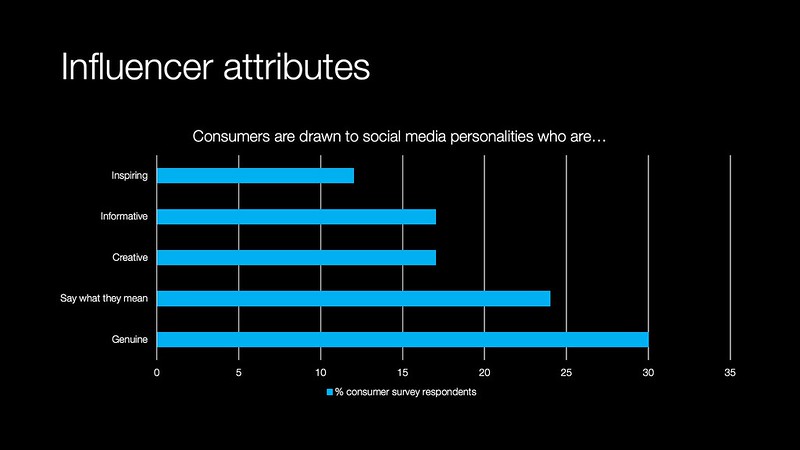
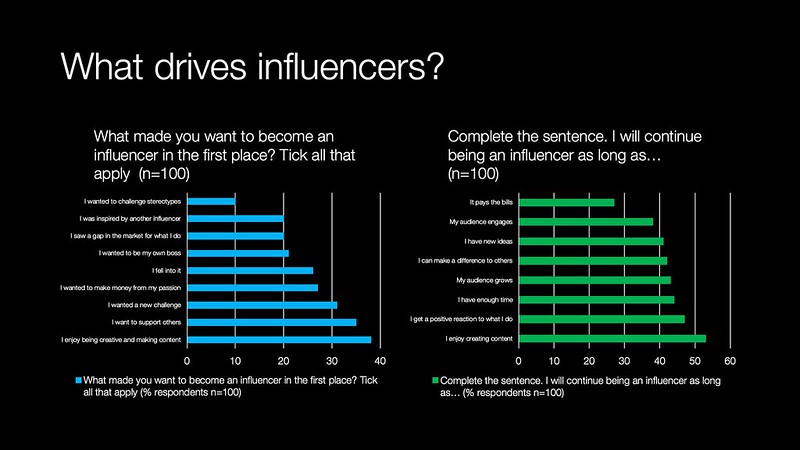
    The research involved surveying 1,000 consumers and 100 influencers. So take the insights with a pinch of salt. The slides weren’t shared but I’ve reconstructed the data from photos I took at the event.

    • 1,000 consumers were asked about their thoughts on the influencer landscape
    • 100 influencers were asked on their views on brand partnerships

    Slide4

    Slide5

    Slide6

    Slide7

    Influencers don’t like to be pigeonholed as influencers, according to consumers the title has become a dirty word

    This conclusion is counter intuitive. The common wisdom is that:

    • Gen-y and gen-z are happy to ‘sell out’
    • Professional v-logger (YouTube, Twitch, TikTok etc) are desired professions in the same way that DJ, rock musician or celebrity were previously

    Yet the influencers surveyed think that they are changing the world for the better. For instance some of them are dealing with fans who share their suicidal thoughts. But the label of ‘influencer’ was considered to have lost its currency.

    Influencers that other influencers respect. People who have demonstrated resilience; they have gone through trials and tribulations and triumphed. Zoella and Lilly Singh were among the most popular cited.

    Influencers feel that they are being treated like a channel and the process has got too transactional. Yet one of their key motivations to stay in their career as influencers is to pay the bills.

    Panel discussion

    If you’d have ran this event ten years ago. The panel discussion would still have been very similar. Measurement was considered very immature, but then the panel bifurcated. Measurement is much easier when you are using advertising and tracking through to a purchase. The discussion got muddled as paid and non-paid measurement strategies were discussed side-by-side without differentiation or explanation.

    Social agency Goat made an interesting disclosure. They’ve worked with about 100,000 influencers and found that the vast majority did not work in delivering sales. But there are no data or heuristics about which influencer is likely to work, or the reasons why?

    What was missing in influencer marketing discussion?

    The main item that I felt the discussion missed was the role of social platform algorithms in creating social bubbles and reducing campaign reach. OgilvyOne’s paper on considering life after the demise of organic reach doesn’t seem to have factored into PR agencies (publicly expressed) thinking some five years after it has been published.

    Secondly, I was surprised at the lack of progress. Whilst the platforms have changed over the past ten years. The issues don’t seem to have altered at all for communications agencies. Whilst some agencies like Edelman (and 90TEN where I am currently working) realise that a blended PESO* media mix is required – there was a large faction of earned media only practitioners in attendance. Ten years later, advertising and creative agencies have learned many of the techniques that PR agencies considered to be their domain in order to improve ‘talkability’.

    This is out of step with clients requirements for two reasons:

    • Clients want to effectively measure their success and the tools available to paid media are more complete
    • As OgilvyOne proved in their research a number of years ago, we’re heading to a demise in organic reach

    Brand marketing is in a resurgence after marketers had fetishised technology-based performance marketing for at least the last decade and a half. Influencer marketing may now be too important to be left to the the PR team…

    *PESO (paid, earned, shared, owned) – different media types.

  • Pioneer Axe + more things

    Pioneer Axe was an old-time US manufacturing company. The company used skilled labour and machine tools to manufacture axes. The Pioneer Axe plant didn’t seem to have been invested in during the 20th century and globalisation was starting to make itself felt in light industrial areas. This documentary film about their manufacturing process was made just prior to the the business closing. I’m a sucker for these kind of films that show case processes. There is something poetic about them. The processes have likely evolved from an initial plan over time organically to enhance productivity.

    This is one of a series of ads done for RACV Pet Insurance in Australia. It’s the kind of work you’d be proud of doing. I love some of the customised rigs that the disabled dogs have been given to enable to keep being good dogs.

    Naomi Wu demonstrates a bin that heat seals its bags. At first I thought it was frivolous; but then thinking about the kind of summer we had last year I can understand the appeal to reduce smells and the opportunities for insects to take up home in your bin content. The bin is positioned as a smart device; but it isn’t really.

    Water Margin Podcast: Outlaws of the Marsh – my favourite general interest podcast to fill the gap after Cocaine and Rhinestones. It is a podcast that explains in relatable terms the Chinese classic. This makes a lot of sense as the number of characters starts to expand a lot.

    I ended up working out of Somerset House for some of this week and shot this Thameside time lapse video. It is amazing how much river traffic there is on the Thames in central London. Despite the congestion charge and outrageous parking charges, the car is still very popular. More London related content here.

  • AngloArabia by David Wearing

    I got sent a copy of AngloArabia and was interested in having a read of it. I grew up at a time when the Gulf states influence grew through OPEC. I started my work life with a brief time in the oil and gas industry. Since then I have moved on through a number of iterations in my career.

    Currently reading

    The Gulf states sit in a peculiar AngloArabia part of British history that isn’t generally understood. Wearing goes through the history of the the area from the Trucial states attached to the British rule of India. And brings up to date regarding the UK’s role in the modern Middle East.

    The modern relationship between the Gulf states and the United Kingdom blurs the hierarchy between client states and their former colonial master. Oil and the OPEC oil crisis was the catalyst as countries got increased financial power and the UK became the number one Euro Dollar market.

    Lots of western countries have seen sovereign funds invest with a view to gaining influence. The UK is unique in terms of the role played by Gulf States who are bailing the country out. Without the support of Middle East money, the country would be overwhelmed by its current account deficit. This money has gone into property, the UK stock market, private equity investments and trophy businesses such as football clubs. The Gulf states are also responsible for a huge amount of consumption in the UK. The UK luxury market revolves around their consumption patterns.

    The implication is that the British economy and the UK government literally can’t afford for any of the Middle East monarchies to fall in an Arab Spring style revolution.

    The author David Wearing is a left of centre leaning journalist with wonkish credentials. As with any author, you need to ask yourself about his agenda. He has managed to write a relatively accessible book. More related content here.

  • Populism & more in 2019

    At a macro level, the world is in a pretty strange place at the moment. Populism is at the centre of uncertainty across many countries in terms of political direction, macro economics, technology and consumer uncertainty.

    2016 State of the Union debate

    Populism and nationalism is on the march: Duterte in the Philippines. Trump in the US. The German right wing populism leaning political party AfD is shifting the Overton window in Germany. The yellow vests in France and the UK is channeling anger into political activism along fringe party lines providing an opportunity for populism. The UK has seen a rise in far right grassroots media mirroring the rise of The Canary and similar publications on the left both of which fuel different forms of populism. The Russians don’t need to do it as the populism and divisive politics is homegrown. The Queen’s speech called for unity in the country and the UK government’s Prevent anti-radicalisation programme has more far right cases than Islamic extremists. Even China has been gradually moving to a Han nationalism as part of its more forceful foreign policy. India and Pakistan have both seen a rise in sectarian politics. This has impacts in terms of foreign trade and economic growth. We are already seeing domestic brands rising in China and India; we may see a decline in brands and product SKUs in the likes of the UK – all of which will impact advertising budgets. At an agency office level; the chilling effect of nationalism is going to affect the movement of talent on both client and agency side. It’s hard to articulate the atmosphere of an agency that I was working in the day after the Brexit vote without using the word bereavement. I know people in my family and peers who are moving away. Over time this will impact culture and creativity. It is hard to remember but back in the 1970s the UK was much more parochial and less multi-cultural than it is now. Everyday things we take for granted like good food were much poorer experiences.

    There are so many variables in play we don’t know where populism and divisive politics is going, but there are dark possibilities to the government ‘by the seat of their pants’ which seems to be prevalent.

    Cryptocurrency and block chain: We’ve seen a wide range of crypto currencies decline in values this year. What are the factors might drive a recovery? Why would there be a spike in demand? I don’t know what that ‘X factor’ would be. I suspect that experiments in block chain such as verifying online media spend to prevent online fraud will start bumping up against the limitations of the technology. Blockchain has a relatively low transaction rate compared to legacy payment systems. Decentralisation still isn’t as good as an Oracle database or a mainframe a la the traditional banking system. Some applications just make no sense.

    From Farm to Blockchain: Walmart Tracks Its Lettuce – The New York Times – is a classic example of technology for technology’s sake. How much lettuce would Walmart be selling day in, day out? That data has to be collected across a complex supply chain. Secondly, its a privatised centralised blockchain which negates the technical benefits of Blockchain and makes me wonder why IBM weren’t selling in Db2 or Oracle high transaction speed relational database on a z-series mainframe. It’s announcements like this that makes one wonder if blockchain has jumped the shark.

    Virtual reality hasn’t seen the level of adoption that was predicted. The problem is no longer one of technology hardware (lets ignore battery life for a little while) but content. VR changes the way stories are told and experienced, it makes it hard to build brand experiences and compelling content. Microsoft has managed to build a community of early adopters in Altspace – a Second Life type environment. Augmented reality (AR) has been sporadically adopted and Apple has been putting a lot of work into building creator tools, but the decline of Blippar. Magic Leap’s demo film for its partnership with Cheddar doesn’t currently look like a compelling AR application to me. It does mirror, anecdotal evidence that suggests the most common use of VR is to replicate a big TV experience in a small space through the Netflix application.

    https://youtu.be/xjYE-joYjQs

    If 2017 and 2018 were the years when ad fraud became the bête noire of marketers, 2019 might see harder questions asked of influencer marketing practices. The move from influencers to micro-influencers was down to cost per reach and engagement. The move to nano-influencers implies a similar kind of shift again. Yet it seems to be largely taken on blind faith by marketers at the moment that influencers are good thing. I think many of the challenges that influence marketing faces when I wrote about them earlier are still valid. One question that I haven’t seen seriously considered by marketers is when you’re in a culture where ‘selling out’ has moved from being shameful to gen-x; to a badge of validation in the space of a decade that has to change the value proposition that influence brings? As a marketer the possible answer to that question worries me.

    The focus on ad fraud might be partly responsible for a slight resurgence in the realisation brand advertising is valuable. Performance advertising is about the now, brand advertising is all about sowing acorns that are reaped for decades to come. As a concept it’s easy to grasp at an empirical and research driven level. But when marketers typically stay in a role for a short time, the now becomes of outsized importance. They have to make an impact and then plan their exit strategy in what’s typically a three year cycle. Brand is hard for FMCG (fast moving consumer goods) brands to take on board as they see channel and shelf disruption from the likes of Amazon and Ocado. They have experimented with the direct sales model a la Birch Box and Dollar Shave Club, but that will only work with certain products. Consultants selling disruption are selling chaos; clients hedging against black swans often miss where change isn’t happening – consumer behaviour doesn’t change at the speed of PowerPoint. I’ll leave the last word on digital disruption to Mark Ritson.

    It’s hard to get emotional or feel any of the romance of news media from a home page, but the paper edition carries with it the great cultural power of journalism. Print editions will become the ‘couture’ offering of the news brands – loss-making but important assets for building and retaining authority and influence over the market

    Mark Ritson, The story of digital media disruption has run its course – Marketing Week 

    Validation of traditional media can be seen all around us. Amazon printing catalogues, online brands having flagship stores. Underground and out of home adverts for e-commerce businesses surround me as I go about my daily life in London.

    Stories with everything – I don’t know whether the recent trend of every social platform having a short form video function that disappears a la ‘stories’ is a wider socio-cultural trend or the constant carousel of changing formats as part of a ploy to keep users engagement rate up. For established platforms there is little to be lost by throwing new features agains the wall and seeing what sticks.

    I’ve omitted talking about 5G as it will take more than a year to get up and running. It won’t be clear what its application is until we start to see how effective the network is in practice. Gadgets like fold out phones won’t fundamentally change the pictures under glass interface used in smartphones for the past decade or so. Their impact may be exaggerated due to their high cost that consumers will bear one way or another.

    I realise that these are a series of random thoughts but would be interested to know what you think. Feel free to comment below.

  • On the sofa: The Man from Mo’Wax

    The documentary The Man from Mo’Wax was something that I’d been looking forward to watching for a while. James Lavelle made his name as the guy at Honest Johns who was the go to guy for Major Force Records releases. Major Force was a Japanese hip hop label that featured the likes of

    • Hiroshi Fujiwara
    • Takagi Kan
    • Masayuki Kudo
    • Milo Johnson (who was part of the pre-Massive Attack group The Wild Bunch)
    • “Tycoon” Toshio Nakanishi
    • Scha Dara Parr
    • Ishida Yoshinori

    These were the people who influenced 

    • Bomb The Bass’s first album Into The Dragon
    • The subsequent trip hop movement
    • Japan’s streetwear scene (Goodenough, Fragment) which has a continuing impact on the global streetwear scene

    Lavelle’s impact before Mo’Wax was huge. His column that had the Mo’Wax name and identity was huge. Mo’Wax the record label in its tunes and championing the designs of Swifty and Futura’s art have been hugely influential. Lavelle was the tastemaker that drove BAPE before the Americans like Pharrell Williams got hold of it. He did things in collectable figures and fashion that other labels still haven’t done. Surrender was a great streetwear label. The first UNKLE album was brilliant. 

    But he lost it; drugs and self indulgent projects that burned money and credibility. He was sufficiently narcissistic to document his life two decades before social media, which is the reason why you have a lot of warts and all material that has elements of Spinal Tap. Lavelle lacked the introspection and self examination in the documentary to make a real turn around. It ends up coming across as a two-hour pitch video for James to take part in a pop star re-invention on VH-1 a la Remaking Taylor Dane. The Guardian’s review summed up Lavelle and The Man From Mo’Wax really well. 

    …from superstar DJ to rock bore

    Cath Clarke, The Guardian (August 30, 2018)