Category: online | 線上 | 온라인으로 | オンライン

The online field has been one of the mainstays since I started writing online in 2003. My act of writing online was partly to understand online as a medium.

Online has changed in nature. It was first a destination and plane of travel. Early netizens saw it as virgin frontier territory, rather like the early American pioneers viewed the open vistas of the western United States. Or later travellers moving west into the newly developing cities and towns from San Francisco to Los Angeles.

America might now be fenced in and the land claimed, but there was a new boundless electronic frontier out there. As the frontier grew more people dialled up to log into it. Then there was the metaphor of web surfing. Surfing the internet as a phrase was popularised by computer programmer Mark McCahill. He saw it as a clear analogue to ‘channel surfing’ changing from station to station on a television set because nothing grabs your attention.

Web surfing tapped into the line of travel and 1990s cool. Surfing like all extreme sport at the time was cool. And the internet grabbed your attention.

Broadband access, wi-fi and mobile data changed the nature of things. It altered what was consumed and where it was consumed. The sitting room TV was connected to the internet to receive content from download and streaming services. Online radio, podcasts and playlists supplanted the transistor radio in the kitchen.

Multi-screening became a thing, tweeting along real time opinions to reality TV and live current affairs programmes. Online became a wrapper that at its worst envelopes us in a media miasma of shrill voices, vacuous content and disinformation.

  • Articles about race + more things

    The Guardian website will no longer allow comments under articles about race, immigration and Islam | JOE.ie – interesting that The Guardian stopped at just articles about race, immigration and Islam. Also controversial given its stance on censorship

    Chips on their shoulders | The Economist – THE Chinese government has been trying, on and off, since the 1970s to build an indigenous semiconductor industry. But its ambitions have never been as high, nor its budgets so big, as they are now. More on semiconductors here and on China here.

    How Facebook tracks and profits from voters in a $10bn US election | US news | The Guardian – there goes the West Wing approach to campaigns

    Attackers Use Word Docs to Deliver BlackEnergy Malware | SecurityWeek.Com – The advanced persistent threat (APT) actor behind the recent attacks targeting Ukraine has started delivering BlackEnergy malware using specially crafted Word documents with embedded macros.

    Twitter Execs Are Annoyed At Facebook For Referring To Them As “Social Media” – BuzzFeed News – At any moment Facebook trending posts always include 2 stories about things happening “on social media” … — Whitewashing Twitter out of news agenda

    Completely Ignoring the DMCA an Option for Torrent Sites? – Rutracker gets blocked in Russia so strips anti piracy bodies of special ‘takedown’ accounts

    TransferWise’s revenues grew by 5x in 2015 — but so did losses – For many companies unicorn status seem to share dot bomb characteristics

    Does Better Internet Access Wind Up Disenfranchising Lower Income Groups? – As counterintuitive as it seems, reducing the digital divide isn’t necessarily beneficial: Our results show that participation in local elections has dramatically declined in recent years, in part as the internet has displaced other media with greater local news content

    Vampire Weekend Played This Classic Song in Honor of Bernie Sanders in Iowa – use of music industry supporters to gather votes is interesting, particularly in the mid-west

  • VGA + more things

    VGA In Memoriam | Hackaday – interesting overview of the VGA display technology. Although as with many technology standards, declaration of its death is likely to be premature. Instead it will gradually decline, but still be supported by a variety of connecting dongles. We still see component video and audio feeds available on the latest television sets alongside HDMI connectors. More technology related posts here.

    Why the iPad Is Going Extinct | New Republic – Interesting assessment of the tablet form factor. One point that the article misses is that tablets also have long replacement cycles. Hand-me-down and secondhand sales for iPads then become important. Relatively speaking the iPad offers a good ratio of computing power to price. But it isn’t a replacement for a laptop. It is no paradigm change on the scale of the PC or the smartphone and that is why it looks doomed to the author. Instead the iPad is a replacement for the portable DVD player, a coffee table magazine or a portable TV for consuming content. It does have roles in replacing paperwork and processes for people like airline pilots who previously would have had a pilots case with a thick binder. In it would be maps, way points, check lists, worksheets computer printouts and reference materials.

    What Influences the Influencers? ComRes/Burson-Marsteller 2016 EU Media Poll findings unveiled – Burson-Marsteller – interesting to see Politico rank highly. It has enjoyed a relatively fast ascendancy to influence, particularly outside the US.

    5 new luxury retail formats to look out for this year – Luxury Daily – Columns – peer to peer fashion lending (AirBnB for bags). It is the  sort of the role that the pawn broker and secondhand stores played to date. It represents a further democratisation of luxury, which in turn causes a bigger question to me. What does this democratisation mean for luxury in the future?

  • Twitter troubles

    You can read elsewhere about Twitter troubles, I have linked to some of the best analyses I found out there at the bottom of this article.
    Twitter
    If you don’t have time to go through the the analyses around Twitter troubles, here’s the ‘CliffsNotes’ version:

    • Management turnover. Three different heads of engineering in 18 months, five different product leads in the past two years, three CFOs in 18 months and 2 COOs (mainly because the role was left vacant for over 12 months)
    • Growth in user numbers has been stagnant in the U.S.. The three published quarters of 2015 showed U.S. active users at 66 million. The last two quarters of 2014 were steady at 64 million
    • Growth in user numbers globally has been a modest 11 percent. Growth outside the U.S. was just 13% year on year in quarter three of 2015

    James Whatley and Marshall Manson called the user number plateau ‘Twitter Zero’.

    There have been product-related Twitter troubles:

    • The ‘Promoted Moments’ advertising option is confusing to look at
    • Will it, won’t move beyond 140 characters
    • Algorithmic filtering of the timeline
    • Utility of the news feed is becoming diminished for the digerati
    • Likely reduction in user engagement
    • Likely uptake in bot content publication
    • Inability to deal with community issues like #Gamergate
    • Twitter’s auto-playing videos are barely more than a rounding error in the battle between YouTube and Facebook for video supremacy

    What less people are talking about is what Twitter troubles means beyond Twitter.

    Advertising purchases are a near-zero sum game. Facebook and other high growth native advertising platforms gain from Twitter troubles. But for marketers this is not all good news. Facebook is poor at giving marketers actionable insights and intelligence. There is no Facebook firehouse of data. Facebook only provides aggregated data.

    The OTT (Over The Top) messaging platforms (WhatsApp, WeChat, LINE, KakaoTalk, Kik) are data black holes. Commercial dashboards on some accounts allow you to see how your account is doing. There is no insight of what is happening across accounts. There is no measure of influence beyond follower numbers and click-throughs.

    Twitter troubles with declining relevance, has a direct effect on social media monitoring and analytics platforms.

    Social media analysis of Twitter data is widespread. From consumer insights / passive market research to brand measurement and financial trading models.

    I had seen data which showed a direct correlation between brand related market research conducted by respected market research firms and social media analysis using Twitter data. The implication of this was that Twitter data could provide a more cost effective alternative.

    All of these research benefits are moot if Twitter is in decline or becoming irrelevant.

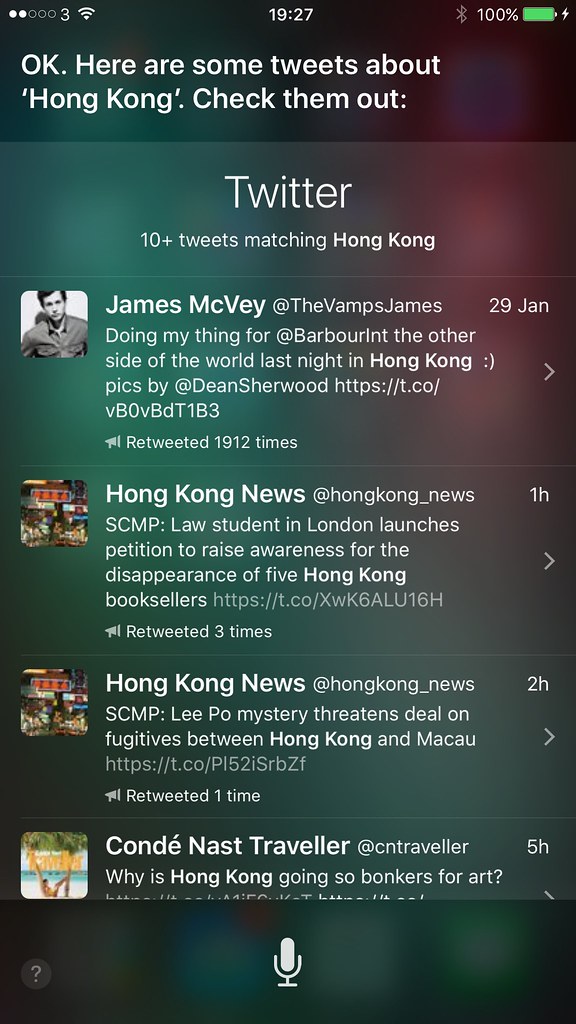
    Twitter data has its use beyond market research. It is the source of breaking news for the western media. Twitter’s firehouse also goes into making smarter phones. Apple’s Siri sources Twitter content to answer news-related requests.
    Siri using Twitter as news
    A poor performing Twitter has implications across the tech sector beyond online advertising. There are no obvious substitute solutions for its data waiting in the wings.

    Perhaps Twitter’s earning’s call on February 10 will give a hint of improvements at the company. But I wouldn’t bet on it. More related content here.

    More information

    Twitter Inc. quarterly results
    How Facebook Squashed Twitter – Stratechery by Ben Thompson
    Can Twitter turn stagnation into progress, or has it hit the wall? | Technology | The Guardian
    Twitter’s Fiscal 2015: Up, Flat, And Down | TechCrunch
    Twitter is teetering because it has turned into one big pyramid scheme | Andrew Smith
    Twitter Might Ditch The 140-Character Limit: What This Means For Marketers | SocialTimes
    Daily Report: The Tough Realities of a Twitter Turnaround – NYTimes.com
    Next Twitter boss faces complex challenges, says departing Dick Costolo | The Guardian
    Twitter data show that a few powerful users can control the conversation – Quartz
    Twitter’s Jakarta office is now open. Here are 6 reasons why Costolo is focusing on Indonesia | Techinasia
    Inside Twitter’s plan to fix itself
    How efficient is Twitter’s Business Model?
    Black Widow | Dustin Curtis – interesting analysis of Twitter and a warning about APIs

  • Yahoo! – how did we get here?

    Understanding who Yahoo! is today means understanding changes in the technology and media sectors. These changes occurred over the past 20 years.
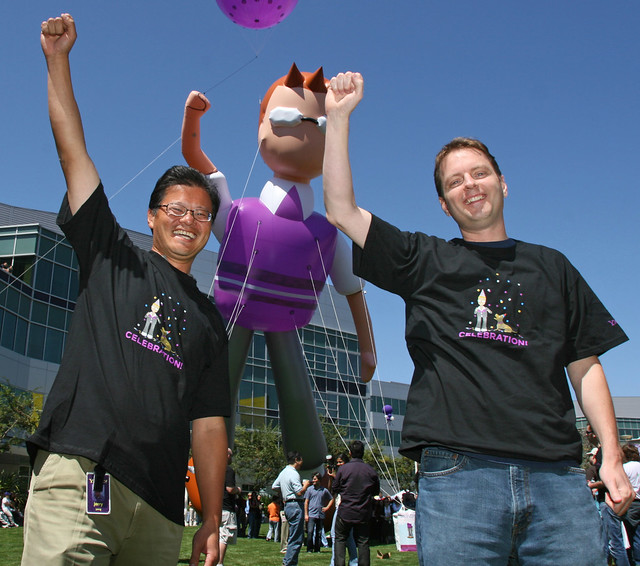
    Jerry, Liam & David celebrate the new Yahoo! Mail

    The Fear

    Yahoo! started off as a hack. The directory grew from a list of sites catalogued by Jerry Yang and David Filo. They did this as students in Stanford. This was back in the early 1990s, Microsoft was the dominant technology company. It is hard to understand the power that Microsoft had at the time. Apple was on a fast track to oblivion. This power was later clipped in the Judge Jackson trial of 2000.

    The Media Company

    At the time, investors and founders were reluctant to go into business against Microsoft. Even the idea that Microsoft may enter a sector was enough for others to stay clear.

    The technology sector was full of casualties: Digital Research, Borland, Go and Stac Technologies. Microsoft’s approach to competition of embrace, extend and extinguish was already well known.

    Yang and Filo would have had this in mind when they positioned Yahoo! as a media company that happened to be online. Yahoo!’s early business deals such as Yahoo! Internet Life magazine and display advertising are symptomatic of this media thinking.

    The advertising display model that Yahoo! operated was reminiscent of print magazine and newspaper businesses. It even went ahead and hired a traditional media sector CEO in 2001. Terry Semel was a former chairman of Warner Brothers. He was brought in following a 30% collapse in online advertising sales. Semel’s efforts to build a media business at Yahoo! didn’t succeed.

    The Technology Company

    Yahoo! has a history of contributing to key open source technologies including:

    • Debian Project
    • PHP
    • Hadoop
    • Oozie

    The work done on Hadoop lead to a spinout technology company called Hortonworks. Hortonworks customers include eBay, Spotify and Expedia. Not bad for ‘media company’.

    Panama, was to drive quality and profit in advertising by increasing click through rates. Yet it took too long to develop, many other projects ended up being canceled.

    Despite of the technical expertise at Yahoo!. The company bought in many key technologies rather than building themselves. Yahoo! Mail came from acquiring the 411.com directory service which owned Rocketmail in 1997. The modern mail web application has its roots in Oddpost, acquired in 2004.

    Failure To Make Big Bets

    Yahoo! bought video and audio streaming company broadcast.com in 1999 for $5.7 billion. This was the most expensive thing Yahoo! every bought. By comparison Tumblr cost $1.1 billion dollars in 2013. Yahoo! ended up with little to show for it’s $5.7 billion. This meant that Yahoo! developed a culture which made it hard to make big bet the farm kind of changes.  Terry Semel rejected the opportunity to buy Google in 2002 for $5 billion. It also failed to buy DoubleClick. Google bought it instead, and used DoubleClick to speed up growth beyond search advertising.

    A secondary effect of not being able to make big bets was a constantly changing set of priorities. Insiders have gone on record talking about the missed changes with aborted projects. This also made it harder to develop and pursue a vision.

    The Google comparison

    Google started some five years later. Google came into a world where Microsoft looked weaker. The US government filed charges against the company and Linux started to gain momentum. Google’s original business model was to be a search engine provider for web portals. There were other competitors in this space like Inktomi. It wasn’t until 1999 that the company started selling its own advertising. Google waited six years to go public. The size and profitability of its business masked from competitors and customers until 2004.

    Google hasn’t been afraid to make big bets or have a big vision:

    • Search
    • Enterprise search
    • Personal productivity
    • Enterprise productivity
    • Mobile operating system

    It has thought carefully about focus and vision – which is part of the reason why the Alphabet conglomerate was formed.

    More information

    New Panama Ranking System For Yahoo Ads Launches Today | Search Engine Land
    A Cyber-Arsenal for Road Warriors | BusinessWeek
    Reflecting on Yahoo!’s Q2 2015 progress report on product prioritisation
    The Yahoo! Post-Bartz post and the perils of Microsoft Excel
    Inflection Point | renaissance chambara

  • Topless model + more things

    Twist ending of moving company’s sexy topless model ad has a silver lining 【Video】 | RocketNews24 – one of the better 15 second spots I’ve seen involving a sexy topless model. This is one of the few times that you will see the words sexy topless model in one of my posts.

    IBM, Ustream-BM, we can’t believe Ustream is now owned by IBM • The Register – this feels a bit Yahoo!-esque as a deal. U-stream is a solid video streaming platform and I am not convinced IBM is a good custodian

    25% of US companies in China are planning to leave, says AmCham survey – this is interesting as the Chinese government is trying to jump start domestic consumption. The argument China would make is that these people will lose out. However, the wider tonality of the government towards foreigners and western culture in general. There is a stronger tone of Han nationalism. More China related posts here.

    Weibo to copy Twitter, abolish 140-character limitw – Tech in Asia – paid up members are a relatively small group of influencers, celebrities and brands. Chinese people have been doing long Weibo posts for years as graphic files. It was a central part of the content strategy that we were doing for CIVB when I led a digital team in Hong Kong.

    Why Google Quit China—and Why It’s Heading Back | The Atlantic – interesting that Western European government intervention is cited as a justification in this.

    Music Geeks Are Retrofitting Old iPods to Keep the Perfect MP3 Player Alive | Motherboard – its the iPod I wished Apple made. I have got a couple of them from eBay.  It would be great if we could also have an LTE compatiable version of the Nokia 6310i to use as a modem for my laptop and as as an app free weekend phone.