Category: technology | 技術 | 기술 | テクノロジー

It’s hard to explain to someone who didn’t live through it how transformation technology has been. When I was a child a computer was something mysterious. My Dad has managed to work his way up from the shop floor of the shipyard where he worked and into the planning office.

One evening he broad home some computer paper. I was fascinated by the the way the paper hinged on perforations and had tear off side edges that allowed it to be pulled through the printer with plastic sprockets connecting through holes in the paper.

My Dad used to compile and print off work orders using an ICL mainframe computer that was timeshared by all the shipyards that were part of British Shipbuilders.

I used the paper for years for notes and my childhood drawings. It didn’t make me a computer whiz. I never had a computer when I was at school. My school didn’t have a computer lab. I got to use Windows machines a few times in a regional computer labs. I still use what I learned in Excel spreadsheets now.

My experience with computers started with work and eventually bought my own secondhand Mac. Cut and paste completely changed the way I wrote. I got to use internal email working for Corning and internet connectivity when I went to university. One of my friends had a CompuServe account and I was there when he first met his Mexican wife on an online chatroom, years before Tinder.

Leaving college I set up a Yahoo! email address. I only needed to check my email address once a week, which was fortunate as internet access was expensive. I used to go to Liverpool’s cyber cafe with a friend every Saturday and showed him how to use the internet. I would bring any messages that I needed to send pre-written on a floppy disk that also held my CV.

That is a world away from the technology we enjoy now, where we are enveloped by smartphones and constant connectivity. In some ways the rate of change feels as if it has slowed down compared to the last few decades.

  • Fallacies and more things

    Departing the wheat from the chaff: identifying fallacies in the pharmaceutical promotion – Shaughnessy, Slawson & Bennett – different logical fallacies deployed in promotional activities (PDF)

    Why Armstrong Really Wanted Yahoo — The Information – interesting play but not sure that it will be successful (paywall)

    Money as Message – Andreessen Horowitz – Connie Chan’s 101 on WeChat wallet is up there with her other WeChat posts. More on WeChat here

    Three Proposes Protection in UK Spectrum Auction | CCS Insight – I would put good money on it that Three loses this fight as well as an ‘invisible hand’ continues to move against the CK Hutchison Group as a whole

    How Putin Weaponized Wikileaks to Influence the Election of an American President – Defense One – where is the evidence that they can leave this at the door of the Russians. Also ‘weaponising Wikileaks’ is a great message to put out there prior to shutting down Wikileaks. It will be more interesting seeing what the FBI investigation comes up with

    Neil Young’s PonoMusic Store Goes Offline as It Switches Content Providers – interesting that the UK music technology start-up scene seems to be imploding on itself (Crowdmix, Omnifone) and that Neil Young’s PonoMusic was taking so much time to get on 7Digital’s HD music offering?

    Superbook turns your phone into a laptop for $99 | Techinasia – reminds me of the Palm Foleo companion laptop device that was previewed but never launched

    GitHub – nerevu/riko: A python stream processing engine modeled after Yahoo! Pipes – interesting tool, BTW who said that RSS is dead?

    Decacorns continue to get funding while the rest of the startup investing declines | TechCrunch – funding skewing towards really big funding projects concealing overall drop in funding

    Microsoft debuts Bookings, a new Office 365 service for online appointment scheduling | TechCrunch – is it just me or is Microsoft throwing out a lot of services that overlap with its core offering and it feels a bit confusing?

    US Congress – Committee on Energy and Commerce – letter to Niantic re Pokemon Go – concerns that consumers understand potential impact on their mobile data allowance (PDF)

    Pokémon Go will launch in Japan tomorrow with game’s first sponsored location | TechCrunch – McDonalds coming in with a sponsorship deal for Pokemon gyms

    China appliance makers share SoftBank dream | FT – many expect SoftBank to sell ARM on after a decent waiting time to companies like these (paywall)

  • Lord Puttnam + more news

    How much TV money goes to footballers? Lord Puttnam attacks hike in sports rights costs | Radio Times – what a depressing thought. More on media related topics here but not necessarily more Lord Puttnam.

    ‘Conflicted’ media auditors come under fire from Sorrell | Campaign – wider issue of trust between media buying and clients (reg wall)

    The next front in the patent wars? Chinese telecom giant Huawei sues T-Mobile for patent infringment – how to make friends and influence people

    This photo from a Huawei camera phone ad was actually shot with a $4,500 Canon camera | Shanghaist – Huawei gets called out, Nokia had been caught doing this in the past as well.

    Twitter estimates that it has 10 million users in China | TechCrunch – how many of these are ’50 cent’ propagandist accounts?

    Vice Media buys Dasha Zhukova’s Garage art magazine – FT.com – paywall

    Applying ML to InfoSec — Startup.ML Conf – ML (machine learning)

    New Cars Are Too Expensive For The Typical Family, Says Study | Slashdot – more data on the decline of the US middle class

    Top Korean carrier launches cut-rate internet of things network | HKEJ Insight – interesting move by SK Telecom

    Martha Lane Fox: Brexit is all about MEEEEeeee! • The Register – It’s almost as if the Establishment is so loath to address the real issues raised by people on “those horrible council estates” it’s created a virtualisation container for the working class instead

    Ask.fm changes hands once again – BBC News – too hot to handle? Reminds me of the debacle about trying to take FriendFinder public a decade ago

    Snapchat’s Teen Fans Wince as App Catches On With Their Folks – WSJ – the Snapchat is fucked moment, parents are venturing on there, partly to stalk their kids, partly for Sky Sports coverage

    All news stories must be verified, China’s internet censor decrees as it tightens grip on online media | South China Morning Post – yes I know its China, but on one level does this sound very sensible in what is likely to be a vacuum of journalistic ethics

  • LBOs in Silicon Valley

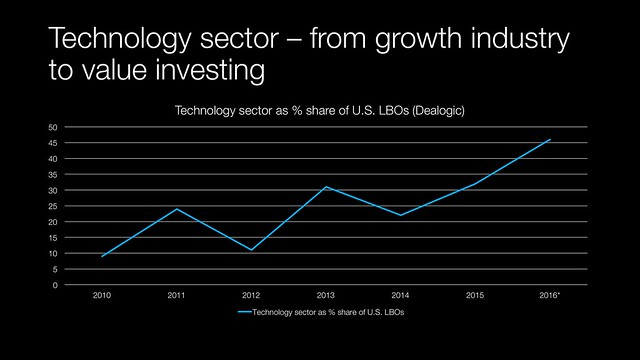
    With the rise of technology sector LBOs it makes sense to reflect on the Silicon Valley use of stock options and going public. In the past the Silicon Valley stock market dream was relatively simple. Hard graft with a possibility of a reward in terms of a stock market listing or a buyout by a larger technology company eager for the new, new thing.

    Now things are different, businesses like Google, Uber and Facebook held out for as long as possible to go public. Technology companies from Apple to Zynga have been punished repeatedly in the market for real and perceived mis-steps. Activist investors charge around Silicon Valley in a similar manner to the way they bullied the S&P index in the 1980s.
    160704 - private equity & the tech sector
    Now technology companies are making up almost half of private equity LBOs. An LBO is a leveraged buy out; its where a prospective owner uses a mix of loans and their own money to purchase a company. The company usually has a steady cash flow that is used to pay down the loans and associated interest. These businesses are generally discounted because they are no longer perceived as being high growth companies.

    The private equity owner looks to either flip the company to another purchaser, or flip parts of the company to pay down the loan. Either flipping or piecemeal sales are designed to raise more value than the original price paid.

    Since these businesses are servicing large amounts of debt, they are vulnerable to fluctuations in their business conditions or interest rate rises. For example, Irish telecoms network Eircom defaulted on corporate bonds in 2012, having been through a couple of LBOs in the previous decade.

    There always has been some LBOs in the Valley, Computer Associates bought up rivals and ran them as part of a conglomerate, with a focus on maximising the business cash flow rather than market share growth. General Atlantic Partners and Cerebus Capital Management had specialised for a long time in LBOs of mature ‘also ran’ business software companies with regular support customer support contracts. But the recent growth in LBOs is unprecedented for the technology sector. More on Silicon Valley here.

    *January, 1 2016 – July 1, 2016.

    More information
    Private Equity Has a Crush on Tech | WSJ – paywall
    What are the major reasons behind Yahoo’s drastic downfall?
    Barbarians in the valley

  • WWDC 2016 – what did it all mean?

    I watched the few hours of keynotes at Apple’s WWDC 2016 (Worldwide Developers Conference). I also read some of the resulting analysis and wondered if we’d been watching the same event.
    Cómo ver la WWDC 2016 en vivo en iPhone, iPad, Mac, Apple TV
    So thought I would think about the event carefully and come up on my take of what it all meant. This is a bit later than I originally planned to publish it.

    Firstly, there was no change in direction for Apple from a strategic point-of-view. Apple has been clear about its direction, it is the ‘how’ which is the mystery. WWDC 2016 was a major unveiling of ‘the how’.

    Over the past few years, Apple has focused on the integration of its devices. The reason why there isn’t one OS*, a la Windows 10, is that the different form factors have different contexts. Cross-pollination of services only takes place where it makes sense, which is why Siri has taken a while to roll out.

    The first big thing is APFS – a new file system for all of Apple’s devices. This builds on upon the feature set of ZFS which was a file system developed by Sun Microsystems for its Solaris UNIX operating system. Apple had experimented with implementing ZFS in OSX Leopard, but then didn’t follow through. Solaris runs on large enterprise computers where the prevention of data corruption and handling a large amount of file changes simultaneously is very important. Like ZFS, APFS supports encryption, granular time stamping, fast file management and has improvements in data integrity. When it’s fully finished it should make encryption on devices easier to manage and provide the user with more control. It should also help with syncing data across devices and the cloud.

    The interesting thing is how this technology will scale over time handling multiple devices and form factors working seamlessly from a common database. Like many of there other technologies this is an extension of Apple’s Continuity offering and future integration with a wider IoT offering.

    When Steve Jobs launched Mac OSX 10.0 in 2001 he described it as being the OS for the next 15 years. At the time the original MacOS was showing its limits. The UI was colour but hadn’t really moved on that much since System 7.5. The operating system wasn’t multi-tasking. The internet felt kludgy even though it performed well on the hardware at that time. Looking at OSX / macOS now, the operating system it feels fresh. The tweaks and changes under the hood keep the performance hub and the features comparable with the rest of the Continuity eco-system. macOS also doesn’t seem to be seriously threatened by iOS ‘pro’ devices.

    iOS 10 was important to me for its embrace of messenger-as-a-platform. Apple innovates within its own Messages apps with some UI gimmicks. More importantly, notification real estate that was once the exclusive preserve of the Apple dialer. This allows you to accept calls from the likes of Skype, WeChat or Slack from the lock screen. This follows Apple’s model of using it’s own apps to work things out and then open up the function once it is mature. Apple’s own Messages app includes a number of features including:

    • Simple chat bot-like functionality
    • Swipe to read on messages to prevent shoulder surfers from reading messages
    • Messages app takeover emotions
    • More emoji / sticker like icons

    Apple Pay roll-out – continued geographic roll-out makes sense. Apple Pay isn’t about building a rival payment system a la PayPal. Instead, Apple is trying to build more touch points with the user. The level of usage doesn’t matter too much from that perspective. Geographic roll-out to Hong Kong and more European countries makes sense. The more exciting development is two-factor authentication for e-commerce payments on compatible sites using the Apple Pay infrastructure. This is big for shopping on both Mac and iOS-powered devices.

    Thinking differently about intelligence. Unless you have been living under tech industry equivalent of a stone, you’ll be aware of cloud companies like Microsoft, Amazon, Google or Baidu using artificial intelligence techniques to drive device function. Apple hadn’t been as visible in this space up to WWDC. The reason for this is due their rigorous approach to user and device privacy.  There were two approaches to this:

    Having the mobile devices GPU to perform relatively simple neural-network computing. This can learn user preferences or intent over time and be more helpful

    Making Siri more intelligent by looking at the behaviour of users encrypted, salted with false data and aggregated up. Differential Security is the process of acquiring this data. In the second world war, the Allies cracked the cryptography derived from the Enigma machine. But that was only the first part of the challenge. In order for it to be useful the Enigma team used statistics to hide any usage of the intelligence hiding reactive activity in the midsts of statistically expected ‘normal’ behaviour.

    Differential security is kind of similar to this. All the data is encrypted, the phone sends a mix of false data and real data. When Apple looks at aggregated data they can see the false data as being false, but can’t tell which users data is false at a given time.

    Apple’s WatchOS 3 is interesting because of the performance boost it gives the wearable. The difference is really noticeable. The boost in performance is due to Apple having more memory to use than it had originally allowed for. This provides a more refined experience. Much of the UX enhancements were focused on fitness.

    From a developer perspective there were a few things missing:

    • Apple had no new pro-level hardware announcements
    • Apple later walked away from Thunderbolt displays, saying that 3rd parties were now making great displays. This reminded me of when Apple stopped making printers, it felt permanent, though there is a lot of speculation about a forthcoming Apple 5K display – we’ll see
    • Apple still needs to do more work on integrating its Swift programming language throughout its OS’
    • Given Twitter’s peak in growth, Apple didn’t show how Siri would cope in a post-Twitter world

    Finally the two-hour keynote was a love letter to China. At every opportunity Tim Cook mentioned the Chinese market, support for China-specific items like language and called out Chinese apps like WeChat.

    * From a technical point-of-view; tvOS, iOS, and macOS all share underpinnings based on NetBSD and a Mach micro-kernel.

    More information
    Apple Pay supporting banks | Apple Support Documents
    Apple finally opens Siri to third-party developers | TechCrunch
    Apple rolls out privacy-sensitive artificial intelligence | MIT Technology Review
    What is Differential Privacy? A Few Thoughts on Cryptographic Engineering
    Digging into the dev documentation for APFS, Apple’s new file system | Ars Technica
    Apple File System Guide | Apple Developer documentation
    Mac & iOS Continuity | Apple

    More articles on Apple WWDC through the years here.
  • Throwback gadget: SnapperMail

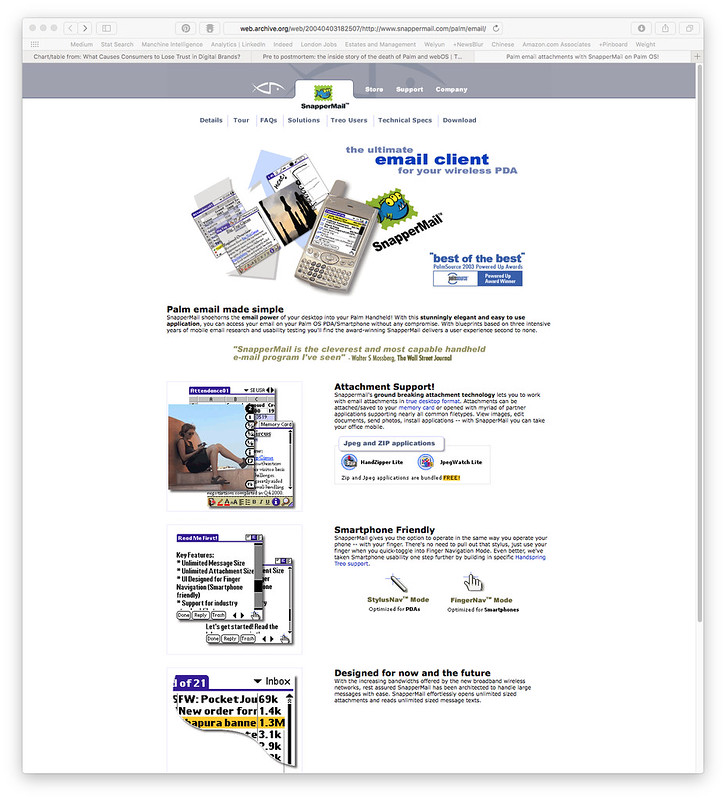
    Thinking about SnapperMail takes me back to end of 2001, I started to prepare for leaving my job at Edelman. This meant upgrading my home IT set up. I picked up an iBook. The iBook was Apple’s consumer-orientated laptop made from 1999 to 2006. Mine was a second generation ‘Snow’ laptop with a G3 processor, dual USB sockets and a combo drive which allowed me to watch DVDs and burn CDs.

    I used the move to go on the first version of OSX. The move also meant that I got a new email account, my default account to date. It had two key attributes:

    • No adverts, so it looked professional in comparison to having a Yahoo! or Hotmail email address and it wasn’t tied to an ISP.
    • IMAP support which allowed me to use my email account across different devices that syncs across the devices. POP3 downloads the  emails from the server to the device, so is ideal only for when you are accessing email from one machine

    My iBook was my only source of email access whilst I left Edelman, freelanced, and then eventually joined Pirate Communications. My first smartphone was a Nokia 6600, which I used alongside a Palm  PDA – l got this sometime around the end of 2003. The 6600 supported IMAP out of the gate, it was slow, but I was connected.

    The 6600 was eclipsed by Palm’s Treo devices which were a better device. I moved from the 6600 and a Palm Tungsten T3 combo to a Treo 600 smartphone in January 2005.

    The process wasn’t smooth. The Treo was sufficiently fragile that I got a translucent silicon jacket that worked surprisingly well with the keyboard and screen protector to look after the touchscreen. Software wise the Treo 600 was a step back from the Tungsten T3 PDA. The screen was smaller and the software felt sluggish in comparison. I had deliberately chosen the 600 over the 650 because I had previously worked agency side on the Palm account and been a long-suffering device owner so knew how crap they were at bug fixes on new devices. The media didn’t call the former Palm CEO ‘Mad’ Bill Maggs for no reason (just sayin’).
    snapperfish limited
    Unfortunately Palm had not been as progressive in comparison to Nokia with its default email client. The software didn’t support IMAP. Fortunately I used to follow Mitch Kapor’s blog and he had recommended SnapperMail: an app from a small New Zealand company SnapperFish.

    SnapperMail was a compact modern email client. It has a number of features that we would expect now:

    • It supported IMAP
    • It supported SSL client to mail box encryption*
    • it was really easy to use
    • You could work with attachments including zipped files**
    • There was no restriction on the file size of attachments, the only restriction was your email account rather than your email client

    This looks like the kind of technology you would have thought Palm should have done. At the this time Palm were competing against Microsoft Windows Mobile 2003, BlackBerry 6200 series, 7100 series and early 8700 series. Yet the default email client was back in the 1990s.

    *The full-fat application cost US$39.99

    **SnapperMail came bundled with HandZipper Lite which handled the compressed files and JPEGWatch Lite image viewer

    I used this alongside MetrO – a public transit directions app and QuickOffice Pro – to read Office documents as part of my modern smartphone experience. It wasn’t just me that loved SnapperMail, it was praised by Walt Mossberg back when he wrote at the Wall Street Journal.

    SnapperMail won two Palm Source (Palm’s software licence business) Powered Up awards in 2003. It was recognised as Best Productivity and Best of the Best Solution. More on Palm here

    More information
    SnapperMail Has Solid Software For Savvy Mobile E-Mail Users | WSJ
    QuickOffice
    MetrO – open source mass transit application
    PalmSource Welcomes Developers with Awards, New Tools; Announces New Licensees | PalmSource press room