Ni hao – this category features any blog posts that relate to the People’s Republic of China, the Chinese communist party, Chinese citizens, consumer behaviour, business, and Chinese business abroad.
It is likely the post will also in other categories too. For example a post about Tong Ren Tang might end up in the business section as well. Inevitably everything is inherently political in nature. At the moment, I don’t take suggestions for subject areas or comments on content for this category, it just isn’t worth the hassle.
Why have posts on China? I have been involved in projects there and had Chinese clients. China has some interesting things happening in art, advertising, architecture, design and manufacturing. I have managed to experience some great and not so great aspects of the country and its businesses.
Opinions have been managed by the omnipresent party and this has affected consumer behaviour. Lotte was boycotted and harassed out of the country. Toyota and Honda cars occasionally go through damage by consumer action during particularly high tensions with Japan.
I put stuff here to allow readers to make up their own minds about the PRC. The size of the place makes things complicated and the only constants are change, death, taxes and the party. Things get even more complicated on the global stage.
The unique nature of the Chinese internet and sheltered business sectors means that interesting Galapagos syndrome type things happen.
I have separate sections for Taiwan and Hong Kong, for posts that are specific to them.
Zynternet is a portmanteau made up of Zyn and internet. If you’re reading this internet is self-explanatory, the Zyn in question is tabacco-free Skoal bandit type nicotine pouches. Zyn comes in a tin and has various flavours.
According to journalist Max Read, the Zynternet is a kind of 90s to early 2000s sports obsessed ‘lad’ type culture; but in the 2020s. There are shades of ‘white van man’ in there as well.
a broad community of fratty, horndog, boorishly provocative 20- and sometimes (embarrassingly) 30-somethings–mostly but by no means entirely male–has emerged to form a newly prominent online subculture.
Despite Read’s definition defining it as a 20 to 30-something thing, the subculture seems to bleed into 40-something Dads and draws on creators like Barstool Sports. They’re less extreme than the Andrew Tate acolytes. They care more about sports and professional golf than they do about current affairs and politics. But they’ll be voting Republican. They like college sports, sports betting, light beers and Zyn nicotine pouches.
The culture has grown prominent on the laissez-faire Musk era Twitter.
Zynternet stretch
It would be very easy to point to the Zynternet audience and draw parallels to the ‘proles’ of George Orwell’s Nineteen Eighty Four. And then go down a dystopian k-hole.
I’ll leave the last words to David Ogilvy for those despairing about the Zynternet:
You aren’t advertising to a standing army; you are advertising to a moving parade. Three million consumers get married every year. The advertisement which sold a refrigerator to those who got married last year will probably be just as successful with those who’ll get married next year. An advertisement is just like a radar sweep, constantly hunting new prospects as they come into the market. Get a good radar and keep it sweeping.
David Ogilvy
TL;DR if you’re not reaching the zynternet, you’re probably not doing political marketing properly. More related content here.
Content or couture? Balenciaga’s 30-minute dress becomes the flashpoint of the season | Vogue Business – “It feels a little like a fast fashion iteration of haute couture,” says Victoria Moss, fashion director of The Standard, of the swirling mass of black nylon. “This feels at odds with what fashion at this level should be, which is exquisitely made pieces that somewhat justify their extreme pricing.” She adds that many invest in couture to have garments perfectly fitted to their bodies — and made to last for years.
“Is it beautiful? That’s debatable. Is it impressive? Not really. Is it brazen? Absolutely. Is it a meditation on the creative process? Maybe. Are we bored of these kinds of gimmicks at Balenciaga? Clearly not, as Demna’s work continues to be both a lightning rod and a conversation starter. “Call it ‘pret-a-polarize’,” says fashion journalist and ‘Newfash’ podcast host Mosha Lundström. “To my eye and understanding, I see this look as content rather than couture.”
Japan declares victory in effort to end government use of floppy disks | Reuters – yes stories like this are funny because ‘modern’ Japan with its flip phones, fax machines and floppy discs are an anachronism. But there’s a few other things to consider. There might be issues in terms of investment a la the NHS and critical systems that for whatever reason can’t be ported on to modern systems (like the problems had with security based on ActiveX).
Dumb systems also have security benefits, you can’t steal nearly as much data on even a compressed floppy disk as you can on a USB stick.
Interesting use cases for generative AI in China which sounds like a plot line from Ghost In The Shell.
Baidu – World No. 1? – Radio Free Mobile – is Baidu ERNIE really the number one generative AI service? It depends on if the numbers are true. 14 million developers, 950,000 models within the eco-system
China plays down importance of lithography tools in semiconductor challenges – Interesting report from Taiwan’s DigiTimes semiconductor trade magazine: China seems to be deliberately playing down the importance of lithography tools as it identifies the challenges for the development of its semiconductor industry in a recently published dossier.
The IT director is seeing a return to power and its thanks to the power of hackers and AI. The smartphone, the resurgence of Apple and SaaS saw IT decisions become more organic thanks to increased access to online services that provided better features than traditional enterprise software companies and the rise of knowledge working. IT teams found management of mobile devices onerous and faced hostile users.
Michiko Fukahori of the Japanese National Institute of Information and Communications Technology at ITU TSB – 8th Chief Technology Officers (CTO) Meeting
This meant that the IT director became less important in software marketing. A decade ago marketing had pivoted to a bottom up approach of ‘land and expand’. This drove the sales of Slack, Monday.com and MongoDB.
Two things impacted this bottom up approach to enterprise innovation:
Cybercrime: ransomware and supply chain attacks. Both are not new, ransomware can be traced back to 1989, with malware known as the AIDS trojan (this had much cultural resonance back then as a name). Supply chain attacks started happening in the 2010s with the Target data breach and by 2011, US politicians were considering it a security issue. Over COVID with the rise of remote working, the attacks increased. The risk put the IT director back in the firing line.
AI governance: generative AI systems learn from their training models and from user inputs, this led to a wide range of concerns from company intellectual property leaving via the AI system, or AI outputs based on intellectual property theft.
The most immediate impact of this is that the IT director is becoming a prized target on more technology marketers agendas again. This takes IT director focused marketing from back in the 1980s and the early 2000s with a top-down c-suite focus including the IT director. This implies that established brands like Microsoft and IBM will do better than buzzier startups. It also means I am less likely to see adverts for Monday.com in my YouTube feed over time.
This doesn’t mean that the IT director won’t be disrupted in other parts of his role as machine learning facilitates process automation in ways that are continuing to evolve.
Brands plan for a quiet Pride Month | News | Campaign Asia – The hesitation around Pride may also be related to executives’ increasing reluctance to speak out on social issues more broadly. Wolff pointed to Edelman’s Trust Barometer, which found that 87% of executives think taking a public stance on a social issue is riskier than staying silent. “Essentially, nine out of every 10 executives believe that the return on investment for their careers is not worth the support during this turbulent time,” said (Kate) Wolff. “This is clearly problematic for both the community and the progress we have made in recent years.”
Chinese Firms Are Investing Heavily in Whisky Market | Yicai Global – Although international liquor giants have developed the local whisky consumption market for many years, the market penetration rate of overseas spirits in China, including whisky, is only about 3 percent. This means domestic whisky producers will need to develop new consumption scenarios, Yang said. Whisky consumption in China centers mainly around nightclubs, gift-giving and tasting events held by affluent consumers, Yang noted, but in these scenarios, imported whisky brands with a long history tend to be more popularly accepted,, so it will be difficult for domestic rivals to compete. According to the latest report from alcohol market analysts IWSR, China’s whisky market was worth CNY5.5 billion (USD758 million) last year, having grown more than fourfold over the past 10 years. It is expected to reach CNY50 billion (USD6.9 billion) in the next five to 10 years.
Yoox Net-a-Porter exits China to focus on more profitable markets – Multi-brand luxury clothing sales platform Yoox Net-a-Porter is closing its China operations, this against a backdrop of other brands also pulling out of Chinese e-commerce including Marc Jacobs fragrances. The corporate line from Richemont was “in the context of a global Yoox Net-a-Porter plan aimed at focusing investments and resources on its core and more profitable geographies”.
Ignite the Scent: The Effectiveness of Implied Explosion in Perfume Ads | the Journal of Advertising Research – Scent is an important product attribute and an integral component of the consumption experience as consumers often want to perceive a product’s smell to make a well-informed purchase decision. It is difficult, however, to communicate the properties of a scent without the physical presence of odorants. Through five experiments conducted in a perfume-advertising context, our research shows that implied explosion, whether visually (e.g., a spritz blast) or semantically created, can increase perceived scent intensity, subsequently enhancing perceived scent persistence. It also found a positive effect of perceived scent persistence on purchase intention. In conclusion, the research suggests that implied explosion can be a powerful tool for advertisers to enhance scent perception, consequently boosting purchase intention.
Mat Baxter’s Huge turnaround job | Contagious – interesting perspective on his time at Huge. What I can’t square it all with is what we know about marketing science and declining effectiveness across digital media
On my LinkedIn, I couldn’t escape from the Cannes festival of advertising. Partly because one of the projects I had been involved in was a shortlisted entry. One of the most prominent films was Dramamine’s ‘The Last Barf Bag: A Tribute to a Cultural Icon’. It was notable because of its humour, which was part of this years theme across categories.
震災復興から生まれた刺し子プロジェクトをブランドに! 15人のお母さんの挑戦! – CAMPFIRE (キャンプファイヤー) – ancient Japanese craft – KUON and Sashiko Gals are part of a new generation of designers keeping the traditional Japanese technique of sashiko alive. And together, they are bringing the decorative style of stitching to our favorite sneakers (including techy Salomons!). Sashiko is a type of simple running stitch used in Japan for over a thousand years to reinforce fabrics. It’s typically done with a thick white thread on indigo fabric and made into intricate patterns.
Nationalism in Online Games During War by Eren Bilen, Nino Doghonadze, Robizon Khubulashvili, David Smerdon :: SSRN – We investigate how international conflicts impact the behavior of hostile nationals in online games. Utilizing data from the largest online chess platform, where players can see their opponents’ country flags, we observed behavioral responses based on the opponents’ nationality. Specifically, there is a notable decrease in the share of games played against hostile nationals, indicating a reluctance to engage. Additionally, players show different strategic adjustments: they opt for safer opening moves and exhibit higher persistence in games, evidenced by longer game durations and fewer resignations. This study provides unique insights into the impact of geopolitical conflicts on strategic interactions in an online setting, offering contributions to further understanding human behavior during international conflicts.
The West Coast’s Fanciest Stolen Bikes Are Getting Trafficked by One Mastermind in Jalisco, Mexico | WIRED – “Not so long ago, bike theft was a crime of opportunity—a snatch-and-grab, or someone applying a screwdriver to a flimsy lock. Those quaint days are over. Thieves now are more talented and brazen and prolific. They wield portable angle grinders and high-powered cordless screwdrivers. They scope neighborhoods in trucks equipped with ladders, to pluck fine bikes from second-story balconies. They’ll use your Strava feed to shadow you and your nice bike back to your home.” – not terribly surprising, you’ve seen the professionalisation and industrialisation in theft across sectors from shoplifting, car theft and watch thefts so this is continuing the trend.
OpenAI Just Gave Away the Entire Game – The Atlantic – The Scarlett Johansson debacle is a microcosm of AI’s raw deal: It’s happening, and you can’t stop it. This is important not from a technology point of view, but from the mindset of systemic sociopathy that now pervades Silicon Valley.
Apple Intelligence is Right On Time – Stratechery by Ben Thompson – Apple’s orientation towards prioritizing users over developers aligns nicely with its brand promise of privacy and security: Apple would prefer to deliver new features in an integrated fashion as a matter of course; making AI not just compelling but societally acceptable may require exactly that, which means that Apple is arriving on the AI scene just in time.
‘Rare, vintage, Y2K’: Online thrifters are flipping fast fashion. How long can it last? | Vogue Business – as secondhand shopping becomes increasingly commonplace, this latest outburst brings to light the subjectivity of resale. What determines an item’s worth, especially in an age of viral micro-trends and heavy nostalgia? Is it ethically moral to set an item that’s the product of fast fashion — long criticised for not paying workers fairly — at such a steep upcharge, and making profit from it? If someone is willing to pay, does any of it matter?
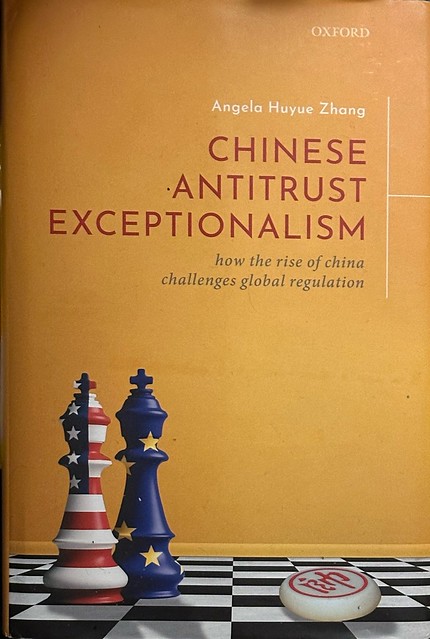
Chinese Antitrust Exceptionalism by Angela Zhang sounds exceptionally dry to the uninitiated. Zhang is a senior legal academic who works at the University of Hong Kong, which until recently got a front row seat to China disputes with both the European Union and the United States. Given the recent changes in Hong Kong where she lives, we may not see as frank a book of its quality come out of Hong Kong academia again on this subject matter if it was viewed to fall under the purview of ‘state secrets’. With the new security law that has come in, definitions have been left deliberately vague and wide-reaching.
So why is Chinese Antitrust Exceptionalism of interest?
If like me, you’ve worked on brands like Qualcomm, Huawei or GSK you realise how much of an impact China’s regulatory environment can have on your client’s success. Around the time I worked on one client, they were shamed on the evening TV news and some of their staff disappeared for questioning by the authorities. They then reappeared months later looking haggard and worn out. It is new important for everything from technology to the millions of COVID deaths that happened in China due to a lack of effective vaccines.
Zhang breaks down the history of China’s antitrust regulatory environment, how it works within China’s power structures and how it differs from the US model. The rise of antitrust was as much down to bureaucratic politics of the Chinese government.
What becomes apparent is that Chinese power isn’t monolithic and that China is weaponising antitrust legislation for strategic and policy goals rather than consumer benefit.
Zhang talks about how regulatory hostage taking and public shaming was a tool of the regulatory authorities from early on.
The book then looks at foreign reactions to Chinese government from EU investigations to current US-China trade restrictions and discusses how China weaponised its regulatory frameworks making ‘hostage taking’ trans-national in nature.
Last of it’s type?
Zhang’s book won awards when it first came out in 2021, and is still valuable now given the relatively static US-China policy views. More on Chinese Antitrust Exceptionalism here. More book reviews here.
Welcome to my March 2024 newsletter which marks my 8th issue.
I am glad that I have moved to the eighth issue. In between St Patrick’s day happening in March, and the number 8 being lucky according to the Chinese in a good place – I figure its a good omen for this issue. 8 symbolises prosperity, joy and infinity. In Chinese pricing strategy 8 holds a similar role to 9 in western markets, so $58, $88 and $688 are frequent pricing points.
St Patrick’s day is particularly lucky for one Chinese city above all others: Yiwu in Zhejiang province is often called Christmas town. In reality it’s a city selling ‘small commodities’ better known to you and I as tat. The Christmas town epitaph came from it being the centre for the global Christmas decorations trade. It’s also where most of the St Patricks Day decorations are made including the leprechaun hats popularised around the world by Irish pubs.
New reader?
If this is the first newsletter, welcome! You can find my regular writings here and more about me here.
Things I’ve written.
Razors for strategists – how we can apply the principle of philosophical razors to aid faster solutions for client work, while also bearing in mind their limitations.
AI two-step – corporate leaders reluctant to admit AI-related job losses.
Books that I have read.
A Hacker’s Mindby by veteran technologist Bruce Schneier provides a guide to the different way people have found loopholes to ‘hack’ systems. Schneier is trying to write a social movement book,, but while it’s interesting enough to read on a plan, it will be harder for it to get people moving as he intends.
I picked up this book from Scheltema book store just off Dam Square in Amsterdam during a work trip, with a bit of time-off bolted on the end. Browsing the English language book section of foreign book stores often gives recommendations that you wouldn’t otherwise look at. Tales from the Cafe: Before the Coffee Gets Cold is book two of a four-book series by Japanese author Toshikazu Kawaguchi is difficult to characterise in terms of genre. It’s a time travel novel with distinct rules that keep its universe coherent. It’s a book that is suitable for children, but not aimed at children- in this respect its more like the childhood books that I read growing up than are popular now as the ‘young adult’ genre. It’s about love lost, but not a romance novel – the love covered is a mix of loneliness of a widower, an orphaned child and a past romance. There is something delightful about the book, especially as it captures the minutae of everyday Japanese life.
Historian Dan Jones portrayal of medieval wars in his Essex Dogs series is very well written and accessible. It’s an ideal holiday read, if you can handle the grim subject matter. The Wolves of Winter is a richer story with greater intrigue in the plot line.
Back in the early 1990s chaos theory was very much in the public zeitgeist in a rather similar way to the internet from the late 1990s to early 2000s and artificial intelligence now. I have noticed mentions of chaos theory has started to pop up again as an idea in email newsletters. Fluke Chance, Chaos and Why Everything We Do Matters resurrects chaos theory as an analogy and hypothesis for everything from global politics to emotion-driven behaviours. The author Dr Brian Klaas is a social scentist by training and has taken a few leaves out of the Malcolm Gladwell school of writing with stories to pull in the audience. I would liked to see a bit more evidence-based findings in the book. But it is a good read.
Things I have been inspired by.
TheOrangeblowfish, a Shanghai design-led agency did an amazing retail / out of home activation for Arc’teryx museum on what looks like a 3D OOH execution a la Ocean Outdoor’s Deepscreen sites in the UK.
Oliver’s white paper on How Brands Can Build Customer Trust looks at how brands can communicate about sustainability in their marketing. It’s a nice first step as a discussion document. There are a few areas I would like them to explore further:
Tonality on sustainability communications is immensely important, given the rise of climate despair amongst some consumers.
The gains earned by behavioural science are argued about, with practitioners relying on models that are often seen as overly complex and stacking of marginal gains. It has footholds in trying to drive meaningful changes in health, where small gains on paper mean a big change in lives saved, or made better. This LSE discussion on how it can be used to make democracy work better was interesting, especially given how many elections will be taking place in 2024.
Finally this paper on the polarisation of popular culture is likely to affect the way marketers think about product choice, media and culture over time. Media buying itself becomes a political act, beyond advertising on overtly political media channels and indicates a widening of the lived experience gap in society. We could see this already in the UK with Brexiter favoured brands.
Things I have watched.
The Knockdown – A Chinese drama where a Chinese Communist Party team goes to investigate a business and runs into widespread corruption. The corruption is centred around a fishmonger who gets tired of thugs and the grind of graft – he then reinvents himself as a gangster within the system. While it’s not Breaking Bad or The Sopranos, it is a good insight into how the Chinese government wants to see itself.
Flic Story – Alain Delon plays a detective pursuing a dangerous criminal in post-war France. This is based on the true story of criminal Emile Buisson who terrorised France. I did wonder whether the roof top chase scenes influenced Jackie Chan’s classic Hong Kong film Police Story in terms of plot and tension rather than his acrobatic skills?
Season 1 of Mr Inbetween had been recommended to me for years, people would rave on about it in the same way you hear about Breaking Bad or The Wire. A friend eventually sent me there copy on Blu-Ray. It has elements of Man Bites Dog about it – which makes sense when you find out it was originally adapted from Scott Ryan’s The Magician – a short fly-on-the-wall rockumentary film about a Melbourne underworld enforcer and occasional killer. Unlike Man Bites Dog – the violence is used sparingly in between the tedium of everyday life and office politics. Helen Mirren had apparently recommended it widely at the time. I am looking forward to season 2 which reputedly takes a darker turn.
Useful tools.
Sensia AI
Sensia AI is an interesting set of tools for consumer brands to easily monitor satisfaction and potential problems with their products and that of their competitors quickly, with ease and efficiently. Sensia analyses diverse data, from online reviews to e-commerce; offering useful insights. I was looking at it for consideration with regards an FMCG project that didn’t come off in the end. If you are interested. Check out some sample reports here, and if it looks of interest – contact Iris Chung.
Passport Online
I am an Irish citizen. The Irish government’s process to renew my passport and passport card via an online service was really easy. The service is called Passport Online and I couldn’t recommend it highly enough.
Untranslatable
Not necessarily something that you would use day-to-day; but definitely of interest during digging into market research transcripts or transliteration of campaigns across different markets and languages. Untranslatable is a dictionary of idioms and expressions. The creators are native speakers, so you get the different cultural nuances.
New ways of using Miro
If you work in brand or connections planning or have thought customer experiences you’ve probably heard of Milanote, Miro or Mural. They also came to the fore with COVID-19 as virtual workshops became much more of a thing. Recently, I have been experiencing new user cases for these platforms. To present:
Creative briefs.
Sharing creative with clients.
A quick folder that holds key documents and shows the links between them.
Zettelkasten
Trying to build that vast mental model to then wrap into a narrative for clients. Vicky Zhao revisits the analogue technique of Zettelkasten. Your mileage may vary. It does remind me of the way I use social bookmarking as a data bank and mind maps as a creative process in writing. I can also recommend Umberto Eco’s How to Write a Thesis for similar organisation ideas.
The sales pitch.
Now taking bookings for strategic engagements from April, or discussions on permanent roles. Contact me here.
Ok this is the end of my March 2024 newsletter, I hope to see you all back here again in a month. Be excellent to each other and watch out for any April fools tricks being attempted on you.
Don’t forget to get in touch, share and subscribe!
Let me know if you have any recommendations to be featured in forthcoming issues.
The train of thought to this post about Hong Kong measurements started with a friend’s class learning do-it-yourself skills. I had rented an apartment when I lived in the city and had no need to do home repairs myself. I wondered past hardware stores, saw metric drill bits and rules.
Metric
My supermarket-bought groceries had their measurements on in metric. Hong Kong measurements go back to history and culture. I knew more about traditional measurements from traditional Chinese medicine shops and period Hong Kong cinema than the local ‘wet’ markets.
I didn’t drive, but the speed limits were all in Km/H like Ireland. Pedestrian signs for the most part didn’t need distances because everything is so compact and the public transport so good.
If I had driven, I would have seen distances in kilometres on the expressway. In fact, the only time I can remember using distances on pedestrian signs were on hikes like this one below, with distances in kilometres and approximate time that the walk should take.
What became apparent in my discussion that that Hong Kong measurements are more complex than would appear at a cursory glance.
Inches and pints
The method of instruction in the do-it-yourself was predominantly imperial measures with a metric equivalent being secondary. Timber could still be provided in 2×4 inch planks. Both imperial and metric drill bits were available to buy.
You could order a pint, though like many other countries, you will be served a 1/2 litre glass in most bars.
The laws governing weights and measures in trade is covered by the Weights and Measures Ordinance. This was drafted in 1988, came into force in 1989 and has been amended for formatting since. The related Weights and Measures Order of 2021 added US units were different alongside imperial measures, metric and traditional Chinese measurements. Though this seemed to be for reference, rather than encouraging the active use of American measures in Hong Kong. American products usually come with the equivalent metric sizing for items like drinks cans volume.
Taels and Cattis
Hong Kong uses Chinese traditional measures alongside more standard measures in certain markets – from fresh produce bought in the ‘wet’ markets to sales of gold and silver.
Before I had got to Hong Kong I had hear of taels and cattis. Taels is the traditional unit by which gold (and silver) had been sold amongst the wider Chinese community from Liverpool to Shanghai. If you’ve sat through enough old kung fu movies, you will have heard of a bounty or reward to be paid in taels.
However like other pre-Metric weights like hundredweights and tons; taels and cattis now mean different dimensions in different markets.
Hong Kong hews to the traditional weights and measures for this. Taiwan’s taels and cattis are more related to the measures of the Imperial Japanese empire. Taiwan may even refer to taels and cattis using different words. Mainland China went through a period of simplification during communist rule from Chinese characters to measures. Their taels and cattis are more aligned to metric measures.
Singapore struck much more closely to the metric system which it has adopted from 1968 – 1970. While traditional measures are included in the statutes for reference and fabric discussions still happen in terms of square yards, you will be charged for the metric measure. This was because post-independence Singapore had to make its own way in the world without the mother country of empire. China was closed off at the time and the city state had to think of its place in terms of global scale.
So why is this all important?
Measurements are essential to our points of reference in everyday life. The variance of points of reference can affect perceptions around attributes like value for money, or whether something is big or small. It affects how we think about tasks to be done or distances to be walked and things to be carried.
It can be a ‘grain of sand’ in the shoe level of dissonance, familiar, yet different. Rather like the average European pondering the American distance definition of ‘a block’. Our cities aren’t built on grid systems for the most part, so we don’t have the same feel for the measure. Speaking to a New Yorker friend; a block was considered by them to about a tenth of a mile. BUT, different cities have different sized blocks and it isn’t a formal definition. It’s a quintessential American cultural artifact and yet very inexact.
For a business there are additional factors to consider
Complexity of regulations.
Additional complexity in terms of product instructions.
Descriptive copywriting and advertising claims.
Pricing strategies and arbitrage opportunities. For instance, while Hong Kong gold might be duty free – does the differing weight from one’s home affect price considerations?
While Hong Kong is being reintegrated back into mainland China, even apparently small issues like measurement units could become political in nature.
As they are product of a unique history and emergent culture not shared with the mainland, rather like modern Hong Kong Cantonese. The Cantonese language evolved from being similar to that spoke in Guangdong province in the early 1960s to develop its own Hong Kong-specific idioms, lone words (from English, Japanese and South Asian languages spoken in the territory by minorities). Now with the increasing influx of mainland immigrants there is use of mandarin code switching added into the mix.
The use of multiple measures allows Hong Kongers and their businesses to be commercial ‘citizens of the world’ in their transactions. Hong Kongers have also taken these measures abroad. Going to a China town jeweller or pawn shop will allow you to buy gold taels, even though the weight on your receipt might be in troy ounces or grams.
Alongside Hong Kong-specific cuisine, the unique mix of measurement units may be its unique informal contribution to the world alongside archive films, long after the city becomes just another city in China.