Interesting and funny film from Mercedes for the SLS coupe AMG. The way the businessman loses his mind trying to define luxury feels like a parody of Zen and The Art of Motorcycle Maintenance. Are the metaphysics of luxury and the metaphysics of quality the same? The SLS coupe AMG is a very impressive looking vehicle. But surely its performance is a bigger draw than its luxury, it’s ride is likely to be very firm. Especially given the AMG heritage.
Vice put together a great documentary about a veteran tattooist in Hong Kong. His work goes back to when Hong Kong was a port of call for the merchant navy as well as the US and Royal navies. More Hong Kong related posts here.
I love the way Honda taps into the inner child of potential customers. With there being no truly bad cars now and green pressures, so brand and emotion becomes so much more important for car brands. Honda has been consistently been ahead of the curve.
PBS have animated interviews that were done with Robin Williams back in 1991, and they’re really good. Really smart and thoughtful stuff that makes you realise the huge hole that the loss of Williams made in the entertainment industry.
TOMY’s Cocoro scanner which detects stress (and according to the maker, lies). I could see managers thinking that it would be a good idea to keep the Cocoro scanner ton their desk. Though I would keep it out of view if I were you, as the display would be stress raising in its own right.
Category: ideas | 想法 | 생각 | 考える
Ideas were at the at the heart of why I started this blog. One of the first posts that I wrote there being a sweet spot in the complexity of products based on the ideas of Dan Greer. I wrote about the first online election fought by Howard Dean, which now looks like a precursor to the Obama and Trump presidential bids.
I articulated a belief I still have in the benefits of USB thumb drives as the Thumb Drive Gospel. The odd rant about IT, a reflection on the power of loose social networks, thoughts on internet freedom – an idea that that I have come back to touch on numerous times over the years as the online environment has changed.
Many of the ideas that I discussed came from books like Kim and Mauborgne’s Blue Ocean Strategy.
I was able to provide an insider perspective on Brad Garlinghouse’s infamous Peanut Butter-gate debacle. It says a lot about the lack of leadership that Garlinghouse didn’t get fired for what was a power play. Garlinghouse has gone on to become CEO of Ripple.
I built on initial thoughts by Stephen Davies on the intersection between online and public relations with a particular focus on definition to try and come up with unifying ideas.
Or why thought leadership is a less useful idea than demonstrating authority of a particular subject.
I touched on various retailing ideas including the massive expansion in private label products with grades of ‘premiumness’.
I’ve also spent a good deal of time thinking about the role of technology to separate us from the hoi polloi. But this was about active choice rather than an algorithmic filter bubble.
-
SLS coupe & other things that made last week
-
Sharing economy & more
Leo Burnett on sharing economy
Leo Burnett put together this great presentation on the state of the sharing economy (Airbnb, Uber, Lyft etc.) The presentation on the sharing economy is well thought out and handy to keep one side as a reference. More related content here.
The Sharing Economy: Where We Go From Here from Leo BurnettCode Rush
Code Rush – an amazing documentary on Netscape and its Communicator product: a mix of email client and web browser. Netscape Communicator was the first desktop email client that I used. I remember that we had it at work and then were put through the trauma of moving to Lotus Notes at work. Communicator had been the first email client to support HTML, so going to text only on Lotus Notes as a culture shock.
At home I switched to Eudora until I eventually moved to mail.app when I set up an Apple services based email account.
The Hundreds x Reebok
The Hundreds X Reebok collaboration movie is a great trip back to the early 1990s and some serious sneaker love. The Hundreds may not be the hippest brand, or the one with the most hype. But they don’t just do clothing, instead the publish content that captures the culture of streetwear. Observers as well as originators and creators in the streetwear scene.
Alan Watts
The creators of South Park put together some great animation to accompany recordings by the philosopher and buddhist Alan Watts. Don’t worry it isn’t done a South Park style and Alan Watts voice is very soothing. Watts’ work was very influential from the 1950s and again in the 1990s as the interest was rekindled in Zen buddhist philosophy and practice.
Video game music origins
Finally, Red Bull put this great documentary together on the origins of video game music. The process that they used to compose the music is amazing. It shows how limitations can enhance creativity.
-
Oddpost webmail
Before Oddpost
When you think about Oddpost, you have to cast your mind back almost two decades in 2002, the web was a very different place. In order for applications to do anything they would have to refresh the whole page. You couldn’t dynamically edit a document with other colleagues like you can with Google Docs for instance. Which made applications like time tracking, or updating the basket on an e-commerce site a bit of a pain.
The catalyst for change for app like performance in the browser was a webmail client called Oddpost.
Oddpost.com
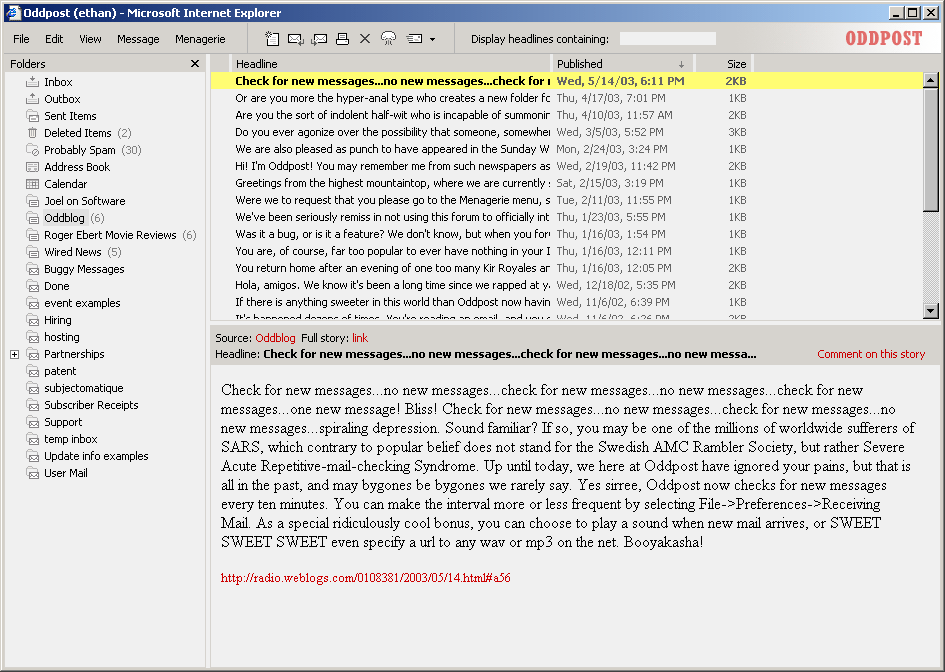
Oddpost was different in a number of ways to anything else at the time. At first glance, it looked like a three pane desktop mail client, there was less navigation controls than your webmail interfaces at the time. Which heralded a very different design approach in subsequent web 2.0 companies. It is hard to articulate now, Gmail wouldn’t arrive for another two years and when it did it was invite only which meant that for the average Joe it took a while to come around. There was no download or application required to make it work (like a Java applet for instance). Oddpost, instead used technologies which are now humdrum, but a decade ago were the web equivalent of a revolution. Dynamic HTML, XML, and Simple Object Access Protocol (SOAP) allowed individual elements of a page to be updated that provided a desktop app-like experience.
Design
Oddpost’s design approach didn’t lend itself to advertising that would slow down it’s dynamic interface and its method of updating components of a page rather than the full page adversely affected the page view metric advertisers cared about at the time. Storage was more expensive than it is now, so it made sense that Oddpost was a paid-for product. In return for your subscription of $30/year got you a whopping 30MB of storage in your email box and an integrated RSS reader (rather like mail.app with OSX or Outlook with Windows). In addition to the unique interface Oddpost offered support for both POP3 and IMAP standards which allowed access over an email client. IMAP allowed you to keep the files on the system providing you with a standard view using the web interface, your own computer, PDA (using Bluetooth and your cell phone as a wireless modem) or early smartphones like the Nokia 7650 and Nokia 6600 which came out in 2003. I was unusual at the time in having an IMAP email account, the entry cost for this service was purchasing an Apple computer.
Oddpost was rough around the edges. It would be another few years before the metal lid of an Apple laptop would be as common as it is now, so it wasn’t as much of an issue that Oddpost only worked on Internet Explorer (version 5 or better) for Windows. The search functionality only did the headlines of messages not the body text. The company was eventually acquired in April 2004 by Yahoo! as it looked to bolster its position as an email provider against the then new Gmail service.
-
Shenzhen ecosystem
It is hard to believe that the Shenzhen ecosystem was built over just a few decades. Just over 30 years ago China moved from a period of cultural isolation to gradually opening up to the commercial world beyond its borders. The place to naturally start this was in Guangdong province close to the then British colony of Hong Kong. A small fishing village grew to become the workshop of the world. The growth of Shenzhen was driven by investment from multi-nationals and overseas Chinese. One of the earliest industrial areas was called Overseas Chinese Town or OCT. OCT has changed from manufacturing to retail and offices for the creative industries in the former factory buildings.
Hong Kong had built up capability and expertise in light manufacturing and clothing from the 1950s through the 1970s. It is still important for supply chain intermediaries. This was the ‘golden age’ of Hong Kong. This is how many of the Hong Kong oligarchs made their first fortunes; which they then invested overseas, in China and into the Hong Kong real estate market.
Globalisation had started after the second world war. But the opening up of China threw it into overdrive. Hong Kong industrials moved manufacturing plants for clothing, shoes, toys, plastic goods and electrical appliances to China.
They were joined by Taiwanese electronics manufacturers and then multinationals from Europe, America and Japan. Hong Kong clothing manufacturers provided China supply chain expertise to western retailers like Walmart.
The Shenzhen ecosystem was built on manual production. The deft fingers of Chinese women workers allowed a lot more precision than Japanese pick-and-place machines. Which meant a lot more flexibility in manufacturing using the Shenzhen factories. You wouldn’t have an iPhone if you used pick-and-place robots on the production line.
Electronics manufacturing
At first, these companies were used to fatten the wallets of customers who took on the marketing and distribution of electronics in the West. The dirty secret about many PC and laptop designs was they were standard underneath. Then this cost saving was passed on to the customer as people like Dell went for close to lowest price operator based on a direct mail / online direct ordering and cut out the channel.
Finally that wasn’t enough, and most of the laptop and PC resellers make no money. Instead the main people to profit from these sales were Microsoft which licensed it’s Windows operating system and Intel which provided the majority of compatible micro-processors capable of running Windows-compatiable applications. In the PC industry there is usually just two or three profitable manufacturers and one of them is Apple. Historically it was Dell, then Hewlett-Packard and now it is likely to have be Lenovo.
Shrinking PC-esque computing power into the palm of one’s hand was inevitable with the rise of flash storage and Moore’s Law facilitating power-efficient processors. The challenge is battery technology, packaging and industrial design. Apple pushed the envelope with suppliers. Hon Hai and other manufacturers installed hundreds of CNC machines to fabricate thousands of metal phone chassis. These radical changes in manufacturing capability were opened up to lower tier manufacturers raising the standard of fit and finish immeasurably over a few years.
Now Xiaomi and Lenovo product handsets that have better build quality than many Samsung and HTC handsets. The performance is good enough (again thanks to Moore’s Law) and the handsets run the same applications. Sony, HTC and Samsung handsets look as marooned as Sony’s Vaio PC range in the Windows eco-system.
Shenzhen’s ecosystem has been a great leveller of manufacturing and industrial design capabilities with Apple at the leading edge of what’s possible from an industrial design and materials technology.
More information
Shenzhen Government Online – this loads slow like they are phoning the pages in from 2002, but is informative
The smartphone value system – An earlier piece I wrote about the challenges of the Android eco-system -
Canada on Twitter
Canada on twitter will be an event that will have delighted my friend and former colleague Matthias Lüfkens. Matthias founded the Burson-Marsteller Twiplomacy project. Time spent at the World Economic Forum on social media meant that Twiplomacy has been a long time personal passion of his. The Twiplomacy looked at which countries have accounts and whom they follow and are followed by. The study isn’t exhaustive, for instance it doesn’t cover China’s wolf warrior accounts.
Canada rolled out an official global account
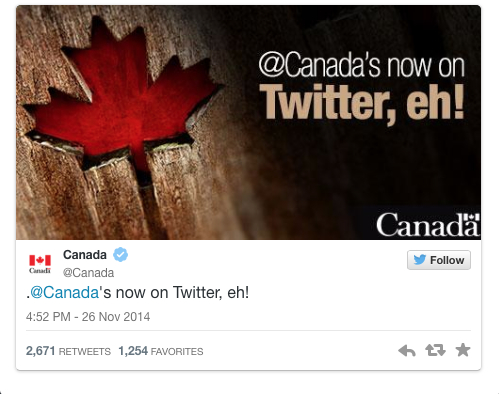
The first post that announced Canada on Twitter showed Canadian self depreciating humour with its ‘eh!’ ending imitating Canadian speech patterns. This account was as much aimed at Canadians as it was at generating digital soft power.
In reality Canada has had a number of digital diplomacy accounts before aimed at specific interest groups like the European Union or Iran. But don’t let those wrinkles get in the way of a good story.
And the internet (actually just over half of them Canadian netizens) responded back. As with most political discussions online this was a male-dominated discussion.
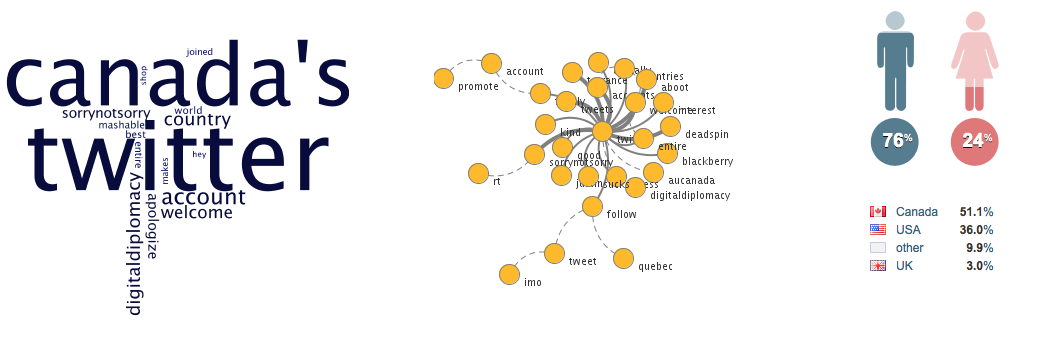
The conversation areas touched upon seemed to mirror the kind of issues that are currently rippling through Canadian politics: the environment, Quebec independence and care for veterans. There was a wonkish strand that talked about this accounts role in digital diplomacy for the Canadian government. Conversationalists also name-dropped well-loved Canadian brands like the Tim Hortons coffee and doughnut chain and the country’s love of ice hockey as the national sport.
Canadian based brands took time out to welcome their country’s government on to Twitter.
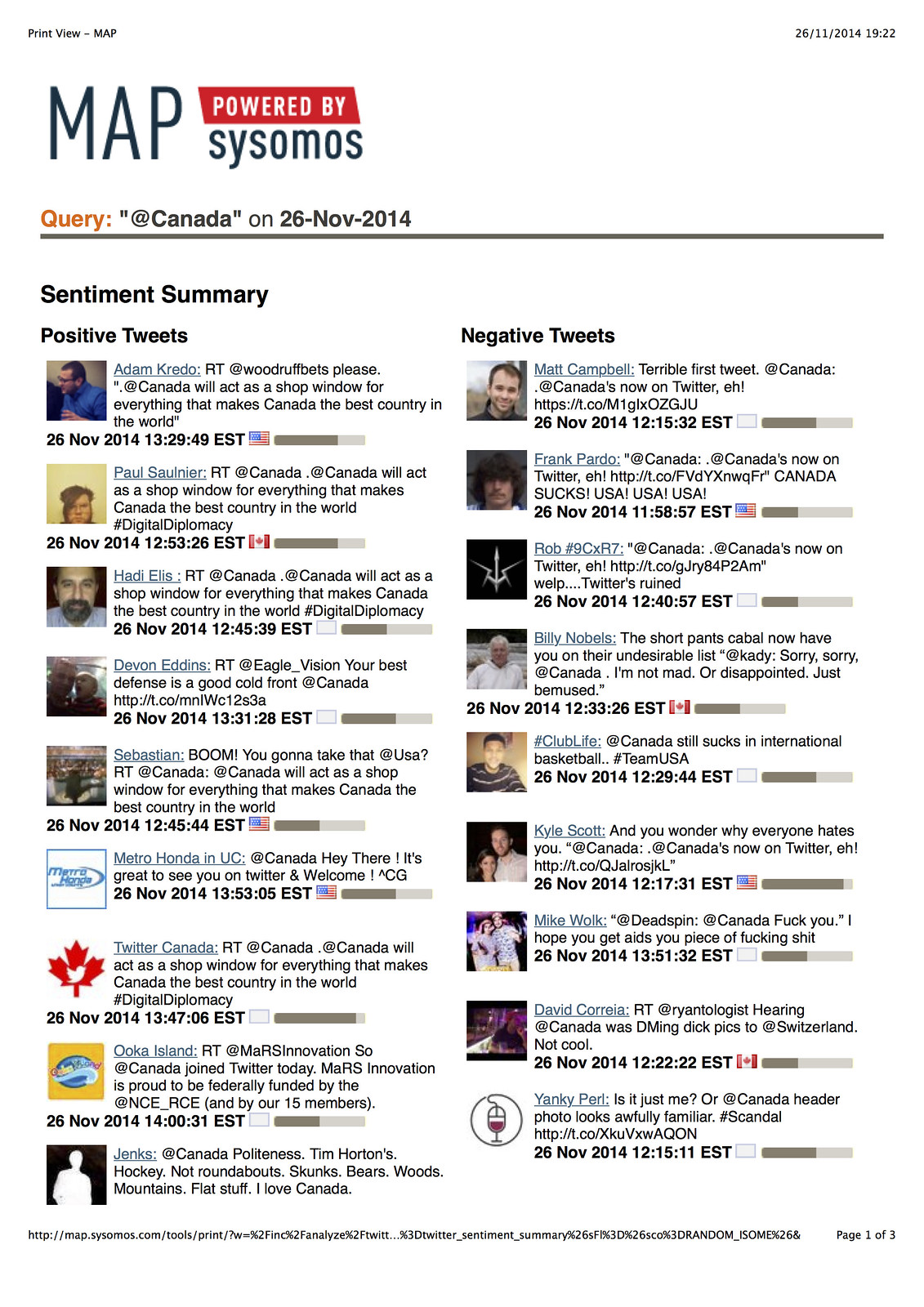
The biggest shock for me was that the account showed blatant favouritism towards Hootsuite compared to other Canadian social monitoring companies like Sysomos. Hootsuite was the only commercial entity that the account followed in what looks like a case of casual nepotism or a default setting in Hootsuite’s management tools. If its Hootsuite’s default setting that’s a scummy way of building followers and engagement. More online related posts here.