Ideas were at the at the heart of why I started this blog. One of the first posts that I wrote there being a sweet spot in the complexity of products based on the ideas of Dan Greer. I wrote about the first online election fought by Howard Dean, which now looks like a precursor to the Obama and Trump presidential bids.
I articulated a belief I still have in the benefits of USB thumb drives as the Thumb Drive Gospel. The odd rant about IT, a reflection on the power of loose social networks, thoughts on internet freedom – an idea that that I have come back to touch on numerous times over the years as the online environment has changed.
Many of the ideas that I discussed came from books like Kim and Mauborgne’s Blue Ocean Strategy.
I was able to provide an insider perspective on Brad Garlinghouse’s infamous Peanut Butter-gate debacle. It says a lot about the lack of leadership that Garlinghouse didn’t get fired for what was a power play. Garlinghouse has gone on to become CEO of Ripple.
I built on initial thoughts by Stephen Davies on the intersection between online and public relations with a particular focus on definition to try and come up with unifying ideas.
Or why thought leadership is a less useful idea than demonstrating authority of a particular subject.
I touched on various retailing ideas including the massive expansion in private label products with grades of ‘premiumness’.
I’ve also spent a good deal of time thinking about the role of technology to separate us from the hoi polloi. But this was about active choice rather than an algorithmic filter bubble.
I came across a couple of interesting terms recently: dark stores and coercive diplomacy.
Dark stores
Gartner for Marketing (formerly L2 Inc.) were talking about a new development at Amazon’s Whole Foods subsidiary. It was what Gartner called digital dark stores. The first one has been established in Industry City to serve much of Brooklyn, New York.
So whats the difference between dark stores and the ‘last mile’ warehouses that Amazon uses for fulfilment in places like London?
Looking at the limited amount of photos available, this doesn’t feel warehouse-like. There wasn’t obvious automation in the pictures. Instead it feels like a supermarket that’s well stocked, but lacking price tags and shopper marketing accoutrements. Gartner describe it as ‘technically a grocery store’, which implies that there might be zoning or planning regulations that they might be working around
It is only for the Whole Foods brand; rather than fulfilling Amazon Fresh and Amazon Prime Now items
This isn’t just an Amazon thing. Gartner points out that American supermarket brands Kroger and Giant Eagle have also embraced the order-only store model. More at Gartner for Marketing here.
Coercive diplomacy
The Australian Strategic Policy Institute published a report on September 1, 2020 called The Chinese Communist Party’s coercive diplomacy. It was written by Fergus Hanson, Emilia Currey and Tracy Beattie. Hanson, Currey and Beattie analysed ten years of Chinese government diplomacy. In there words:
The Chinese Communist Party (CCP) is increasingly deploying coercive diplomacy against foreign governments and companies. Coercive diplomacy isn’t well understood, and countries and companies have struggled to develop an effective toolkit to push back against and resist it.
The Chinese Communist Party (CCP) is increasingly deploying coercive diplomacy against foreign governments and companies. Coercive diplomacy isn’t well understood, and countries and companies have struggled to develop an effective toolkit to push back against and resist it.
This report tracks the CCP’s use of coercive diplomacy over the past 10 years, recording 152 cases of coercive diplomacy affecting 27 countries as well as the European Union. The data shows that there’s been a sharp escalation in these tactics since 2018. The regions and countries that recorded the most instances of coercive diplomacy over the last decade include Europe, North America, Australia, New Zealand and East Asia.
There seems to be an escalation of economic and non-economic measures deployed. Economic measures would include:
Trade sanctions – such as the recent ban on German pork products. This was rolled out just a few days in advance of a trade negotiation meeting between China and the European Union
Investment restrictions in strategic industries such as the ‘agreement‘ that Yahoo!, Softbank and Alibaba had over Alipay (which included what would now be Ant Group). Strategic industries like state security is notoriously (and deliberately) ill-defined in China
Tourism bans
Popular boycotts such as Korean corporate Lotte being driven out of China and the 2012 anti-Japan protests where the public smashed Japanese stores, attacked factories and burned Japanese cars
Coercive pressure is also applied at below state level on businesses. It may also be applied on individuals, based on the data leak provided from Zhenhua Data seems to imply.
Non economic measures include:
Arbitrary detention. The best example of this would be Michael Kovrig and Michael Spavor detained as part of China’s dispute with Canada. Another example might be Australian citizen Karm Gilespie. China didn’t admit it had detained him for over six years, until they announced his death sentence in the summer
Restrictions on official travel
State-issued threats which are usually issued on a regular basis as part of wolf warrior diplomacy. (Wolf Warrior is a set of two films with a Chinese action hero, a la Rambo – but with less humour).
Some of the imputus for coercive diplomacy might come from the Chinese Communist Party’s continued rancour over Qing dynasty-era unequal treaties. More China related content here and more on retailing here.
I decided to revisit the idea of orchestrated media recently. I had been working on the SEO of a post from 2011. This post linked out to an article by BBC research and development on orchestrated media.
Test card from Chinese public broadcaster CCTV.
The BBC where aware that media consumption had become more complicated. Attention whilst watching the TV at one time competed with the occasional trip to the kettle; or flicking through a newspaper that was to hand but otherwise undivided. What became the TV changed with the advent of content distributed over internet connections to the web and mobile devices. But it wasn’t only about the proliferations of screens, but also how it interplayed with other media.
It doesn’t necessarily imply simultaneous consumption of content via these different media forms. Nor does it imply the consumed content is related across the screens (e.g. an audience member may be using Facebook or Twitter for a completely unrelated purpose, while paying less attention to the TV show).
Thinking in those terms is perhaps unnecessarily limiting in scope and misses the broader picture around the opportunities of social media, creating more seamless media experiences, and how these flow from home environment to beyond.
This gives marketers a number of interesting things to think about. When is TV not TV. Think about live event programmes like The Apprentice or Britain’s Got Talent where social acts a ‘giant sofa’ as viewers share their opinions on what they see on screen. Twitter has tried to tap into this link between TV and discussion in its marketing efforts.
As broadcasters, the BBC started to think of the potential in a two-way conversation that was far more democratic than SMS polling, email or letter bags and phone-ins.
Orchestrated Media (OM)to refer to this experience of interaction, synchronisation, and collaboration of programme and companion content across devices. OM creates a new form of audience engagement with the broadcaster. Let’s start with some high level goals
• Enable interactivity around the content (voting, games) and synchronisation thereof, based on time and/or events (such as a producer-console triggered “button push”) • Enable richer exploration of programme • Enable social network interactions through sync-related information and content identifiers for replay purposes • Migrate content between the TV and mobile devices (such as a load-and-go service that runs overnight to load the mobile with video corresponding to the unwatched portion of a program, or a resume-for-home service that picks up viewing on the TV from where it left off on mobile)
Some of the necessary components in reaching these goals include • Visual feedback of shared interactions on TV screen • Private interactions on mobile screens • Support for not only live experience but also time-shifted and on-demand and pay-per-view ones • A back-channel to broadcaster for interactions, behaviour etc • Audio for different languages, directors commentary, clean audio etc, selectable per individual, synchronised to the programme • Accessibility for all above • Application life-cycle and runtime management
This seems to be aimed to provide a seamless anytime, everywhere experience. Think of the way services work in the background as part of Apple’s ‘Continuity’ service layer. As marketers, if we’re thinking about an orchestrated media landscape, how do we hand off between channels and provide prospective customers a similar kind of seamless experience. How do we manage long term and short term attribution and feed these insights into proportion of media spend?
Science, Strategy and War isn’t a book that would have normally made it on to my reading list, but we’re living in strange times. The book is an analysis of the history and strategic theory created over time by John Boyd.
Boyd’s thinking led to the development of post-Vietnam, pre-stealth fighter aircraft that dominated the world’s skies. Boyd employed his experience and the insight that a ‘Swiss Army knife’ approach seldom provided an adequate design solution. A lesson that the US failed to learn when it created the F-35.
Boyd was also responsible for creating the ideas that encouraged the US to move war into the IT space. Boyd’s thinking on strategy has shaped military thinking on tools, structure, integration and responsibility. What military-types call network-centric warfare. This seeks to translate an information advantage, enabled in part by information technology, into a competitive advantage.
We saw the potential of this thinking in the first Gulf War when sensors, missiles and satellite imagery changed the face of modern warfare. What was less appreciated at the time by commentators is that this form of warfare was uniquely aided by Iraq’s flat terrain; which aided remote sensors and wireless networks. But the network-centric aspect really came into its own with William Owens’ paper on the system-of-systems which was emerging as the military followed Boyd’s approach.
Ok, whilst there is some crossover with technology concepts such as Kevin Kelly’s ‘mirrorworld‘; where AR knits together networked information with location this is all pretty arcane stuff.
Boyd breaks out of military circles
John Boyd is particularly famous for a model called OODA which has broken out from its military origins. Probably the most high profile fan at the moment is Dominic Cummings – the special advisor to Boris Johnson and political activist.
Cummings has talked about Boyd in terms of disruption and marketing of his political messages – through getting inside their OODA loop.
Boyd’s ideas have also been picked up by sports coaches and even litigation teams in the US.
OODA
OODA or observe–orient–decide–act, is often described as a ‘loop’ and shown that way. However this deceives the audience of its true nature. As Osinga correctly points out; observe and orient are continual flows of information that feed into the decide and act functions. Strategists talk about ‘getting inside the enemies OODA loop’; that is disrupting their intelligence, understanding of their situational awareness and ability to act.
Osinga’s critique of Boyd
In Science, Strategy and War, Osinga sets out to do achieve a number of things with regards John Boyd’s ideas.
First of all Osinga provides context, by providing a history of Boyd’s career in military service and as a retired service member and academic. Osinga brings a great deal of understanding to this part of the book as he also served in an air force and is an academic.
John Boyd standing up in the cockpit of the F-86 Sabre that he few during his military service.
Secondly, he explains how Boyd developed and honed his ideas over time. Boyd’s OODA model was borne out of empirical experience as a combat pilot. It was first used to change fighter pilots about engaging with the enemy. Use of it then expanded to encompass bigger strategic outlooks.
Boyd read widely and had a deep understanding fo scientific principles due to his engineering background. He applied meta analysis to the great strategies and military campaigns of history and the literature describing them. He drew on his understanding of science to try and provide analogies for the many areas of uncertainty in implementing a strategy. He drew on the social sciences and concepts like post-modernism.
Whilst Boyd was technical; Science, Strategy and War makes it clear that he wasn’t technocratic in nature. Boyd was keenly aware of human factors including the different aspect of moral power. I think that this one of the least understood aspects of Boyd’s thinking.
I don’t think that Osinga’s book is essential reading for marketing. It was never meant to be. Instead, it provides a good insight into how many of our thinkers operate only at the surface level without truly understanding the concepts they talk about. Boyd was not a surface player, he thought deeply about things and read widely. In that respect I think he can be an example to us all. Osinga did a really good job at bringing this to light in an accessible way.
More on strategy here, more strategy related book reviews here.
I was reading Rob Manuel’s Facebook post about the origin of B3ta’s ‘magic donkey’ and its wider connection to the modern dystopian web experience.
B3ta and magic donkey
I guess it makes sense to first explain what B3ta is. B3ta is a community of bored driven people with a creative bent and a finely tuned sense of the absurd. The Guardian described it as a ‘purile digital arts community’. To be fair the works are more multi-displinary, than just digital in nature. Brands and memes get hacked.
By SR4K on B3ta. Unilever’s ice cream ‘heart brand’ gets flipped to become a stylised scrotum. The UK version of the heart brand is Wall’s which becomes Ball’s.
Its humour and its contributors are mostly British.
B3ta was founded as a website and forum back in 2001 and I found it as a passive consumer a few years later. The front page and weekly email sent to members curated a selection of the content in the forums. Whilst contributors weren’t paid, there was a lot of kudos to getting your content on to the front page of the website, or into the weekly email that went out to the community of creators and consumers.
This meant that Manuel was under pressure by contributors to put their work on the front page or in the weekly update email. The ego of the creator is familiar to anyone who has watched TV shows or films such as:
Manuel invented an imaginary editor to deflect pressure away from himself. Of course, imaginary editor had to be slightly absurd. Hence a magic donkey.
Flickr and the magic donkey
While Rob Manuel was responsible for trying to fend off B3ta contributors aspirations to get on the front page, Cal Henderson was responsible for the technology. He had been a co-founder of B3ta alongside Manuel.
Henderson is better known as a long time collaborator with Stewart Butterfield and CTO of Slack. But before that he was responsible for the technical aspects of B3ta and then moved on to Flickr.
Flickr had a strong tight community, with agreed well-adhered to rules. A large part of this was down to the Flickr team including co-founder Caterina Fake and Heather Powazek Champ. The community met up in real life; rather like users of Chinese network Douban had been known to do. Flickr users were also good at organising their pictures providing labels or tags for images. But as the community scaled, surfacing the right content at the right time would have been more difficult.
Henderson word on a algorithm-driven function called ‘interestingness’ that surfaced ‘the best’ content on a particular subject. Here’s what Steve’s Digicams said about is likely to go into the ‘Interestingness’ algorithm.
There are a number of factors that go into what makes a photo interesting including, the number of tags it has, the number of groups it belongs to, how many people have viewed the image, and how many people have made it their favorite.
Cal Henderson called the algorithm ‘magic donkey’. This would be a substitute for the curation done by an editor or a community manager and be applied across all subject areas. If the descriptions of Henderson’s interestingness algorithm reminds you a bit of Larry Page and Sergei Brin’s original working paper The PageRank Citation Ranking: Bringing Order to the Web, you’re probably right. At a base level both seem to rely on different feedback mechanisms to provide a reductive way of resolving what to show. Feedback as a concept is a hugely important role in computing and technology. Bell Labs were using feedback in its solutions to reduce noise on telephone lines at the start of the modern electronic age. Now feedback and analysis is done thousands of time a second to try and provide robots with some form of situational awareness.
Magic donkey, search and social search
Just over 12 months after it was formed, Flickr was purchased by Yahoo!. Yahoo! was interested in flickr for a number of reasons:
Yahoo! (and Microsoft) were fighting a losing battle against Google’s search engine and needed an edge
Web 2.0 had started to take off and Flickr was a cool property in this space.
At that time search lacked meaning and context. To help you understand what search was like back then. I used to use the analogy of a shop assistant
Imagine going to the supermarket and asking the assistant for an item, they run down the corridor and run back with their arms full of different stuff. They empty the stuff into your trolley and say to you ‘Your item is in there’. If you are lucky, the item is at the top of the pile, it you aren’t you may sort through it all and find you don’t have it anyway. You complain to the manager and he dismisses you with ‘Its your own fault, you asked in the wrong way’.
In order to deal with the meaning and context problem, all the main search engines brought out vertical search services
Video Search
Maps
Blog search
Google Scholar
Shopping search
And ‘easter eggs’ such as providing information on local time in different cities or countries and measurement conversions. Whilst these weren’t great at driving advertising revenue they encouraged usage. Search became a giant Swiss army knife for knowledge workers.
All the search providers had a keen interest to the GWAP (games with a purpose) work that was being done at Carnegie Mellon University by Luis von Ahn. von Ahn is a specialist in the field of ‘human computation’.
Human computation was providing machine learning something to learn from. You want to teach a machine learning algorithm how to identify cats? von Ahn’s ESP game was the ideal teacher. In the words of von Ahn’s own page at Carnegie Mellon University:
The first GWAP developed by von Ahn, the ESP Game displays images to two players who each try to guess words that the other player would use to describe the image. The game improves web image searches by generating descriptions of uncaptioned images. Google Inc. has licensed the game, which the company calls Google Image Labeler.
von Ahn went on to design other games that would have a similar utility
Matchin, a game in which players judge which of two images is the more appealing. (This might introduce cultural bias and would probably be much more problematic now.) Back in the late noughties this was seen as progress towards better search. Automating systemic racial bias just wasn’t on the radar and ‘bro culture’ wasn’t as prevalent in its engineers
Tag a tune – which looked to get genres and descriptors like happy or sad music
Verbosity – tests ‘common sense’ knowledge to build facts for machine learning platforms like ‘you shouldn’t walk under ladders’
You can still try Google’s use of GWAP here. Though most people are more used to engaging with GWAP functions as part of CAPTCHA and reCAPTCHA verification services. Google used reCAPTCHA and CAPTCHA technology to digitise the archives of The New York Times and libraries into Google Books.
Yahoo!’s answer to this has been variously termed knowledge search and social search. The idea was to improve the quality of results through people and provide context through human effort. A few of the things were in Yahoo!’s favour for this approach.
Heuristics that support social search
Search like many categories of commerce, tends to follow the principle of the long tail. The bulk of interest or transactions are the head. This existed pre-Internet; if you’re of a certain age you’ll remember that most people seemed to have a Sade or Dire Straits album in their CD collection. Ed Sheeran or Beyonce on their Spotify playlists would be a similar phenomenon now.
Search is quite similar. The biggest searches on search engines are likely to be something along the lines of:
Porn
Google (on Yahoo! or Bing)
Amazon
eBay
Facebook
(The lists that you see published of the top searches put out by Google, Yahoo! etc are usually cleaned first by the PR teams; so have limited value as trustworthy information sources.)
A lot of searches are looking for things that you’ve found before online. Whether it was a particular article or a website that you use on a regular basis.
Social search was manifested in a number of different ways. Questions and answer sites had originally got popular in east Asia, notably Korea, Taiwan and Japan.
Jerry Yang himself got behind the launch of what would become Yahoo! Answers following the popularity of a Q+A service launched by Yahoo! in Taiwan.
Yahoo! had an interest in tagging and folksonomies as a way of providing context around content. In a similar way to the way lexemes work.
So if you were listening to a report on the stock market. The report wouldn’t necessarily have to use the phrase stock market to indicate that was what the report was about. There would be lexemes – words associated with the concept of a stock market that would be indicators for instance:
Wall Street
Bull market
Bear market
Standard & Poors 500 (S+P500)
NASDAQ
Share price
FTSE
The Hang Seng
The Nikkei
There would be similar language for other subjects as well. This allows for one item to be in multiple categories. Yahoo! acquired Flickr which helped because it had a community that tagged their images.
Yahoo! also launched a series of social bookmarking services. Remember what I said earlier about people often searching for things that they’d found before? Well a social bookmarking tool offers a few benefits
Your bookmarks exist online so you don’t have to worry about getting access to your browser bookmark folder at home, at work or on the move
You organise things using the language that makes the most sense for you
You can search amongst links that you’ve found before
Searching amongst content that you and others like you chose to bookmark should raise the overall quality of the links that you are provided with
There was Yahoo! MyWeb, MyWeb 2 (beta) and it then acquired Delicious. Stewart Butterfield used to joke that Yahoo! bought flickr because they thought flickr were the ‘tagging people’; when they’d really just been copying the feature from Joshua Schacter at Delicious. Yahoo! then went on to buy social bookmarking site Delicious as well.
The problem is that to tag your bookmarks and content carefully requires a discipline that many people struggled to maintain. I have found it to be personally beneficial over time, but I had a strong incentive to stick with it; even then I have been far more lax on my photo tagging since I no longer use Flickr’s desktop app to upload my photos.
Changing behaviour is hard; when I worked there, reputedly a higher proportion of Yahoos used Google search than the general population. I heard that there was a similar behaviour pattern at Microsoft.
There is also a certain irony in Henderson et al falling back closer towards a Google PageRank citation / feedback-type model of algorithm given the nature of a more human-powered and humane ideal of social search.
Magic donkey and content firehose
Cal Henderson literally wrote the book on scaling websites to cope with the kind of growth you would see driven by social web applications such as photo sharing, bookmarking and social networks.
But social networks grew at a phenomenally fast rate. You could never log on to Friendster. That meant that the bar was set very low for MySpace to compete against Friendster.
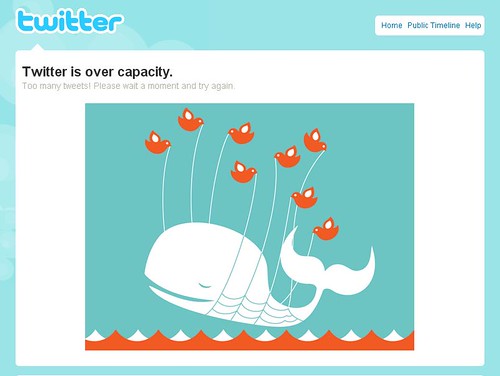
MySpace and Facebook were initially very sluggish sites. Twitter and the ‘fail whale’ of the site being down were a cultural touchstone of the late noughties.
Fail Whale via The Diva Rockin on Flickr.
This increase in audience, meant a consequent increase in content. YouTube for example was running at over 45minutes of video being uploaded every minute. I am sure that rate is even greater now. How to sort through this firehose of content?
To engineers the solution would look a lot like Henderson’s magic donkey. Algorithms slowed down the newsfeed to something more manageable, otherwise it would overwhelm the users.
On the commercial side, the social platforms need to show sticky content that will keep users on their site longer and that they can vend advertising against.
No great plot to up-end civilisation or spread hatred and bile. But algorithms can have unintended consequences. Content that polarises, engages. The algorithm doesn’t know that’s a bad thing. Soon those that want to engage with audiences in an emotive political way understand how the system can work with them.
A mix of trial and error with a bit of understanding of behavioural science and continual learning allows political actors to learn how to use the system. Incremental tweaks in approach that their rivals or peers make drives that knowledge at a faster rate than the algorithms seem to evolve. The algorithm is blind to it all. It sees the things it cares about ‘improving’. Time spent on service, engagement with content, commenting and sharing. A human-machine feedback mechanism is created.
In essence, it’s Google’s ‘stupid shop assistant’ all over again and this time human input in the feedback mechanisms is hurting rather than helping the magic donkey of social platforms.
More on flickr here and more on internet culture here.
UPDATE (September 24, 2020): Earlier this week the FT ran the story ‘YouTube reverts to human moderators in the fight against misinformation‘ – in an apparent indication that the ‘magic donkey’ model has reached its limits (at the moment). YouTube’s machine learning algorithms when given control had a false positive bias banning a ‘significant number’ of videos that broke no rules. In a three month period 11 million videos were taken down. (The usual number is about half that).
Indonesia is a fascinating place in and of itself and comes up with all kinds of cultural nuggets. The latest one that I came across was the Vespa Extreme moped sub-culture. Vespa scooters are plentiful in Indonesia, as is the desire to invent. Car tuning culture is big amongst the middle class. But for those who need something more affordable Vespa Extreme builds are a site to behold. The South China Morning Post put together this great documentary film on the Vespa Extreme culture and its riders.
Like car culture there are meet-ups, cruises and even festivals organised.
Vespa Extreme Culture.
About half of the mobile game developers on iOS are based in China, the country’s universities turn out more programmers each year than anywhere else (including India). Yet China has still lagged behind other countries games in terms of incorporating technology and art. That’s where Black Myth: Wukong is supposed to come in. Sun Wukong is one of the names of the Monkey King in the Chinese literary classic Journey To The West. This has been a staple of Chinese animation and film for years.
Black Myth: Wukong
Could it be popular in China? It’s hard to tell from this pre-Alpha release footage. The biggest issues are likely to come from Chinese regulators. But hopefully the game won’t have to undergo the lengthy rewrites and changes foreign games have to do to comply. Instead the Chinese developers should be able to bake compliance in from the start. However, its China; so nothing is guaranteed.
The Ikea Taiwan Facebook page faithfully created looks from their catalogue on Animal Crossing, much to the delight of their Taiwanese and Hong Kong based followers. The original post is here.
The original Facebook post
Front cover with Animal Crossing characters, but on Ikea furniture
Side-by-side comparison between the original catalogue and a recreation using sets dressed in Animal Crossing
Another example, all prices are in Taiwan dollars rather than Animal Crossing belles