Category: ideas | 想法 | 생각 | 考える

Ideas were at the at the heart of why I started this blog. One of the first posts that I wrote there being a sweet spot in the complexity of products based on the ideas of Dan Greer. I wrote about the first online election fought by Howard Dean, which now looks like a precursor to the Obama and Trump presidential bids.

I articulated a belief I still have in the benefits of USB thumb drives as the Thumb Drive Gospel. The odd rant about IT, a reflection on the power of loose social networks, thoughts on internet freedom – an idea that that I have come back to touch on numerous times over the years as the online environment has changed.

Many of the ideas that I discussed came from books like Kim and Mauborgne’s Blue Ocean Strategy.

I was able to provide an insider perspective on Brad Garlinghouse’s infamous Peanut Butter-gate debacle. It says a lot about the lack of leadership that Garlinghouse didn’t get fired for what was a power play. Garlinghouse has gone on to become CEO of Ripple.

I built on initial thoughts by Stephen Davies on the intersection between online and public relations with a particular focus on definition to try and come up with unifying ideas.

Or why thought leadership is a less useful idea than demonstrating authority of a particular subject.

I touched on various retailing ideas including the massive expansion in private label products with grades of ‘premiumness’.

I’ve also spent a good deal of time thinking about the role of technology to separate us from the hoi polloi. But this was about active choice rather than an algorithmic filter bubble.


  • Dumb internet

    Over the past 20 years has the modern web became a dumb internet? That’s essentially a less nuanced version of what media theorist Douglas Rushkoff proposed.

    Douglas Rushkoff at WebVisions 2011
    Douglas Rushkoff at WebVisions 2011 taken by webvisionevent

    In his essay ‘The Internet Used to Make Us Smarter. No Not So Much” Rushkoff outlines the following points:

    • Too much focus and analysis has been put in the new, new thing. Novelty gets the attention over human impact
    • Consumer movements or subcultures become fads when they lose sight of their purpose
    • Rushkoff thinks that netizens let go of the social / intellectual power of the web. This provided the opportunity for them to become yet another large corporate business
    • Bulletin boards, messaging platforms and email lists facilitated non-real time or asynchronous communications. Asynchronous communications channels allowed people to be ‘smarter’ versions of themselves.
    • The move to an ‘always-on’ medium has been detrimental
      Going online went from an active choice to a constant state of being. The resulting disorientation is self-reinforcing.

    Rushkoff’s commentary is interesting for a number of reasons. He had been a herald of how online culture would change society and consumer behaviour.

    But his essay posits a simple storyline. It wasn’t people that ruined the internet, it was big business that did it when people weren’t looking. So I wanted to look at the different elements of his hypothesis stage-by-stage.

    Too much focus and analysis has been put in the new, new thing

    With most technologies we see the thing and realise that it has potential. But it is only when it reaches the consumer, that we truly see its power.

    Different cultures tend to use technology in very different ways. Let’s think about examples to illustrate this. Technology research giants like Bell Labs and BT Research had science fiction writers onboard to try and provide inspirational scenarios for the researchers. So it was no surprise that mobile wireless based communications and computing was envisaged in Star Trek.

    Tricorder
    A replica of a Science Tricorder from Star Trek by Mike Seyfang

    And yes looking back Star Trek saw that the computer was moving from something the size of a filing cabinet, to something that would be a personal device. They realised that there would be portable sensing capabilities and wireless communications. But Star Trek didn’t offer a lot in terms of use cases apart from science, exploration and telemedicine.

    These weren’t games machines, instead the crew played more complex board games. Vulcan chess seemed to be chess crossed with a cake stand.

    Yes, but that’s just the media, surely technolgists would have a better idea? Let’s go to a more recent time in cellphones.

    Here’s Steve Ballmer, at the time the CEO of the world’s largest technology company. Microsoft Research poured large amounts of money into understanding consumer behaviour and tech developments. In hindsight the clip is laughable, but at the time Balmer was the voice of reason.

    Nokia e90 and 6085
    The Nokia E90 Communicator and Nokia 6085 that I used through a lot of 2007

    I was using a Nokia E90 Communicator around about the time that Ballmer made these comments.

    I was working in a PR agency at the time and the best selling phone amongst my friends in the media industry were:

    • The Nokia N73 I’d helped launch right before leaving Yahoo! (there was an integration with the Flickr photo sharing service)
    • The Nokia N95 with its highly tactile sliding cover and built in GPS

    The Danger Sidekick was the must-have device for American teenagers. Japanese teens were clued to keitai phones that offered network-hosted ‘smartphone’ services. Korea had a similar eco-system to Japan with digital TV. Gran Vals, by Francisco Tárrega was commonplace as the Nokia ringtone, from Bradford to Beijing. Business people toted BlackBerry, Palm or Motorola devices which were half screen and half keyboard.

    The iPhone was radical, but there was no certainty that it would stick as a product. Apple had managed to reinvent the Mac. It had inched back from the brink to become ‘cool’ in certain circles. The iPod had managed to get Apple products into mainstream households. But the iPhone wasn’t a dead cert.

    The ideas behind the iPhone weren’t completely unfamiliar to me. I’d had a Palm Vx PDA, the first of several Palm touch screen devices I’ve owned. But I found that a Think Outside Stowaway collapsible keyboard was essential for productive work on the device. All of this meant I thought at the time that Ballmer seemed to be talking the most sense.

    Ballmer wasn’t the only person wrong-footed. So was Mike Lazaridis of Research In Motion (BlackBerry) repeatedly under-estimated the iPhone. Nokia also underestimated the iPhone too.

    So often organisations have the future in their hands, they just don’t realise it yet; or don’t have the corporate patience to capitalise on it. A classic example is Wildfire Communications and Orange. Wildfire Communications was a start-up that built a natural language software-based assistance system.

    In 1994 the launched an ‘electronic personal secretary’. The Wildfire assistant allowed users to use voice commands on their phone to route calls, handle messaging and reminders. The voice prompts and sound gave the assistant a personality.

    Orange bought the business in 2000 and then closed it down five years later as it didn’t have enough users taking it up. Part of this is was that the product was orientated towards business users, like cellphones has been in the 1980s and early 1990s.

    But growth took off when the cellphone bridged into consumer customer segments with the idea of a personal device. There wasn’t a horizon-scanning view taken on it, like what would be the impact of lower network latency from 3.5 and 4G networks.

    Orange had been acquired by France Telecom and there were no longer executives advocating for it.

    Demo of Wildfire’s assistant that I found on the web

    In retrospect with the likes of Siri, Alexa and Google Assistant; Wildfire was potential wasted. Orange weren’t sufficiently enamoured with the new, new thing to give it the time to shine. And the potential of the service wasn’t fully realised through further development.

    The reason why the focus might be put on the new, new thing is that its hard to pick winners and even harder to see how those winners will be used.

    Consumer movements or subcultures become fads when they lose sight of their purpose

    I found this to be a particularly interesting statement. Subcultures don’t necessarily realise that they’re a subculture until the label is put on them. It’s more a variant of ‘our thing’.

    • The Z Boys of Dogtown realised that they were great skaters, but probably didn’t realise that they were a ‘subculture’.
    • Shawn Stüssy printed up some t-shirts to promote the surf boards he was shaping. He did business the only way he knew how. Did he really realise he was building the foundations of streetwear culture of roadmen and hype beasts?
    • Punks weren’t like the Situationists with a manifesto. They were doing their thing until it was labelled and the DIY nature of doing their thing became synonymous with it.
    • The Chicago-based producers making electronic disco music for their neighbourhood clubs didn’t envisage building a global dance music movement. Neither did the London set who decided they had such a good time in Ibiza; they’d like to keep partying between seasons at home.

    Often a movement’s real purpose can only be seen in hindsight. What does become apparent is that scale dilutes, distorts or even kills a movement. When the movement becomes too big, it loses shape:

    • It becomes too loose a network
    • There are no longer common terms of reference and unspoken rules
    • The quality goes down

    But if a community doesn’t grown it ossifies. A classic example of this is The WeLL. An online bulletin board with mix of public and private rooms that covered a wide range of interests. Since it was founded in 1985 (on dial-up), it has remained a disappointing small business that had an outsized influence on early net culture. It still is an interesting place. But its size and the long threads on there feel as if the 1990s have never left (and sometimes I don’t think that’s a bad thing).

    When you bring in everyone into a medium that has an effect. The median in society is low brow. This idea of the low brow segment of society was well documented as a concept in the writing of George Orwell’s 1984 and Aldus Huxley’s Brave New World. Tabloid newspapers like The Sun or the National Inquirer write to a reading age of about 12 years old for the man in the street. Smart people do stupid things, but stupid people do stupid things more often.

    It is why Hearst, Pulitzer and Beaverbrook built a media empire on yellow journalism. It is why radio and television were built on the back of long-running daytime dramas (or soap operas) that offer a largely-stable unchanging backdrop, in contrast to a fast-changing world.

    Netizens let go of the social / intellectual power of the web

    When I thought about this comment, I went back to earlier descriptions of netizens and the web. Early netizen culture sprang out of earlier subcultures. The WeLL came out of The Whole Earth Catalog:

    • A how too manual
    • A collection of essays
    • Product reviews – a tradition that Kevin Kelly keeps alive with this Cool Tools blog posts

    The Whole Earth Catalog came out of the coalescence of the environmental lobby and the post-Altamont hippy movement to back to the land. Hippy culture didn’t die, but turned inwards. Across the world groups of hippies looked to carve out their own space. Some were more successful than others at it. The Whole Earth Catalog was designed as an aid for them.

    The hippy back to the land movement mirrored earlier generations of Americans who had gone west in the 19th century. Emigrates who had sailed for America seeking a better life. Even post-war GIs and their families who headed out to California from the major east coast cities.

    The early net offered a similar kind of open space to make your own, not bounded by geographic constraints. Underpinning that ethos was a certain amount of libertarianism. The early netizens cut a dash and created net culture. They also drew from academia. Software was seen as shareable knowledge just like the contents of The Whole Earth Catalog. Which gave us the open source software pinnings that this website and my laptop both rely on.

    That virtual space that was attractive to netizens also meant boundless space for large corporates to move in. Since there was infinite land to stake out, the netizens didn’t let go of power.

    To use the ‘wild west’ as an analogy; early netizens stuck with their early ‘ranch lands’, whilst the media conglomerates built cities that the mainstream netizens populated over time.

    The netizens never had power over those previously unmade commercial lands which the media combines made.

    Asynchronous communications channels allowed people to be ‘smarter’ versions of themselves

    Asynchronous communications at best do allow people to be the smarter version of themselves. That is fair to a point. But it glosses over large chunks of the web that was about being dumb. Flame wars, classes in Klingon and sharing porn. Those are things that have happened on the net for a long long time.

    In order to be a smarter version of yourself requires a desire to reflect that view to yourself; if not to others. I think that’s the key point here.

    The tools haven’t changed that much. Some of my best discussions happen on private Facebook groups. Its about what you choose to do, and who you choose to associate with.

    In some ways I feel like I am an anachronism. I try and read widely. I come from a family where reading was valued. My parents had grown up in rural Ireland.

    I remember that my Dad brought home a real mix of secondhand books from Modern Petroleum Technology and US Army field manuals for mechanics to Grimm’s Fairy Tales and Hammond Innes.

    This blog is a direct result of that wider reading and the curiosity that it inspired. I am also acutely aware that I am atypical in this regards. Maybe it is because I come from a family of emigres, or that Irish culture prides education in the widest sense. My Mum was an academically gifted child; books offered her a way off the family farm.

    My father had an interest in mechanical things. As the second son, so he had to think about a future beyond the family small holding that his older brother would eventually inherit.

    Being erudite sets up a sense of ‘otherness’ between society at large and yourself. This shows up unintentionally in having a wider vocabulary to draw from and so being able to articulate with a greater degree of precision. This is often misconstrued as jargon or complexity.

    I’d argue good deal of the general population doesn’t want to be smarter versions of themselves. They want to belong, to feel part of a continuum rather than a progression. And that makes sense, since we’re social animals and are hardwired to be concerned about difference as an evolutionary trait. Different could have got you killed – an enemy or an infectious disease.

    The move to an ‘always-on’ medium has been detrimental

    Rushkoff and I both agree that the ‘always-on’ media life has been detrimental. Where we disagree is that Rushkoff believes that it is the function of platforms such as Twitter. I see it more in terms of a continuum derived directly from network connectivity that drove immediacy.

    Before social was a problem we had email bankruptcy and information overload. Before widespread web use – 24-hour news broadcasting drove a decline in editorial space required for analysis which changed news for the worse.

    James Gleick’s book Faster alludes to a similar concept adversely affecting just about every aspect of life.

    Dumb Internet

    I propose that the dumb internet has come about as much from human factors as technological design. Yes technology has had its place; algorithms creating reductive personalised views of content based on what it thinks is the behaviour of people like you. It then vends adverts against that. Consumers are both the workers creating content and the product in the modern online advertising eco-system as Jaron Lanier’s You are not a gadget succinctly outlines.

    The tools that we have like Facebook do provide a base path of least resistance to inform and entertain us. Although it ends up being primarily entertainment and content that causes the audience to emote.

    But there is a larger non-technological pull at work as well. An aggregate human intellectual entropy that goes beyond our modern social platforms.

    If we want a web that makes us smarter, complaining about technology or the online tools provided to us isn’t enough:

    • We need to want to be smarter
    • We need to get better at selecting the tools that work for us as individuals
    • We need to use those tools in a considered, deliberate way
  • Economics of YouTube + more

    lifeintaiwan have gone into the economics of YouTube by looking at their own channel in this video. It makes fascinating viewing and provides more questions than answers about the value of ‘influencer’ fees being paid in travel, beauty and FMCG sectors. It will provide additional grist on the economics of YouTube moving forwards

    Photochromeleon: Creating Color-Changing Objects – YouTube – I thought that this was projection mapping but it seems to be just variable light wavelengths. Really interesting applications from activations to packaging design

    The nth room sex scandal is a mix of dark web fears played out within a private Telegram channel. Some great explanations and vox pops interviews in Korea by Asian Boss. This scandal falls on the back of other sexual exploitation scandals in the Korean media, notably around the Burning Sun club in Seoul. It is also interesting how Telegram had been perceived as a super-safe channel for delivery of services, rather than building a dark web site. More Korea related posts here.

    Asian Boss vox pop interviews with the Korean public on the nth room sex abuse scandal

    Mark Ritson talks about marketing in the midst of a recession. If you do nothing else this week, get a CMO you know to watch it. The big thing to take away is the concept of eSOV. Although Ritson doesn’t mention this explicitly, this is the foundation of Proctor & Gamble’s success during the Great Depression.

    The history of Marriott carpet camouflage. Uniform History do some interesting design story videos and their April’s Fools videos tap into odd but true stories. Apparently this camouflage was for cosplay conventions in the US. The video then goes into a tangled mess of intellectual property, fair use, parody and cultural appropriation of a carpet. The thing has taken a life of its own. When Marriott refreshed its carpet choice the old ones were dumpster dived or bought up by cosplayers so that they could continue the convention tradition that had build up over a few years.

  • TSMC to SMIC + more things

    Huawei is gradually shifting chip production from TSMC to SMIC  – this is China decoupling from western supply chains. TSMC to SMIC also has the additional benefit of damaging Taiwan’s leverage on China. More on Huawei here.

    Plastic surveillance: Payment cards and the history of transactional data, 1888 to present – Josh Lauer, 2020 – interesting but hardly surprising conclusions from data-mining

    ‘Furious and scared’: Long before COVID-19, these families knew Canada’s long-term-care system was broken | The Star – issues with Chinese government-owned companies and a complete lack of accountability

    HNA in chaos as internal divisions erupt in public | Financial TimesOne investor who sought to buy a large real estate portfolio from HNA in late 2018 said that the deal fell through because it was no longer clear who was in control of the assets – this is interesting when you start about thinking allegations of all Chinese businesses (like Huawei) essentially being state-directed businesses. Especially when you consider it in the context

    Inside Icebucket: the ‘largest’ CTV ad fraud scheme to date | Advertising | Campaign AsiaWhite Ops has uncovered what they report to be the largest-ever connected TV fraud operation in history, affecting more than 300 publishers and millions of dollars in ad spend.

    Local TV Is Back (With an Assist From Coronavirus?) | The National Interest – yet broadcast TV isn’t in mix when experts talk about advertising at the present time

    What really happens to the clothes you donate | Macleans – interesting complex supply chain for fibres and nothing. Also interesting how grading of garments stayed within the Asian diaspora formerly based in the British colonies of East Africa

    Sorry Huawei, the P40 Pro without Google apps is just too broken to live with – probably one of the best rundowns on how the lack of access to Google mobile services is handicapping Huawei handsets

    China’s top chipmaker says it can match Samsung on memory tech – Nikkei Asian Review – how much of it is stolen technology?

    Contingency planning: where should brands be moving their ad spend? – GlobalWebIndex – an interesting read but needs the additional lens of channel effectiveness as well

    Cam Girls, Coronavirus and Sex Online Now – The New York Times – it will be interesting to see if it continues on post crisis

  • How brands grow part 2

    I’ve been re-reading How Brands Grow Part 2 by Jenni Romaniuk and Byron Sharp. Part 1 is well known. It is the go-to bible for consumer marketers written by Sharp.

    part2
    How Brands Grow Part 2 by Romaniuk and Sharp

    In part 2 Sharp and Romaniuk looked at business-to-business marketing, luxury marketing and influencer marketing. The things that I found particularly interesting in part 2:

    • The heuristics around business-to-business marketing are remarkably similar to consumer marketing. This means that even in B2B marketing, the importance of brand building is paramount. This is very much at odds with the way in which business-to-business marketing is practiced
    • Part 2 provides a much needed dose of pragmatic realism on influencer marketing. Influencer marketing carries the most weight with people that would be interested in the brand anyway. It is less efficient than marketers seem to believe. If you look at Unilever at the end of the Keith Weed era; influencer marketing took an outsized proportion of marketing spend that could not be explained in a world of zero based budgeting (ZBB) that the company had brought in
    • Romaniuk and Sharp manage to explain why luxury brands need sustained advertising to sustain their standing despite the very nature of luxury being hard to find (and so discover) unless you’re part of the cognoscenti

    Regardless of your marketing area both part 1 and part 2 will help you to be a better marketer. What immediately becomes apparent is that empirical research done by Sharp and company outlined in part 1 and part 2 are best viewed selectively.

    Fads become orthodoxy in the face of empirical evidence to the contrary. A classic example would be the headlong dash into digital regardless of its role in the marketing mix.

    It would be great if these books were paid attention to as well as read by marketers.

  • Playlists and mixtapes

    Working as a remote team got me thinking about playlists and mixtapes. One of my colleagues started off a themed playlist on Spotify. The playlist creativity was based around a narrative. The narrative is driven by song title.

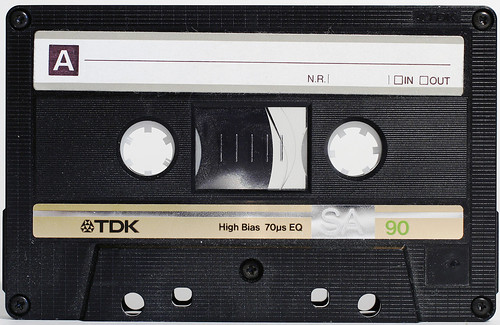
    cassette tape
    Thegreenj / CC BY-SA (http://creativecommons.org/licenses/by-sa/3.0/)

    Spotify made it easy to collaborate on putting more in there.

    Its a form of surface data, easy to see. Easy for machines to grasp.
    It is easy to analyse. Hence Spotify’s ad campaigns and pitch to advertisers based on data.

    Initially, I thought it was this data treasure trove that made me feel uneasy about music streaming services. Where other people felt Spotify’s ads were clever, I felt they were intrusive, even voyeuristic. It felt voyeuristic reading some of them.

    Music curation is a very personal thing. But in the end I realised it wasn’t the data that bothered me. Now I realise its the nature of curation and consumption on the platforms.

    Music is something that exists in everyone’s lives. For some people it was background wallpaper. It occasionally took on ‘sound track’ starring roles at important life moments. For instance, the track the bride and groom choose to dance to at their wedding. Or a one-hit wonder attached to holiday nightlife memories.

    For some people it moves beyond being a trigger. It stirs a passion. Myself and some friends have collections of records. Owning a thing has a power of its own. Digital services don’t really understand this drive.

    iTunes organisation

    iTunes in its day revolutionised digital music. It made music accessible in way that consumers wanted. But it wasn’t a perfect experience.

    For instance, someone like myself won’t necessarily follow an artist. Electronic music often sees artists change names as often as changing an overcoat.

    The producer or remixer becomes important. Tom Moulton back in the days of disco, Danny Krivit’s famous edits or London’s Nicolas Laugier (The Reflex). All of them have distinctive sounds that bring tracks to life.

    A record label becomes synonymous with a particular sound. Blue Note Records’ jazz, Strictly Rhythm’s New York tinged house music or the early rock of Sun Records. This is a mix of a curators ear, in house studios, producers and engineers.

    Yet in iTunes you could never search by remixer, or record label in the way that you could search for an artist or group name.
    Even the way iTunes treated DJ names indicated a lack of understanding. Someone like myself would treat DJ, the way rock fans would treat ‘The’ in a band name. So DJ Aladdin would come before The Beatles. But DJ Krush would come after.
    In iTunes, it ignores ‘The’ so The Beatles sit just behind The Beastie Boys. Both of them come before DJ Aladdin who is grouped with with all the other DJ names.

    Playlists and mixtapes

    iTunes introduced the concept of playlists with the iPod, but the marketing around it was creating lists for how they made you feel. Music to run by, a chillout list etc.

    In design, this was closer to a mixtape than a typical Spotify playlist. Apple worked on making them social. At one stage artists could share playlists of tracks that influenced them. Apple tried to create editorial content around it. It was an interesting idea, but discovery in iTunes was problematic.

    A mixtape is about careful curation. You take the listener on a journey, it is often meant to convey a feeling or an emotion. One of the few people that I’ve seen do this within Spotify has been Jed Hallam’s Love Will Save The Day selections. A non-verbal message.

    A mixtape was often time bounded by its medium.

    • Cutting your own vinyl record which was done on 78rpm discs might give you 2 minutes. Enough for a short voice mail home, if the record survived the postal system.
    • Reel to reel tape might give you up to 90 minutes at reasonable quality on a 10 1/2 inch reel of tape.
    • Cassette tapes were typically 30 or 45 minutes per side.
    • CDs could provide up to 80 minutes, depending on the disc. But the original ‘Red Book’ standard capacity was 74 minutes

    The playlist has no capacity considerations. No limitations that force choices or prioritisation.

    Consuming playlists and mixtapes

    A mixtape often brought a deeper experience to the listener. Whether it was an expression of love, passion or nerdiness. A playlist tends to operate much more at a surface level. This changes the dynamics of consumption. A playlist doesn’t require active listening. Its like drive-time radio. A backdrop to life.

    A playlist is often found, again rather like tuning into a radio station. It is usually a more passive consumption experience. The audience has less invested in it.

    Playlists and mixtapes business models

    This difference in attitude helps explains how music changed in fundamentally in business model. When you’re more passive, you don’t need to own your music.

    You don’t mind if tracks disappear due to licencing disputes. Music becomes a utility that you pay for each month. In this respect Spotify looks a lot like the post-war Rediffusion service.

    It’s an operating expense rather than a capital outlay for young consumers. It facilitates algorithm as taste maker which leads to a reductive path. Apple Music has tried to keep away from this. They’ve got specialist curators in niche genres. Want to hear the best of bluegrass and outlaw country? Apple Music likely covers you better than Spotify.

    If I am following your playlist, it opens up opportunities for payola. Artist brands become less important than a steady stream of releases in popular genres. Music plugging becomes an arbitrage play; streams versus promotional costs RoI. Traditional artist development no longer makes sense. Instead you end up with a model that looks closer to a fast-failure production line. More on media related topics here.