I discovered something at the end of last year. The belatedly missed Yahoo Pipes was, in fact, officially called “Pipes by Yahoo.” I made that mistake, despite being well-versed in the brand guidelines, having spent a year working there with a copy consistently at my side.
Now, why this journey down the memory superhighway? That’s a valid question. The inspiration for this post came from Bradley Horowitz’s initial post on Threads. (I had to go back and re-edit the reference to post from tweet to include it in the previous sentence, force of habit). In his post, Bradley shared the history of Pipes by Yahoo. I’m acquainted with Bradley from my time at Yahoo!. During that period, he was one of the senior executives in Jeff Weiner’s Yahoo! Search and Marketplace team.
Consider this article as complementary to the Pipes by Yahoo history that Bradley pointed out. I will share the link where it makes sense to go over and read it in my depth. My commentary provides context prior to Pipes by Yahoo launching, the impact it had and why it’s pertinent now.
Origins
To comprehend Pipes by Yahoo, a fair amount of scene-setting is necessary. The contemporary web experience is now a world apart from the open web of Pipes, just as Pipes was distant from the pre-web days of the early 1990s.
Boom to bust
During the mid-1990s through the dot-com bust, Yahoo! generated substantial revenue from various sources, with online display advertising being the most pivotal. Launching a blockbuster film from the late 1990s to the early 2010s often involved a page takeover on Yahoo! and featuring the trailer on the Yahoo! Movies channel and Apple’s QuickTime.com. A similar approach applied to major FMCG marketing campaigns, with large display advertising initiatives.

Yahoo! profited significantly during this period, as the internet was the new trend, and display advertising was a cornerstone for brand building. Money was spent generously, akin to contemporary budgets for influencer marketing programmes.
Yahoo! occupied a space between TV, magazine advertising, and newspaper advertising. The design of the My Yahoo! page mirrored the multi-column layout of a traditional newspaper.
Similar to a newspaper, Yahoo! developed various departments and services:
- Search
- News (including finance)
- Music services
- Shopping, featuring a store for small businesses, auctions, and a shopping mall-type offering
- Sports
- Communications (email, instant messaging, voice calls, early video calling)
- Web hosting
Then came the dot-com crash. Advertising revenue plummeted by around a third to 40 percent, depending on who you ask. Deals like the acquisition of Broadcast.com shifted from appearing speculative and experimental to extravagant wastes of money as the bust unfolded. This experience left scars on the organization, restraining the size of deals and the scope of ambition. Opportunities were second and third-guessed.
Yahoo! Europe narrowly survived, thanks to a white-label dating product. Love proved to be a more dependable revenue source than display advertising. A new CEO from the media industry was appointed to address shareholder and advertiser concerns.
The advertising industry was in a constant state of learning. Performance marketing emerged as a significant trend, and search advertising gained prominence.
The initial cast in this story
Weiner was hired into Yahoo! by then CEO Terry Semel. Semel knew Weiner from his work getting Warner Brothers into the online space.

Yahoo! had started getting serious about search by acquiring a number of search technology companies and hiring talented people in the field. Bradley Horowitz had found an image and video search startup called Virage and joined Yahoo! (a year before I got there) as director of media search.

There was former Overture executive Tim Mayer who was VP of search products and drove an initiative to blow out Yahoo!’s search index as part of a feature and quality battle with Google, Bing and Ask Jeeves. It was a great product, but with the best effort in the world we didn’t have the heat. The majority of Yahoos internally used Google because of muscle memory.

Vish Makhijani was ex-Inktomi and was VP – international search and has more of a focus on operations. He worked on getting non-US Yahoo! users feature parity – at least in search products.
Former Netscaper, Eckhart Walther was the VP in charge of product management.
Aside: where did Ged sit?
Where did I sit? Low on the totem pole. To understand my position in the organisation, imagine a Venn diagram with two interlocking circles: the European central marketing team and Vish’s team. I would have sat in the interlocking bit. If that all sounds confusing, yes it was.
Search wars and web 2.0
Pipes by Yahoo emerged from the confluence of two technological trends that developed in parallel, extending all the way to early social media platforms.
Search wars
I had been discussing the prospect of working at Yahoo! with a couple of people since around 2003. I had an online and technology brand and product marketing background. I had been blogging regularly since late 2002 / early 2003 and managed to incorporate online reviews and forum seeding into campaigns for the likes of Aljazeera and BT. The business was emerging from survival mode. As an outsider, it wasn’t immediately apparent how precarious Yahoo!’s situation had been. However, the threat posed by Google was undeniable.
At that time, Google didn’t have the extensive workforce it boasts today. One of my friends served as their PR person for Europe. Nevertheless, Google had embedded itself into the zeitgeist, seemingly launching a new product or feature every week. If there wasn’t a new product, stories would sometimes ‘write themselves,’ such as the time the face of Jesus was supposedly found on Google Maps photography of Peruvian sand dunes. The closest contemporary comparison might be the cultural impact of TikTok.
The geographical impact of Google’s cultural dominance was uneven. In the US, Yahoo! was a beloved brand that many netizens were accustomed to using. Yahoo! held double the market share in search there compared to Europe. Part of this discrepancy was due to Europeans coming online a bit later and immediately discovering Google. But Google didn’t do that well with non-Roman derived European languages like Czech. It has similar problems with symbolic languages like Korean, Chinese and Japanese.
Google explosion
I can vividly remember the first time I used Google. At that time I was using a hodge podge of search engines, usually starting with AltaVista and then trying others if I didn’t get what I wanted. This was before tabbed browsers were a thing, so you can imagine how involved the process became.
Google appeared in an online article, which I think was on Hotwired some time during late 1998, less than a year after it had been founded. I clicked on a link to use the search engine. Google looked every different to now. It had a clean page with three boxes beneath. The first one was a few special searches, I think one of them was Linux-related, which tells you a lot about the audience at the time. The second was set of corporate links including a link explaining why you would want to use Google – although experiencing one search was enough for most people that I knew. The final box was to sign up to a monthly newsletter that would give updates on what developments Google was up to.
From then on, I very rarely searched on Alta Vista, though my home page was still My Excite for a long time. This was more because I had my clients news set up on the page already and they had decent finance overage at the time.
The difference in searches was really profound, there were a number of factors at work:
- Google’s approach seemed to give consistently better results than the vectored approach taken by Excite or AltaVista.
- There was no advertising on the SERP (search engine results page), but that was to soon change.
- You could use very directed Boolean search strings, which isn’t possible any more since Google optimised for mobile.
- Search engine optimisation wasn’t a thing yet.
- The web while seeming vast at the time, was actually small compared to its size now. Web culture at the time was quirky and in aggregate nicer and more useful than it is now. Part of this was was down to the fact that early web had a good deal of 1960s counterculture about it. Wired magazine would write about the latest tech thing and also profile psychedelic experimenters like Alexander Shulgin. Cyberpunk, rave and psychedelic tribes blended and found a place online. You can see the carcass of this today with Silicon Valley’s continued love of Burning Man. (Note: there were rich dark seams if that was the kind of thing you were into. There wasn’t the same degree of social agglomeration that we now have, nor were there algorithms that needed constant new content to feed diverse realities.)
- Content creation on the web was harder than it is now. Blogging was at best a marginal interest, the likes of Angelfire, AOL Hometown, Geocities and Tripod provided free hosting, but you couldn’t put up that much content to pollute the search index even if you wanted to.
The impact was instantaneous and by early 1999, it was much a part of the nascent netizen culture as Terence McKenna.

McKenna spent the last bit of his life interrogating the search engine for four to five hours a day. He was convinced that the online world it provided access to represented some sort of global mind.
Sometimes he treats the Net like a crystal ball, entering strange phrases into Google’s search field just to see what comes up. “Without sounding too cliché, the Internet really is the birth of some kind of global mind,” says McKenna. “That’s what a god is. Somebody who knows more than you do about whatever you’re dealing with.”
As our society weaves itself ever more deeply into this colossal thinking machine, McKenna worries that we’ll lose our grasp on the tiller. That’s where psychedelics come in. “I don’t think human beings can keep up with what they’ve set loose unless they augment themselves, chemically, mechanically, or otherwise,” he says. “You can think of psychedelics as enzymes or catalysts for the production of mental structure – without them you can’t understand what you are putting in place. Who would want to do machine architecture or write software without taking psychedelics at some point in the design process?”
Terence McKenna’s Last Trip – Wired.com (May 1, 1999)
A year after that McKenna interview, Google was running over 5,000 Linux servers to power the search engine.
At first, Google also powered search on some of the web portals and saw itself as a competitor to search appliance businesses like Inktomi and Autonomy. The advertising kaiju started operation in 2000 and it was tiny. This violated patents held by GoTo.com – a business subsequently acquired by Yahoo!.
Post-bust
Once Yahoo! had disentangled itself from the carnage of the dot com bust, search was a much bigger deal. And Google had become a behemoth in the space of a few years. In 2002, Google launched Google News – a direct challenge to web portals like Yahoo!, MSN and Excite. Around about this time Google started to be used as a verb for using a web search engine.
While display advertising had taken a dive, search advertising had took off for several reasons:
- It was performance marketing, even when a business is just surviving sales are important
- Behavioural intent – if you were searching for something you were likely interested in it and may even purchase it
- So easy to do at a basic level, even small and medium sized businesses could do it
- Advertising dashboard – Google did a good job at helping marketers show where the advertising spend had gone.
We’ll ignore on the difficult facts for the time being, for instance:
- The role of brand building versus brand activating media
- What attribution might actually look like
- That Google advertising is a rentier tax, rather than a business generator
Google listed on the stock market in August 2004. Investors ignored governance red flags like the dual share structure so the founders could retain voting rights.
Yahoo! in the search wars
Yahoo! had come out of the dot com bust battered but largely intact. Yahoo! was scarred in a few important ways.
Identity crisis
Yahoo! came about pre-Judge Jackson trial when Microsoft spread terror and fear into the boardroom of most sensible technology companies. I know that sounds weird in our iPhone and Android world. Rather than the bright cuddly people who give us Xbox, it was a rabid rentier with a penchant for tactics that organised crime bosses would have approved of. It took a long time to work that out of their system.
Another big factor was the fear of Microsoft. If anyone at Yahoo considered the idea that they should be a technology company, the next thought would have been that Microsoft would crush them.
It’s hard for anyone much younger than me to understand the fear Microsoft still inspired in 1995. Imagine a company with several times the power Google has now, but way meaner. It was perfectly reasonable to be afraid of them. Yahoo watched them crush the first hot Internet company, Netscape. It was reasonable to worry that if they tried to be the next Netscape, they’d suffer the same fate. How were they to know that Netscape would turn out to be Microsoft’s last victim?
Paul Taylor – ex Yahoo and founder of Y-Combinator
Yet Yahoo! went on to hire media mogul Terry Semel as it went through the dot com bust, shows that this thinking must have coloured views somewhat.
Cheque book shy
Even Mark Cuban would admit that Broadcast.com was not worth the billion dollar price tag that Yahoo! paid for it. It was a high profile mistake at the wrong point in the economic cycle which haunted Yahoo! acquisition plans for years. Which is one of the reasons why may have Yahoo! dropped the ball when it had the chance to buy Google and Facebook.
The game has changed
But the game had changed. Display advertising was no longer as profitable as it had been. Search advertising was the new hotness, fuelled by online commerce. By early 2004, Yahoo! is confident enough in its own search offering to drop Google who had been providing its search function.
Yahoo! acquired search appliance business Inktomi in 2002 and then Overture Services in 2003. Overture services provides the basic ad buying experience for Yahoo! search advertising.
In 2004, Yahoo! realises having search is not enough, you have to offer at least as good as product as Google, if not better. This is where Tim Mayer comes in and for the next couple of years he leads a project to build and maintain search parity with Google.
You had a corresponding project on the search advertising side to bring the Overture buying experience up to par with Google with a large team of engineers. That became a veritable saga in its own right and the project name ‘Panama‘ became widely known in the online advertising industry before the service launched.
Search differently
Googling is a habit. In order to illicit behavioural change you would have to
- Have an alternative
- Change what it means to search in a positive way
Yahoo! approached this from two directions:
- Allowing different kinds of information to be searched, notably tacit knowledge. I worked on the global launch of what was to become Yahoo! Answers, that was in turn influenced by Asian services notably Naver Knowledge IN. This approach was championed internally by Jerry Yang.
- Getting better contextual data to improve search quality providing a more semantic web. This would be done by labels or tags. In bookmarking services they allowed for a folksonomy to be created. In photographs it provided information about what the pictures or video content might be, style or genres, age, location or who might be in them.
Web 2.0
Alongside a search war there was a dramatic change happening in the underpinnings of the web and how it was created. While the dot com bust caused turmoil, it also let loose a stream of creativity:
- Office space was reasonably priced in San Francisco only a couple of years after startups and interactive agencies had refurbished former industrial buildings South of Market Street (SoMo).
- Office furniture was cheap, there was a surplus of Herman Miller Aeron chairs and assorted desks floating around due to bankruptcies and lay-offs.
- IT and networking equipment was available at very reasonable prices on the second hand market for similar reasons. You could buy top of the range Cisco Catalyst routers and Sun Microsystems servers for pennies on the dollar that their former owners had paid for them less than one computing generation before. This surplus of supplies be bought online from eBay or GoIndustry.com.
- Just in time for the internet boom wi-fi had started to be adopted in computers. The first wi-fi enabled laptop was the Apple iBook. Soon it became ubiquitous. Co-working spaces and coffee shops started to provide wi-fi access connected to nascent mainstream broadband. Which meant that your neighbourhood coffee shop could be a workspace, a meeting space and a place to collaborate. We take this for granted now, but it was only really in the past 25 years that it became a thing. It also didn’t do Apple’s laptop sales any harm either.
- Open source software and standards gave developers the building blocks to build something online at relatively little financial cost. Newspapers like the Financial Times would have spent 100,000s of pounds on software licences to launch the paper online. In 2003, WordPress was released as open source software.
- Amazon launched its web services platform that allowed developers a more flexible way for putting a product online.
- The corresponding telecoms bust provided access to cheaper bandwidth and data centre capacity.
All of these factors also changed the way people wrote services. They used web APIs building new things, rather than digital versions of offline media. APIs were made increasingly accessible for a few reasons:
- Adoption of services was increased if useful stuff was built on top of them. Flickr and Twitter were just two services that benefited from third party applications, integrations and mashups. Mashups were two or more services put together to make something larger than the ingredients. The integration process would be much faster than building something from scratch. It worked well when you wanted to visualise or aggregate inputs together.
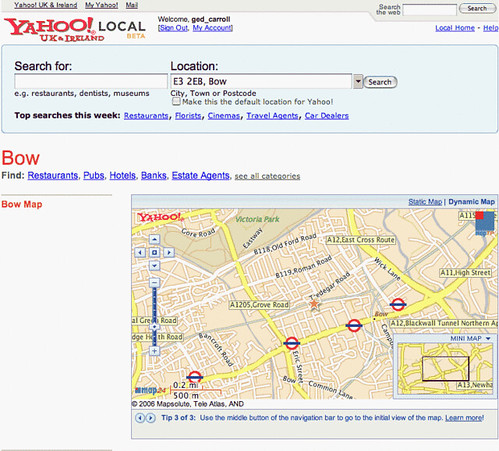
- Having a core API set allowed a service to quickly build out new things based on common plumbing. Flickr’s APIs were as much for internal development as external development. Another example was the Yahoo! UK’s local search product combining business directory data, location data and mapping.
There was also a mindset shift, you had more real-world conferences facilitating the rapid exchange of ideas, alongside an explosion of technical book publishing. One of the most important nodes in this shift was Tim O’Reilly and business O’Reilly Publishing. Given O’Reilly’s ringside seat to what was happening, he got to name this all web 2.0.
Finally, a lot of the people driving web 2.0 from a technological point of view were seasoned netizens who had been exposed to early web values. The following cohort of founders like Mark Zuckerberg were more yuppie-like in their cultural outlook, as were many of the suits in the online business like Steve Case or Terry Semel. But the suits weren’t jacked into the innovation stream in the way that Zuckerberg and his peers – but that would come later.
This was the zeitgeist that begat Pipes by Yahoo.
The approach to a new type of search needed the foundational skills of web 2.0 and its ‘web of data’ approach. Yahoo! acquired number of companies including Flickr, Upcoming.org and Delicious. At the time developers and engineers were looking to join Yahoo! because they liked what they saw at Flickr, even though the photo service was only a small part of the roles at the business.
Web 2.0 talent
The kind of people who were building new services over APIs were usually more comfortable in a scrappy start-up than the large corporate enterprise that Yahoo! had become. Yet these were the same people that Yahoo! needed to hire to develop new products across knowledge search, social and new services.
There were some exceptions to this, for instance the 26-person team at Whereonearth who operated a global geocoded database and related technology had a number of clients in the insurance sector and Hutchison Telecom prior to being acquired by Yahoo!. The reason why Yahoo! became so interested was a specific Whereonearth product called Location Probability Query Analyser. The technology went on to help both the Panama advertising project and Yahoo! search efforts. George Hadjigeorgiou was tasked with helping them get on board.
I knew some of the first Flickr staff based out of London, they sat alongside technologist Tom Coates who would later work on FireEagle. They all sat in a windowless meeting room on a floor below the European marketing team sat in.
Most people didn’t even know that they were there, working away thinking about thinks like geotagging – a key consideration in where 2.0 services and mobile search.
Going over to the Yahoo! campus in Sunnyvale made it clear to me that the difference in cultural styles was equally different over there, from just one cigarette break with Stewart Butterfield of Flickr.
Secondly, there was the locale. The best way I found to help British and Irish people get the environment of Silicon Valley was to describe it as a more expansive version of Milton Keynes with wider roads and a lot more sunshine. One of the biggest shocks for me on my first visit to the Bay Area was how ordinary Apple and Google’s offices felt. (This was 1 Infinite Loop before Apple Park construction started). The canopy over the main building entrance looked like an airport Novotel, or every shopping centre throughout the UK.
In the same way that Milton Keynes is not London; Silicon Valley’s quintessential campus laden town Sunnyvale is not San Francisco.
This is not the dystopian doom spiral San Francisco city of today with failed governance and pedestrianisation projects. At this time, San Francisco was on the up, having been clobbered by the dot com bust in the early noughties, financial services had kept the city ticking over. Technology was on the rise again. Home town streetwear brand HUF was making a name for itself with its first shop in the Tenderloin, the DNA Lounge had consistently great nights from west coast rave and goth sounds to being a haven for mashup culture with its Bootie nights.
There was great cinemas, vibrant gay night life and the sleaze of the Mitchell Brothers O’Farrell theatre. The Barry Bonds era San Francisco Giants won more than their fair share of baseball matches.
If Yahoo! were going to keep talent, they’d need a place in the city. It makes sense that setting up the San Francisco space fell to Caterina Fake. Fake was co-founder of Flickr and was given a mandate by Jerry Yang to ‘make Yahoo! more like Flickr’. So she decided to set up an accelerator for new products.
Brickhouse
According to Caterina Fake on Threads:
I dug around on the company intranet and exhumed an old deck for an initiative called “Brickhouse” which had been approved by the mgmt, but never launched.
Caterina Fake (@cefake on threads)
This tracks with my experience in the firm, projects would form make rapid progress and then disappear. And during the first dot com boom, San Francisco was home to online media companies, such as Plastic (Razorfish SF), Organic and Agency.com, many of whom also had offices in New York. Wired magazine had its office there, as did a plethora of start-ups.
Fake goes on to say that Brickhouse managed to use the same office space she had worked in while she had worked at Organic over a decade earlier.
The 60 Minutes episode Dot-com Kids marked an acme in this evolution of San Francisco. At the time Fake was doing this exercise, there was probably a Yahoo! sales team based in San Francisco proper, but that would be it.
Fake cleans up the Brickhouse deck and gets it through the board again with Bradley Horowitz with the then Chief Product Officers Ash Patel and Geoff Ralston, president Sue Decker and chief Yahoo Jerry Yang being the board champions of the project.
Fake hands off to Chad Dickerson to realise Brickhouse as she heads off on maternity leave. Fake, Dickerson and Horowitz assemble the Brickhouse team (aka the TechDev group) and ideas that would eventually build Pipes by Yahoo!, Fire Eagle and other projects.
This is where my origins viewpoint on Pipes by Yahoo finishes. For the download on its creation, go here now; the link should open in a new tab and I will still be here when you get back to discuss the service’s impact.
Pipes by Yahoo was launched to the public as a beta product on February 7 2007. Below is how it was introduced on the first post added to the (now defunct) Yahoo Pipes Blog. At this time product blogs became more important than press releases for product launches as information sources to both tech media and early adopters.
Introducing Pipes
What Is Pipes?
Pipes is a hosted service that lets you remix feeds and create new data mashups in a visual programming environment. The name of the service pays tribute to Unix pipes, which let programmers do astonishingly clever things by making it easy to chain simple utilities together on the command line.
Philosophy Behind the Project
There is a rapidly-growing body of well-structured data available online in the form of XML feeds. These feeds range from simple lists of blog entries and news stories to more structured, machine-generated data sources like the Yahoo! Maps Traffic RSS feed. Because of the dearth of tools for manipulating these data sources in meaningful ways, their use has so far largely been limited to feed readers.
What Can Pipes Do Today?
Pipes’ initial set of modules lets you assemble personalized information sources out of existing Web services and data feeds. Pipes outputs standard RSS 2.0, so you can subscribe to and read your pipes in your favorite aggregator. You can also create pipes that accept user input and run them on our servers as a kind of miniature Web application.
Here are a few example Pipes to give you an idea of what’s possible:
- Pasha’s Apartment Search pipe combines Craigslist listings with data from Yahoo! Local to display apartments available for rent near any business.
- Daniel’s News Aggregator pipe combines feeds from Bloglines, Findory, Google News, Microsoft Live News, Technorati, and Yahoo! News, letting you subscribe to persistent searches on any topic across all of these data sources.
What’s Coming Soon?
Today’s initial release includes a basic set of modules for retrieving and manipulating RSS and Atom feeds. With your help, we hope to identify and add support for many other kinds of data formats, Web services, processing modules and output renderings.
Here are some of the things we’re already got planned for future releases:
- Programmatic access to the Pipes engine
- Support for additional data sources (such as KML)
- More built-in processing modules
- The ability to extend Pipes with external, user-contributed modules
- More ways to render output (Badges, Maps, etc…)
Pipes is a work in progress and we’ll need your help to make it a success. Try building some simple pipes and advise us what works well and what doesn’t in the online editor. Tell us how you’d like use Pipes, what we can do to make cool things possible, and show us ways you’ve found to use Pipes that never even occurred to us. In return, we promise to do our best to make Pipes a useful and enjoyable platform for creating the next generation of great Web projects.
And please have fun!
The Pipes Development Team
Pipes impact
I had a good, if exhausting time at Yahoo! It was first inhouse role and my part of the central marketing team had an exhausting workload. By the time Pipes by Yahoo launched, I had left Yahoo! Europe. There has been a re-organisation of European arm and the business had been ‘Kelkoo-ised’; a few of us on the European central marketing team took the opportunity to take the money and run.
I remember bringing Salim (who headed the European search team) up to speed and getting his support to push for me getting a payout, rather than fighting my corner.
Peanut Butter Memo
Brad Garlinghouse’s peanut butter manifesto was made public towards the end of the year portraying a game of thrones type power play which would have seen the kind of structures that were put in place in the European organisation rolled out globally.
On the face of it, some of it was pertinent, but it lacked a wider vision.
While Garlinghouse has gone on to have a really successful career at Ripple; the Yahoo! business unit he ran had several problems. He was in charge of Music and the Comms & Community BU. At the time it had a poor record of building products fit for early adopters like music properties that aren’t Mac-compatiable, this was when the iTunes store and Apple iPod springboard off the Mac community and into the mainstream.
The then new Yahoo! Mail which didn’t work on Safari and a Messenger client which was worse to use than third party clients like Trillium or Adium. All of which made it hard to build a buzz that will bridge to mainstream users. Yahoo! Messenger, could have been Skype or WhatsApp. It became neither.
For a more modern example, think about the way Instagram and Threads were Apple iPhone first to build a core audience.
At the time, I was less charitable about the memo. And the memo raised wider questions about the business; like was the CEO facing an executive revolt?
The launch of Pipes by Yahoo helped to inject some more positive energy back into the Yahoo! brand. Remember what I said earlier on how talent wanted to join Yahoo!’s engineering and development teams because of Flickr. They started to want to join Yahoo! because of Pipes.
The outside world
I was back agency side when Pipes launched. I had friends within Yahoo! still and kept an eye on the various product blogs. I got the heads-up on Pipes and put aside an afternoon and an evening to explore it fully. A quick exploration gave one an idea of how powerful Pipes by Yahoo could be. While Pipes was powerful, it was also relatively user friendly, like Lego for data. It was more user friendly than Apple’s Automator, which inspired Pipes by Yahoo! in the first place.
At this time in London the amount of people working on social media and online things was still relatively small. Knowledge was shared rather than hoarded at grassroots events and on an ecosystem of personal blogs. This was a group of eople with enquiring minds, a number of whom I can still call friends.
We shared some of the public recipes on Pipes by Yahoo and learned from them, just as I had learned about Lotus 1-2-3 macros in the early 1990s, by picking through other peoples examples. (I put this to use automating data records in the Corning optical fibre sales support laboratory that I worked in at the time.)
The agency I worked with had a number of large technology clients including AMD, Fujitsu Siemens personal computing devices – notably smartphones, parts of Microsoft and LG.
AMD and Microsoft were keen to keep track on any mention of their brand in a number of priority blogs or news sites at the time. Social listening was in its infancy and there were a number of free tools available, which I got adept at using.
We managed to build and sell both AMD and Microsoft respectively a custom feed which provided them with links to relevant content in near real-time, which they then published on an internal site so that key audiences always had their fingers on the pulse.
This was all built on top of two free Pipes by Yahoo accounts which used a similar but tweaked recipes to make this happen.
On the back of that work, we managed to sell in a couple of small websites to the Microsoft team based on WordPress. I had long moved on to another agency role by the time the Pipes by Yahoo feeds would have died.
Discussing Pipes by Yahoo with friends, they said it had inspired them to learn to code. Pipes by Yahoo spurred creativity and creation in a similar way to HyperCard.
Zeitgeist
While all of this has talked about Pipes by Yahoo! and how great the launch was, the ending of Pipes was much more humdrum. The service had been glitchy at the best of times and wasn’t being maintained in the end. In conversations I had with friends, it was compared to a British sports car: unreliable but loveable. Yahoo! closed it down on September 30, 2015.
Which begs the question, why is Pipes by Yahoo, which was shut down eight and a half years ago being celebrated amongst the digerati?
I think that the answer to this is in the current online zeitgeist. The modern web isn’t something that anyone involved in web 2.0 would have signed up for. Algorithms have fragmented the global town hall archetype envisaged for social. The web no longer makes sense in aggregate, as it’s splintered by design.
The modern web feels ephemeral in nature. This seems to have gone hand-in-hand with a video first web exemplified by TikTok.
The social platforms the fragmentation seem to be declining in relevance and its isn’t clear what’s next. The people-driven web of knowledge search and web 2.0 is under pressure from AI content providing a mass of ‘just good enough’ content. Even influencers are being usurped by digital avatars. Even the audience engagement is often synthetic. All of which leaves the netizen in a state of confusion rather than the control that Pipes by Yahoo offered.
Taylor Lorenz is a journalist who made net culture and platforms her beat. Taylor Lorenz’ book Extremely Online feels like she is reporting from another planet rather than the recent web and it was published in October last year.
More information
Let’s Get This Straight: Yes, there is a better search engine | Salon.com (December 21, 1998)
The Original GOOGLE Computer Storage Page and Brin
Notre histoire en détail | Google
How Google Became a Verb | TLF Translation
Facebook Yahoo! patents case | renaissance chambara
Yahoo! Answers Adoption | renaissance chambara
Nobody Knows What’s Happening Online Anymore – The Atlantic
Extremely Online: The Untold Story of Fame, Influence and Power on the Internet by Taylor Lorenz
The Age of Social Media Is Ending | The Atlantic
AI is killing the old web, and the new web struggles to be born | The Verge