Ideas were at the at the heart of why I started this blog. One of the first posts that I wrote there being a sweet spot in the complexity of products based on the ideas of Dan Greer. I wrote about the first online election fought by Howard Dean, which now looks like a precursor to the Obama and Trump presidential bids.
I articulated a belief I still have in the benefits of USB thumb drives as the Thumb Drive Gospel. The odd rant about IT, a reflection on the power of loose social networks, thoughts on internet freedom – an idea that that I have come back to touch on numerous times over the years as the online environment has changed.
Many of the ideas that I discussed came from books like Kim and Mauborgne’s Blue Ocean Strategy.
I was able to provide an insider perspective on Brad Garlinghouse’s infamous Peanut Butter-gate debacle. It says a lot about the lack of leadership that Garlinghouse didn’t get fired for what was a power play. Garlinghouse has gone on to become CEO of Ripple.
I built on initial thoughts by Stephen Davies on the intersection between online and public relations with a particular focus on definition to try and come up with unifying ideas.
Or why thought leadership is a less useful idea than demonstrating authority of a particular subject.
I touched on various retailing ideas including the massive expansion in private label products with grades of ‘premiumness’.
I’ve also spent a good deal of time thinking about the role of technology to separate us from the hoi polloi. But this was about active choice rather than an algorithmic filter bubble.
This Reid Hoffman video stands in sharp comparison to the Ayn Rand-loving frat-bro culture that seems to infect technology sector companies based in Silicon Valley. However Hoffman in his past has reflected at least some of their libertarian views.
However Reid Hoffman is cut from different cloth and represents a slightly older generation in the technology sector who pioneered the dot.com era.
He grew up in Berkeley, back when the technology sector was more hardware focused and Silicon Valley actually made micro-chips. Back then HP (now Agilent) and Techtronix made measurement equipment in the Valley and it was the centre of the cold war missile technology. The east coast from IBM in New York State to the Boston corridor represented a worthy adversary of Silicon Valley. The technology sector only opted to have Silicon Valley as its home during the move to personal computing.
eWorld
Hoffman worked at Apple on eWorld – an early way of connecting Macs to the nascent public internet. There was interesting ideas that came out of that at the time including work on object orientated programming. Apple later abandoned eWorld when they saw the ‘net taking off and instead collaborated with selected ISPs like ClaraNet and Demon in the UK.
Reid Hoffman later founded a prototype-social network and was part of the PayPal mafia before founding LinkedIn. The irony is that the PayPal mafia were ground zero for the current generation of technology company CEOs.
Reid Hoffman offers a more thoughtful considered viewpoint on the future of the technology sector.
How Technology is Shaping the Future of Human Society was filmed by the Aspen Institute.
Sex Workers Say Porn on Google Drive Is Suddenly Disappearing – Motherboard – don’t assume that the contents of your Google Drive hasn’t been thoroughly examined by Google. Adult entertainment is merely the canary in the coal mine for Google Drive privacy. I would be very careful about using a cloud storage platform if you haven’t encrypted the entire folder as a bundle before uploading it. And don’t use Google Drive. More related content here.
Consumer behaviour
The unparalleled joy of writing with a fountain pen – and five beautiful pens to inspire you – Country Life – Among the obituaries of a former Conservative Minister a few years ago, there was one delightful snippet. A line in The Daily Telegraph described how, when she received the letter from Mrs Thatcher appointing her to the Lords, Lady Blatch initially believed it to be a hoax, because the letter was signed in Biro and she had been ‘brought up to believe that nobody who matters uses a Biro’.
Millennials: you will not be quite so special in the ‘futr’ | FT – could it be that millennials, the most scrutinised, criticised and debated generation of our time, were not that special any more? “Millennials are still important as a customer,” Ms Ganatra told me later. But there is now a “millennial mindset” that has nothing to do with age, she said. In other words, millennials may have been the first generation to have grown up in a digital world but the rest of us are catching on fast. People of all ages are now so used to shopping with a click or talking to a chatbot that retailers need to think about the needs and desires of all their customers, not just those born between 1981 and 1996 – or an artificial construct in terms of their digital uniqueness
Ideas
Cigarettes are the vice America needs | FT Alphaville – Cigarette smoking is essentially the anti-Facebook. While Facebook is a fundamentally misanthropic venture that pretends to be a community, smoking is a community activity for people who pretend to be misanthropes. The activity itself is fundamentally pro-social! It gives people reasons to interact with strangers (“got a light?”). And since it was banned indoors — undeniably a good choice — it gives people a reason to go outside and make idle small talk, all while pursuing a common activity. And unlike alcohol, cigarettes alone don’t often lead to property damage or missed days of work (paywall)
Study: Smart Speakers are Changing the Way We Select Products – interesting how this is impacting retail. FMCG brands in particular should be really concerned as this is far beyond what supermarkets could do with dodgy shelving layouts and look-a-like private label brands
Building for the modern web is really, really hard | O’Reilly – average website clocks in at 4MB with 100s of elements including 3rd, 4th and 5th party based interactions – which also explains page load times – and slow AF ad related technology such as trackers
Is Facebook Really Scarier Than Google? | Nautilus – worthwhile reading about the effect of Google – of course they both have an impact otherwise you wouldn’t advertise on it. The question needs to be does the utility justify the impact? I think search has a better case than a social network, but both have merits
Alex Stamos, Facebook Data Security Chief, To Leave Amid Outcry – The New York Times – Some of the company’s executives are weighing their own legacies and reputations as Facebook’s image has taken a beating. Several believe the company would have been better off saying little about Russian interference and note that other companies, such as Twitter, which have stayed relatively quiet on the issue, have not had to deal with as much criticism
Technology
China’s Huawei Technologies reshuffles board for first time since 2012 – I presume the reason why Mr Ren is getting back behind the wheel is that overall and smartphone revenue figures for 2017 was Huawei’s slowest growth in four years. I am not convinced that premium products will be the way forward when they are locked out of the North American retail system. I am also not sure why the management team at Huawei Mobile Devices hasn’t been refreshed
The Valley of Death: the students vying to be millionaires | Telegraph – In 2015 Oxford, the UK’s number one university for research, produced four spin-outs. Not per professor. That was for the whole university. The situation was not better elsewhere. Data on British university spin-outs is not in any publicly available league table. But it exists, via what’s called the HE-BCI survey (it stands for Higher Education – Business and Community Interaction). For 2015-16, Cambridge University recorded a total of two spinouts in the HE-BCI survey. Imperial College London, another of this country’s most vaunted research universities, listed three. Of 160 institutions, 59 officially produced no spinouts at all.
The new Roxanne Shante biopic looks amazing and you know the soundtrack is going to be good. Roxanne Shante was like a breadth of fresh air in the early rap scene. She had an amazing technique and was well able to cut male competitors down to size. Roxanne Shante is a legend despite her limited profile.
The South China Morning Post have launched a news site for an international audience focused on the Chinese technology sector – Abacus. Given the amount of blogs that used to cover the China tech sector that have disappeared, this is a welcome addition. Its a nice looking site, it has great interactive design and a good editorial team. My one complaint is that it doesn’t have an RSS feed which is a real bummer.
Unsupported | The Greatest Stories Retold – interesting attempts at really short form storytelling. It doesn’t work well in Safari as a web browser. Something to provide creative inspiration for those 15 second ad spot scripts.
Re-evaluating Media is a piece of research put together that tried to rebalance expectations on more traditional media. Whilst there was room to land meaningful points (TV is better at mass reach for a given CPM), and there is an argument to be made for a media neutral approach where the media mix fits the communications problem to be solved. Instead they made bigger leaps and had a methodology that was optimistic at best – this became the focus of debate among people that I knew. There are arguments to be made about the wider role of brand building which would better help traditional broadcast advertising more.
What Siri creator Norman Winarsky thinks of Apple’s Siri now — Quartz – not terribly surprising. Norman Winarsky is now a partner at a number of Silicon Valley venture firms. Whilst he is better known in business space now as a lecturer on business, entrepreneur and VC, he is an academic at heart.
Norman Winarsky via the TechCrunch account on Flickr
Norman Winarsky studied and eventually ended up with a doctorate in mathematics. He started his private sector career at RCA Research (RCA’s answer to Xerox PARC or IBM Research), he had a career there for a number of decade as that moved through various owners. Eventually it became the east coast campus of SRI. Norman Winarsky went on to help found the SRI process for spinning off businesses and technology licensing. He was a co-founder of one of those businesses: Siri – that was bought by Apple. It will be interesting to see if Norman Winarsky has another high impact idea in him moving forwards. More related content here.
That’s the key finding from an analysis of regional and global agency deals by global marketing management consultancy Trinity P3 and Mark Ritson
Alibaba rival JD.com posts first annual profit as a public company | TechCrunch – The company’s fiscal profit was helped by a surprise $35 million profit in Q1 and a lucrative Q3 quarter in which it posted a RMB 1 billion ($151 million) profit thanks to its own efforts on Single’s Day, China’s online shopping bonanza. The company posted a RMB 909.2 million (US$139.7 million) loss for Q4, but that marked a 28 percent decrease year-on-year.
While Alibaba has a higher profile — with enormously profitable quarters — JD.com has quietly built out its e-commerce by expanding into financial services, offline retail and more
Consumer behaviour
This Chinese billionaire felt lost in US without WeChat, mobile payments | South China Morning Post – The chairman of Legend Holdings, the controlling shareholder of Lenovo, said China was now comparable to Japan and ahead of the US in terms of mobile internet technology, digital content and innovative business models.“If you haven’t stayed abroad for a long time, you might not understand [the difference],” said Liu, citing his recent experience in the US. His insights give credence to how Chinese technology companies have cultivated a hi-tech universe so large that it exists almost exclusively on its own – sustained by the country’s 1.4 billion people – but cut off from the rest of the world by Beijing’s Great Firewall, which blocks content not approved by the government. – the problem is that Chinese systems are ‘Galapagos’ technologies
BlackBerry suing Facebook for patent infringement | CNBC – “Blackberry’s suit sadly reflects the current state of its messaging business. Having abandoned its efforts to innovate, Blackberry is now looking to tax the innovation of others. We intend to fight,” Facebook general counsel Paul Grewal said – you see Facebook has sucked the blood out of other businesses for too long. I have little sympathy with them in this suit. It will be interesting to see how robust BlackBerry’s patents are and whether it would be cheaper for Facebook to pay them off or buy the business outright. The question is who is next after Facebook in Blackberry’s legal sights?
Luxury
Balenciaga is Putting its Money Where its Logo-Covered Hoodie Is for F/W 2018 | The Fashion Law – garments on the brand’s runway bore a phone number, +33156528799, which turns out to be Balenciaga’s “new hotline.” Call the number and you can answer a 20-question survey, inquiring about your age, primary language, height, and shoe size, as well as your favorite form of transportation, type of music, season, taste (your options are: Bitter, Salty, Sour, Sweet, or Umami), and so on.
A way for Balenciaga to better understand its customers? Maybe. Considering that the message is ends with the following note: “Thank you for taking the time to answer our questions. All data will be erased now,” I, for one, am guessing this is more interactive experience than fact gathering mission. If we have learned anything over the past several years, it is that “experiences” are everything to the modern-day consumer – I can imagine a choir of marketers howling in a symphony of pain about this
Meet the billionaire millennial pouring money into British fashion… and she’s only 27 | Telegraph Online – ‘My generation has completely different shopping habits,’ says Yu. ‘People born in the 1960s and ’70s buy into established brands such as Dior and Chanel. For them, it’s about showing status and where they fit into society. But my generation isn’t into logos – it’s not cool, it’s too obvious. [And] we prefer to shop online. We’ve become very interested and hungry for young, emerging designers.’
P&G’s Marc Pritchard calls for ‘fewer project managers’ at agencies as he vows to destroy ‘maze of complexity’ – “For media, data and analytics is enabling us to bring more media planning in-house, replacing multiple layers,” said Pritchard. “When it comes to buying, our purchasing people can negotiate with the best of them, so we’re doing more private marketplace deals in-house. And if entrepreneurs can buy digital media, why can’t the brand team on Tide, Dawn and Crest be entrepreneurs and do the same? They can, and they will.”
He explained that P&G wants and needs brilliant creatives, and will invest in such talent. But “creatives represent less than half of agency resources, because they’re surrounded by excess management, buildings and overhead.”
Media
Time for news to fight back | The Australian – Mark Ritson arguing that that agencies may be pushing clients into digital media because it can result in greater commissions for the agencies — in some cases almost 3 times greater than for traditional media (paywall)
Retailing
Smartphone users are spending more money each time they visit a website – Recode – The amount of money people spent per visit to online retailers has increased 27 percent since the beginning of 2015, according to new data from Adobe Analytics. Meanwhile, the length of smartphone website visits has actually declined 10 percent
Silicon Valley Is Over, Says Silicon Valley – The New York Times – In recent months, a growing number of tech leaders have been flirting with the idea of leaving Silicon Valley. Some cite the exorbitant cost of living in San Francisco and its suburbs, where even a million-dollar salary can feel middle class. Others complain about local criticism of the tech industry and a left-wing echo chamber that stifles opposing views. And yet others feel that better innovation is happening elsewhere – like Shenzhen? I think a lot of the problem with Silicon Valley is that it doesn’t build hardware any more. Bright people are mobile for the right pay, what you can’t easily do is the kind of commercialisation and manufacturing speed as a feedback loop like you see in Southern China
Sometimes the most straightforward posts take the longest to write. When I started on this one last week the big question in the minds of people who watch the big advertising conglomerates is are WPP numbers a company problem or an industry problem?
WPP is looking to simplify its structure with a view to becoming a more agile and transparent business from a client perspective.
Or as it was put in the New York Times
WPP plans to accelerate a programme to simplify the business by aligning digital systems, platforms and capabilities to provide bespoke teams for its clients as opposed to the different agencies that currently compete with each other to win contracts.
Other conglomerates, notably Publicis had already started on this path when it started realigning the group under the ‘Power of One’ vision. WPP is bigger with a fuller offering and wider range of specialisms than many of its peers, no one can be under the illusion about the size of this undertaking.
Let’s talk about the tectonic plates shifting around beneath the feet of ALL the large advertising and marketing combines:
Interpublic Group (IPG)
Omnicom
Havas
Publicis
WPP
Dentsu
The tectonic plates are:
The Four
Amazon
The decline of brand marketing
The new competition
The Four
The Four is a label that Professor Scott Galloway put on Apple, Amazon, Google and Facebook. All of whom he considered to be monopolists that created value for their shareholders by putting the ‘real world economy through a shredder.
In this case I would swap out Amazon and Apple for Alibaba and Tencent, but the allusion to a quartet of horsemen portending a digital apocalypse is a useful allegory for the advertising and marketing sector. Amazon deserves a section of its own later.
Galloway’s predictions of their destructive power led to an accurate prediction of WPP’s share price tumble this week. (see the video below)
Correlation does not prove causality however — it doesn’t mean that he got the right numbers for the right reasons.
Depending whom you believe Facebook and Google are responsible for 90 percent of online advertising growth outside of China. This represents a massive concentration of media power. It has implications for the creative and planning functions of an agency. Google and Facebook also run much of the advertising technology that purchase are made on. This has decimated much of the advertising technology sector and made it harder to differentiate media planning and buying based on the technology stack.
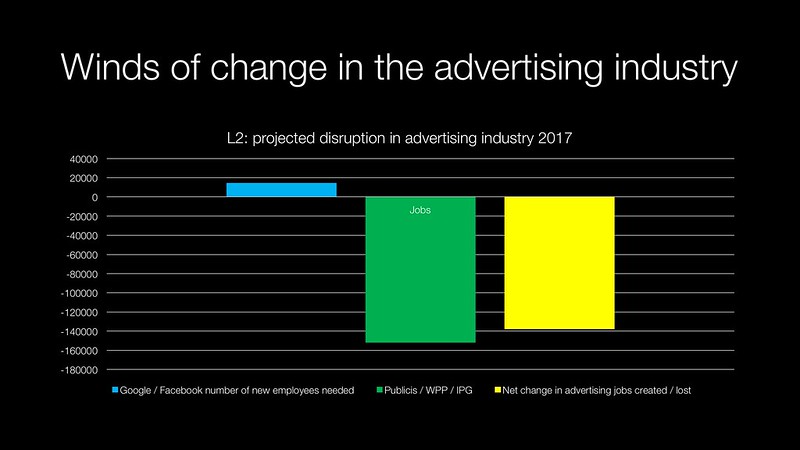
L2 came up with this research last year based on Google and Facebook revenue targets. If they hit their numbers they would be treating around 14,193 jobs. But it would mean that the corresponding projected number of jobs lost in the advertising industry would be roughly the equivalent of every man and woman around the world employed at vehicle maker Nissan. And that’s just 2017.
L2’s calculations don’t take into account China where the advertising industry has been digitising at a much faster rate than in the west with the bulk of growth going to companies controlled by Tencent or Alibaba.
Given that most of the agencies within WPP and its peers operate on a billable hour model; this represents a considerable potential loss of value. Since the number of people directly equates to revenue.
The consolidation of online media also means that many clients will look to take back control of their media planning and buying process. The argument goes something along the lines of ‘a consolidated media landscape allows for consolidated buying by a global media trading desk due to the inherent simplicity in suppliers. The data comes from the inhouse data management platform and the media vendor (Facebook, Google, Tencent or Alibaba)‘.
The always on creative needed to fuel this process is also being increasing done in inhouse studios, in partnership with their creative agencies as a kind of hybrid model.
This is what Marc Pritchard meant when he talked about taking back control of Procter & Gamble’s marketing as part of a process to save $1.2bn by 2021. In the latest financial results, WPP claimed that their media buying margins had not suffered – only creative had.
Amazon
At the time of written Jeff Bezos is worth about 112 billion dollars, or just under double the annual defence budget of the UK for 2018. Amazon impacts the advertising and marketing industry in multiple ways.
It is starting to become a big player in online advertising in its own right. I think it would be fair to say that this competition to Google is welcome for the marketing conglomerates judging by Sir Martin Sorrell’s commentary on the likes of CNBC.
Amazon has decimated the high street. Toys R Us, Borders Group, Tower Records, Radio Shack, Maplins are just some of the names which have disappeared. It took a good number of years for people to realise that retailers are locked in a zero sum game when Amazon competes against them. Amazon has unique access to exceptionally cheap capital via its shareholders. There have been companies who have beaten it back like Alibaba’s Taobao and TMall in China. But the company has built up a huge amount of retail power and decimated brands that would have been advertising agency clients.
Amazon has become the default search engine for buying things. This has already displaced up to 20 percent of Google searches depending on whom you believe. It also means that they can place imitation goods and private label goods against branded products.
Amazon has got great data. Amazon has data at the centre of its business what consumers like, what they don’t like, what sells well on marketplace resellers. This has driven a number of the product decisions:
Increasing customer basket sizes
Expanding into new areas by screwing over marketplace resellers
Focusing their efforts on private label products which directly impacts branded products across categories. Amazon Basics is the most obvious private label to consumers, but there are many more where the link isn’t so obvious
Depending on your brand category the answer may be:
Owning your own retail chain like Apple or LVMH’s DFS Group
Direct sales and subscription services have piqued the interest of FMCG brands like Dollar Shave Club
All of this impacts the advertising sector. For more information on the power of Amazon, I can recommend Scott Galloway’s The Four.
The decline of brand marketing
The relative decline of brand marketing has been driven by a number of factors, some of these factors are good and some aren’t.
Let’s talk about the good reasons first of all.
‘Performance marketing’ driving customers directly to a sale has been transformed by the rise of modern online advertising techniques including search advertising and retargeting. Retailers can zero in on intent to a much greater degree than shopping television or direct response print adverts ever could. Google and social media have turned into reputation platforms which then displayed below-the-line spend from the likes of public relations agencies. This was happening at a time when journalist employed by publications have declined; implying a natural progression
At least some consumers can’t be reached through traditional media channels with sufficient frequency for brand advertising. Social media, online video and banner ads make sense as part of an omnichannel approach
The bad reasons:
The focus on ROI rather than profits has meant that a balance longer term brand building and shorter term sales has fallen out of kilter. Marketing then becomes a reductive process. To use a farming analogy; its like moving from arable farming with crop rotation to slash and burn. This is particularly noticeable in the way private equity management has affected fast moving consumer brands under its control. Zero-based budgeting is seen as a source of cost cutting rather than ensuring the efficient and effective use of marketing resources
Digital first strategies – for many marketers this has meant a move from media-neutral, let the communications problem define the channels used to a digital dogma. I make my living with digital media, but I recognise the flexibility required in thinking to deliver an effective strategy
It isn’t about one approach over another but finding balance that works for sales now and in the future.
The new competition
The rise of digital advertising has seen business services expand ways that we couldn’t predict. Advertising agencies like Ogilvy understood the potential for digital early on. Consultancies were focused on systems integration and the use of technologies to change business functions. As they became interconnected internally and externally; the progression into marketing made sense.
A reduction in creative budgets caused marketing agencies to move into areas like service design. Consultancies have looked to inject creativity into their values and skills set by mirroring the kind of acquisition strategy that built the marketing conglomerates.
In the meantime technology companies, notably Adobe have treated marketing like any other business function with a sale conducted at the c-suite level just like Oracle or similar. In many respects this move is understandable as companies use a data management platform (DMP) to derive audience insights and improve their digital marketing. This isn’t vastly different from historic data warehousing and data mining applications.
The enterprise software companies allow large companies to do internally what they have previously asked media agencies to do.