Ideas were at the at the heart of why I started this blog. One of the first posts that I wrote there being a sweet spot in the complexity of products based on the ideas of Dan Greer. I wrote about the first online election fought by Howard Dean, which now looks like a precursor to the Obama and Trump presidential bids.
I articulated a belief I still have in the benefits of USB thumb drives as the Thumb Drive Gospel. The odd rant about IT, a reflection on the power of loose social networks, thoughts on internet freedom – an idea that that I have come back to touch on numerous times over the years as the online environment has changed.
Many of the ideas that I discussed came from books like Kim and Mauborgne’s Blue Ocean Strategy.
I was able to provide an insider perspective on Brad Garlinghouse’s infamous Peanut Butter-gate debacle. It says a lot about the lack of leadership that Garlinghouse didn’t get fired for what was a power play. Garlinghouse has gone on to become CEO of Ripple.
I built on initial thoughts by Stephen Davies on the intersection between online and public relations with a particular focus on definition to try and come up with unifying ideas.
Or why thought leadership is a less useful idea than demonstrating authority of a particular subject.
I touched on various retailing ideas including the massive expansion in private label products with grades of ‘premiumness’.
I’ve also spent a good deal of time thinking about the role of technology to separate us from the hoi polloi. But this was about active choice rather than an algorithmic filter bubble.
Walmart has built over 100 Walmart store of the future designs. Some of the elements seek emulate the best bits of Target with seasonal low priced items close to the door and a more experiential approach to merchandising.
Mike Mozart
Some of the other changes in the Walmart store of the future include QRcodes on signage and a Walmart smartphone app for self-checkout show a blending of real world and digital, or as we like to call it here, the web of no web.
CIA director William Burns
CIA William Burns gave this wide ranging talk in February 2023. It seems apropos to share it here. Burns was involved in the Middle East before and through much of GWoT (global war on terror). Burns commentary on the Middle East at the time is very much worthwhile about thinking about now. Burns’ book The Back Channel was frank about his failings as well as successes when it was published back in 2021.
Burns handled the Ukraine conflict particularly well in the early stages. His comments on Israel and Palestine look particularly prophetic now, even though western intelligence agencies were shocked by what happened on October 7, 2023.
I’m sorry to be so uplifting today about the international landscape, and I also have to say that, you know, in the conversations I had with Israeli and Palestinian leaders, you know, I think it left me quite concerned about the prospects for even greater fragility and even greater violence between Israelis and Palestinians as well. You know, I was, as Barbara mentioned, a senior U.S. Diplomat 20 years ago during the Second Intifada, and I’m concerned, as are my colleagues in the intelligence community, the lot of what we’re seeing today has a very unhappy resemblance to some of those realities that we saw then too.
William J Burns
Operation Shady RAT
How an experimental honey pot simulating computerised industrial systems reveal the long term hacking programme done by APT 1 for the Chinese government. The RAT in question was a ‘remote access trojan’ piece of malware.
Irish radio broadcasting
RTÉ, the Irish public broadcaster started broadcasting radio programmes in 1926. At the time it was called 2RN, it became by Radio Athlone, which was eventually called Radio Éireann in 1938. The ‘T’ came in after to the first television broadcasts in 1961.
RTÉ was central to my identity as an Irishman spending a good deal of my childhood in Britain – my culture, language and literature came through the speakers. The programmes now conveyed online offer my parents an information lifeline to everything happening at home since the long wave and medium wave radio services were shut down. This documentary from 2001 reflects one the first 75 years of Irish radio broadcasting.
Greg Lukianoff and Rikki Schlott: The Canceling of the American Mind
Talk at the Churchill Club of California about their book The Cancelling of the American Mind. It is interesting hear Rikki Schlott reference The Coddling of The American Mind, which Lukianoff co-wrote with Jonathan Haidt. In Cancelling the authors look to document some of the failings in how cancel culture works on campus and in the workplace. It is much more of a partisan work than Coddling, mainly because it driven by Foundation for Individual Rights in Education. The comparison to the red scare of the 1950s are interesting.
China’s rule is described by the German government as guided by ideology. Germany has pulled away from its historic strategy due to China’s approach being guided by ideology. The classification of systemic rival due to China’s guided by ideology approach sets the German government against pro-China businesses including BASF, Daimler-Benz, Deutsche Telekom and Volkswagen Group.
Chinese acquisitions of German specialist companies have been guided by ideology as much as business benefit. Germany let go critical companies like Kuka – the robotics specialist to specialist construction equipment.
Sentiment in the Mittelstand industrial base of Germany has turned negative as China’s rule became increasingly guided by ideology.
Apple discriminated against US citizens in hiring, DOJ says | Ars Technica – investigation “found that Apple engaged in a pattern or practice of citizenship status discrimination in recruitment for positions it hired through PERM, and that the company’s unlawful discrimination prejudiced US citizens, US nationals, lawful permanent residents, and those granted asylum or refugee status. These less effective recruitment practices deterred protected workers from applying to positions that Apple preferred to fill instead with PERM beneficiaries.” Apple did not advertise PERM positions on its external job website like it does with other positions, the DOJ said. “It also required all PERM position applicants to mail paper applications, even though the company permitted electronic applications for other positions,” the DOJ said. – Bob Cringely had been talking about similar antics at IBM for years. I expect that you will see this across the technology sector
Alstom: the French train giant battling to stay on the rails – “If Alstom had a problem, the whole of France would find itself pretty stuck,” given the company supplies most of the country’s trains and metros, said an executive at a rival manufacturer. “It can pose a major industrial risk.”
Klick Wire | Telehealth top app type for 45+ – it all comes down to how you define telehealth and how app versus ‘system’ usage is measured. I would imagine alarm and SMS / messaging would still rank very high
Hong Kong
Hong Kong man wanted over fatal hold-up shooting arrested after 32 years on the run | South China Morning Post – its like a vintage Chow Yun Fat film, but in real life. In the years running up to recolonisation there were a lot of armed robbers perpetrated by mainlanders who would come in do the job and return. These jobs often used AK pattern weapons, apparently from China but just as likely left over from the wars that ravaged South East Asia
How Israel’s spymasters misread Hamas | FT – before Hamas launched its October 7 attack, Avi Issacharoff, co-creator of Israel’s hit television thriller Fauda, rejected a possible plotline for one episode in which Hamas fighters stormed the border fence and attacked Israel, deeming it too implausible. Israel’s security services apparently thought the same.
I put the December 2023 newsletter together early because I know how December goes.
It used to be that Christmas parties and a gradual disappearance of clients and colleagues meant that the month effectively ended on December 15.
Christmas card from the old Adidas Originals boutique on Newburgh Street (as I write this the store is now occupied by Ralph Lauren’s RRL brand
In recent years all that went out the window. Clients called pitches for early January, which meant working up to and over the Christmas period. New projects came in that absolutely, positively had to have a first round of creative for the first week in January.
Whatever the holiday season throws at you, and whatever your favourite festival of choice to celebrate it is called. Have a great one! (Here’s a soundtrack for the vibes.)
Being thankful.
A good deal of December is about being thankful. The people and things that I am being thankful for (a by no means complete list).Things and people that I am being thankful for (a by no means complete list).
My strategy brethren: Parrus Doshi, Lee Menzies-Pearson, Sarath Koka, Colleen Merwick, Maureen Garo, Conall Jackson, Alice Yessouroun, Makeila Saka, Zoe Healey and Calvin Wong
Client services and creative partners who were in the thick of it: Greg Barter, Francisco Javier Galindo Aragoncillo, Anthony Welch, Ian Crocombe, Leanne Ainsworth, Stephen Holmes and Noel Wong
Other smart people in the industry: Stephen Potts, JeremyBrown, Darren Cairns, Robin Dhara, Martin Shellaker and Lisa Gills
Things: WARC, the IPA
With that done, let’s get into the December 2023 newsletter!
Things I’ve written.
Thinking about listening pleasure and the amount of factors that affect how we listen to music.
Omakase – how a personalised experience migrated from high end Japanese sushi restaurant to reinvent food and beverage practice in Korea. What is it likely to mean for the rest of us?
Beep – time, time signals and changing consumer behaviour.
Soft girls and slackers – why generational dropout is likely to be a fiction and the true picture of how engaged we all are at work.
Books that I have read.
Technofeudalism: What Killed Capitalism by Yanis Varoufakis posits that Europe has already moved to a post-capitalist (and post-political) technofeudalist state where technology platforms are the defacto rulers. Varoufakis is more important in the way his book will likely influence future regulation and digital policy than as an analysis of the current zeitgeist per se. His viewpoint on the rentier economics of technology platform businesses is shared by other thinkers and academics including Lina M. Khan of the US. Federal Trade Commission.
Warren Buffett and the Interpretation of Financial Statements by Mary Buffett and David Clark. What I would have given for this book when I was studying my finance module in the first year of college. Buffett and Clark break down a bit of the history of Warren Buffett and what to look for on financial statements of publicly listed companies in a very homespun style. I don’t know if it’s a deliberate effect but even the cutting of the thicker than normal pages and inconsistent printing adds to its homespun feel.
Licensed to Kill reminded me of Kipling’s portrayal of ordinary British soldiers in India. Their stories were never told by the historians. It is a similar state today with the contractors that serve in the conflict. There is at least one example where they are whitewashed out of a story in real-time by the US military, who instead gave credit elsewhere in their press statements. It’s fascinating and hugely dispiriting all at the same time.
The surprise for me was that the US reliance on contractors didn’t go back to the first Gulf War, but all the way to Vietnam where oilfield services and engineering contractor Brown and Root were responsible for 85% of the infrastructure deployed. Something I’d never seen mentioned before.
Underground Empire focuses on how financial and trade measures were used by the United States during the conflict and since. My main criticism of the book would be its singular focus on the US, whereas we have also seen these tools used by the European Union, China and Russia in more recent times – with varying degrees of success.
Things I have been inspired by.
The power of nostalgia is constantly underestimated in brand marketing. It’s why you remember ads and jingles decades later – the ‘long’ of The Long and The Short of It. Nothing is more wrapped into nostalgia than what marketers call ‘moments. Christmas is a classic example of a ‘moment’. Christmas in the Carroll household means working with my Dad to get his electro-mechanical control unit and Christmas tree lights down from the attic and carefully assembled in the front room. These lights are old, filament bulbs. Amazon’s plethora of LED lights for the tree mean that you no longer have the opportunity for training in zen-like patience on a December afternoon; checking and replacing each bulb that was blown in order to get the lights to work. Each year my Dad’s tobacco tin of spare bulbs gets precipitously closer to empty.
The tree itself was proudly made in Hong Kong sometime in the late 1960s or very early 1970s with authentic looking plastic pine needles held on branches of tightly wound wire about as thick as a coat hanger, held upright by an ancient plastic-legged tripod. The mechanism to run it is something my Dad cobbled together soon after buying the tree. The lights are wired into a giant disc of metal contact and a former radar motor swings around an armature to activate each contact in turn. All of this is held on a stout board that also has a circuit with a dully glowing bulb to provide resistance. The heat given off by the board and the dull light in a darkened room when it’s going is a reasonable substitute for an open fire in the smokeless zone where my parents live.
The smell of carbon bushes burning and old electrical products warming up is as much Christmas to me as cinnamon or an Old Spice gift set.
Once everything is running optimally it is covered in fibreboard boxes that are still wrapped in unblemished vibrant kitsch 1970s Christmas paper.
Another element of Christmas in the Carroll household is Jim Reeves’ 12 Songs of Christmas album that my parents have on repeat from December 1st onwards.
I took a trip down to the Young V&A museum in Bethnal Green to see their Japan: Myths to Manga exhibition. It’s designed for little people but delightfully curated.
Sailor Moon drawings from the animation cells
This month, I have been mostly listening to Patten’s second album alongside all the Christmas music. Patten uses AI created samples as his instruments on his tracks. His first album using this technique Mirage.FM reminded me of early 1980s techno in terms of its avant garde, at times discordant sound and tempo. The latest album Deep Blue feels much more organic, closer to hard bop jazz.
I was inspired by an end of year wrap-up by the folks at Superheroic AI on the leading edge of creative tools, which will feed into something I will drop in the new year.
McSweeney’s reimagined Spotify (and last.fm‘s) end of year recaps as if WebMD had done it…
But Ged, why no Christmas adverts?
By this time of the month, I am over Christmas adverts already, instead here’s a vintage clip from the Republic of Telly that explores some of the tropes of Christmas ads. I suspect that this was strongly influenced by campaigns mobile phone network Three Ireland had run over a number of years, but neatly skewers the cliches in much of Ireland’s adverts that come to focus on family members who can’t come home.
RTÉ television
Ok, ok, I will give you a Christmas ad, just not one of the ones that you’re expecting. In Japan, Christmas is when people eat KFC (this is down to KFC’s first Japanese franchisee marketing to expats looking for a turkey substitute on Christmas in the 1970s, which then became a wider thing in Japanese society). It is also a kind of mid-winter version of Valentine’s Day since it’s not bound by its western context. Which is why Sky condoms dropped this advert below. Thankfully there is no awkward fumbling with a drunk colleague in the stationery cupboard in the advert.
Going beyond Christmas and into 2024, Trendwatching have created an interactive web page outlining 15 industry-specific trends and 45 innovations related to the trends. Worthwhile going through for thought-starters, more here.
Things I have watched.
It’s cold and dark and I make no apology for my films being unapologetically escapist and and entertaining to try and counterweight the drab conditions.
Bosch Legacy season 2 – Titus Welliver as Harry Bosch is a great bit of casting and I have yet to tire of the Bosch series on Amazon Prime.. Part of this is down to Michael Connelly’s involvement, who has done a good job keeping the show in tune with his books. Season 2 is based on The Wrong Side of Goodbye and The Crossing. If you haven’t watched any of them start at the beginning with Bosch season 1and work your way through to the Bosch Legacy series.
Reacher season two – I always found Tom Cruise’s adaption of the Jack Reacher books a bit odd. I liked watching him play opposite Werner Herzog, but Cruise wasn’t Reacher. In the Lee Childs books Jack Reacher’s a blond blue-eyed man mountain. He’s not a weirdly intense Napoleon-sized fragile soul – the very things that made Cruise fantastic in Magnolia. In the Amazon Prime series, that is not an issue because former teenage mutant ninja turtle Alan Ritchson fits Childs’ character to a tee and the character development is really well done. Season one was amazing and season two is off to a great start. This season is based on the book Bad Luck and Trouble.
The Lord of The Rings – I was in primary school when I first got to see this film. We’d just read The Hobbit and aped around hall acting out part of The Lord of the Rings that we were reading in class. Ralph Bakshi’s animation of the first book and a half of LOTR amazed me with its mix of animated characters and rotoscoped backdrops.
Ralph Bakshi in his own way has been just as much a visionary as Walt Disney, he brought a ‘realism’ to his animation. Due to a dispute with the studio Bakshi refused to make the second part of this film which is a shame. When you get to see Peter Jackson’s trilogy, the first film in particular, draws on Bakshi’s work shot for shot in parts (as well as the famous BBC radio drama from 1981). I have enjoyed watching this regularly since, along with Bakshi’s other works: Wizards and Fire & Ice.
Useful tools.
TeuxDeux.
It’s hard to get a to do list that works for you. Trust me I have tried a number of them. What works for me may have variable mileage for you. I have been finding TeuxDeux working for me at the moment and it’s $36/year. Secondly, I like small software companies that are more invested in their software or service and won’t ‘sunset’ (that’s Silicon Valley-speak for shutting down a service) it at the drop of a hat like Google, Yahoo!, Meta etc.
EmbedResponsively.
An oldie but goodie, EmbedResponsively provides a simple service that allows you to put video on a page that will adapt to the viewing device.
FREEKey system
I needed keyrings for my parents that were easy to put keys on or off. My Mum isn’t particularly patient and a broken nail spurred my search for them. The Swedish designed FREEKey system of keyrings solved that problem.
Infogram
Infogram is a service that makes it easier to create data visualisations of different types that I have found useful over the past couple of weeks.
Control Panel for Twitter
Twitter is style annoyingly useful at times. I have got around the worst aspects of it through the use of lists of trusted accounts in certain areas. Control Panel for Twitter is a plug-in that rolls back some of the amendments that Twitter has undergone by Elon Musk.
In terms of my own post-Twitter active social channels, you can find on Mastodon and Bluesky. I am still recovering from the trauma of Pebble closing down as it had the best community of all the post-Twitter platforms.
Cyberduck
When I first started using Cyberduck, it was to access FTP servers for images and videos being transferred. Now it’s more about accessing cloud storage facilities such as Google Drive and Dropbox, without having to synch all the files on to my computer. It can even work with Egnyte within reason.
The sales pitch.
Now taking bookings for strategic engagements or open to discussions on permanent roles. Contact me here.
Ok this is the end of my December 2023 newsletter. Be excellent to each other, have a great Christmas and New Year, I look forward to seeing you back here in 2024. Let me know what you think or if you have any recommendations to be featured in forthcoming issues. See you next month!
I read about soft girls, when a friend shared an article from Glamour magazine with me.
Glamour
Glamour is a women’s magazine published by Conde Nast. When it launched in the UK, it was famous for its ‘handbag format’ size, which then spurred innovation in the summer editions of men’s magazines. Nowadays it’s important for its beauty-led content. But it covers other aspects of wellness through to personal finance.
What is a soft girl?
Soft girl seems to be an extension of quiet quitting. Soft girls was considered to be an aspirational lifestyle. Soft girls are about the now, they don’t want a high-achieving high-flyer. Instead it about being in tune with herself: energy levels, her moods and her menstrual cycle. They’d like to live slowly, read books, artistic pursuits and making dinner for their partner or family.
Many working women can’t to go ‘full soft girl’ and quit working due to having bills to pay. Ultimately, it’s a sub-set of an idealised lifestyle shared on TikTok and Instagram by some women.
Why soft girl mattered?
I received the article wrapped in a critique:
Soft girl lifestyle implies immense social privilege to live a life of leisure.
It would put feminist achievements back decades.
Sharing such content set a bad example for girls and teenagers.
It was a social conservative version of Elysian fields for women who knew their place.
It wasn’t a proper piece of journalism.
Like the gender neutral quiet quitting, it’s a rejection of the rat race at a time when the deck is stacked against workers. In this respect it’s rather similar to the story of generation X slackers who were dealing with Reagonomics and a jobs market devastated by globalisation and automation.
Why soft girls don’t actually matter.
The whole story is based on a central conceit – that cohorts of people, generations if you will are somehow unique and special. The reality is that doesn’t hold true as much as you think. We change as we go through life stages, but there is more that binds us than differentiates us from one and other.
Group cohesion scores ( a measure of how much a given community holds a common set of values measured across 419 statements). In the UK population as a whole, the average majority opinion is held by 48.7% of the population. BBH looked at how generations scored on this measure and found that they differed from the overall population about +1.3, ‘gen-z’ cleaved even closer to the population norm with a difference of -0.2. Generations have no stronger connections to each other than the rest of the population.
Longitudinal patterns.
Remember when I talked earlier about the story of generation X opting out, instead choosing to hold down a McJob and becoming a slacker due to cynicism fuelled by Reaganomics, the cold war and poor employment prospects? It turns out that a Stanford research project found that the cynicism-fuelled life view was down to cross-generational increase in cynicism, rather than gen-Xers. However, the label stuck and marketers missed out on a valuable insight.
The Economist recently highlighted Gallup’s State of the Global Workplace 2023 Report. A survey that it uses to promote its corporate employment engagement practice to help business managers become effective coaches to their teams and use ‘science-based management’.
Gallup describes the survey as ‘the voice of the world’s employees’. In their introduction Gallup discuss how low engagement is costing the global economy about 9% of global GDP, because 59% of employees are ‘quietly quitting’. A further 18% were ‘loud quitting’ or actively disengaged from work. On those numbers alone, quiet quitting is cross-generational in nature.
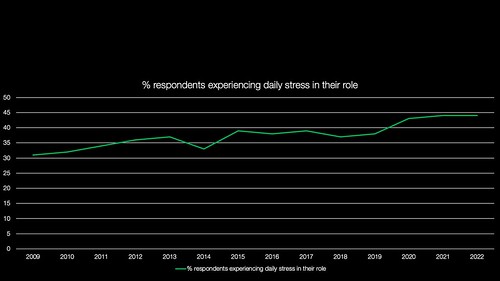
And actively engaged employees have been increasing over the past decade and a half. This increase in work engagement came against a background of progressively increasing daily stress levels at work.
The most reliable indicators of engagement were whether the person was able to work remotely (high engagement) or in a workplace (lower engagement) and management (high) versus individual contributor (low). Women were slightly more engaged than men and age showed no difference.
Soft girls might be just a dreamy balm to get them through the daily grind.
In Canada, as with other countries a beep electronic sound punctuated the correct time. In Canada, this is called the long dash because of its extended tone. In the UK and Ireland I have heard it called the ‘pips‘ three short beeps instead.
Consistency and precision
Before we had precise time mediated by a beep; consistency was still important. The time was marked in different ways:
Church bells
Farm estate clocks
Railway station clocks
Factory sirens
While this time would be consistent on a daily or weekly cycle, it gradually became apparent that it could differ from one town to another. Accurate time was crucial for mariners looking to gain an understanding of how east or west they were – their position in terms of longitude . You compare the position of the sun in the sky, how far it is on its access at midday GMT time and then back calculate your position. But marine chronometers were not commonplace onshore.
Half a century after the development of the chronometer, George Stephenson’s work developing the steam locomotive started what we now think of as railways and the Bessemer steel process allowed for mass production of railway tracks. Railway timetables were the point at which widespread consistency and precision were needed, with a country (or at least a time zone in the case of large countries like Russia, Canada and the United States) having a common time.
Radio
Radio programmes carrying some sort of time signals allowed a country to use watches and clocks that weren’t chronometer accurate that could be periodically compared and reset against the beep of the time signal.
The delay in propagating a time signal in most countries was not meaningful. The beep also featured on speaking clock services where a caller could dial in to a telephone line at a time of their choosing to receive the precise time to the second, every ten seconds. BT still provides the service in the UK. They are used less frequently with the rise of quartz watches, mobile phones and computers.
The Angelus
In Ireland, Roman Catholic heritage combined with the need for a time signal meant that the bells were rung on TV and radio at 12 noon and 6pm for The Angelus. When the Angelus started on the radio, Roman Catholic households would be able to mutter the prayer to themselves. Having it on the radio also served a socio-political purpose as well as a time marking purpose in the Ireland of Eamon DeValera where piousness was a key part of the Irish identity the young country looked to foster.
Modern Ireland, particularly in the urban areas is a very different, more diverse Ireland than the rural-dominated Ireland of DeValera
RTÉ aside
Before Ireland went to a 24 hour broadcast schedule on RTÉ radio 1, the station turned on at 5:30am with an electronically created interval signal that was a more tuneful version of the beep.
This repeated at regular intervals until 6am when the announcer would the start of programming. It often marked my time to get up for my milk round or shift work.
It still appears at the same time, announcing the transition of overnight programming shared with RTÉ Gold to radio one’s first programme of the day Rising Time.
Technology systems
Accuracy was improved by the invention of the first atomic clock in 1955. This built on theoretical work that had been done from the 1930s onwards in the area of magnetic resonance imaging (MRI) devices. By the mid-1960s Hewlett-Packard were building 19″ rack mountable atomic clocks, eventually it became small enough to squeeze on a satellite. By 2004, researchers had built an atomic clock mechanism the size of a coffee bean.
Atomic clock time codes are a crucial part of global positioning satellite signals. Mobile operators have used these. Then there are several radio stations around the world on shortwave and long wave transmitters who send out a regular time code. These timecodes are used to correct clocks and watches including Casio watches with the ‘Multiband 6 feature‘.
Prior to widespread adoption of the internet, computer network workstations, be they Mac or PC would have different times on them, usually set by the user or the system administrator at the computer. While mobile phone networks could distribute accurate time signals to mobile phones, they often didn’t. Some networks supported the summer time transfer, others didn’t.
The internet and workstation grade PC operating systems provided an opportunity for widespread use of network time protocol servers. Sudden your Mac and later on your iPhone and iPad would all have the same time.
Internet time problems
The internet, while providing a format for distributing relatively accurate time to machines has presented its own problem propagating time to humans. There can be a substantial amount of time difference between different ways of receiving broadcast content. The difference is most apparent between internet streaming and terrestrial broadcast radio and television. A good deal of this is down to the nature of best effort packet networks that support the modern web. Video and audio are buffered to provide a seamless experience rather than a precise experience. So time signals on IPTV and audio streamed radio are indicative at best rather than having precision.