Ideas were at the at the heart of why I started this blog. One of the first posts that I wrote there being a sweet spot in the complexity of products based on the ideas of Dan Greer. I wrote about the first online election fought by Howard Dean, which now looks like a precursor to the Obama and Trump presidential bids.
I articulated a belief I still have in the benefits of USB thumb drives as the Thumb Drive Gospel. The odd rant about IT, a reflection on the power of loose social networks, thoughts on internet freedom – an idea that that I have come back to touch on numerous times over the years as the online environment has changed.
Many of the ideas that I discussed came from books like Kim and Mauborgne’s Blue Ocean Strategy.
I was able to provide an insider perspective on Brad Garlinghouse’s infamous Peanut Butter-gate debacle. It says a lot about the lack of leadership that Garlinghouse didn’t get fired for what was a power play. Garlinghouse has gone on to become CEO of Ripple.
I built on initial thoughts by Stephen Davies on the intersection between online and public relations with a particular focus on definition to try and come up with unifying ideas.
Or why thought leadership is a less useful idea than demonstrating authority of a particular subject.
I touched on various retailing ideas including the massive expansion in private label products with grades of ‘premiumness’.
I’ve also spent a good deal of time thinking about the role of technology to separate us from the hoi polloi. But this was about active choice rather than an algorithmic filter bubble.
KanDenko is a Japanese construction company that specialises in infrastructure. This advert communicates effectively what they do in a creative manner. KanDenko must have spent a good deal of money to have this film produced. But it is well worth it.
Vintage Singapore
Footage of Singapore‘s North Boat Quay circa 1983. This area has now been redeveloped with the shop houses refurbished and now holding cafés, restaurants and bars. What this video shows is traditional Chinese life that would have been similar to the mainland prior to Mao’s ‘new China’ which culminated in the cultural revolution.
Thankfully overseas Chinese and Taiwan had preserved the culture and beliefs.
Stussy x Nike
Nike and Stüssy have collaborated on bringing an old Nike model back to life.
New Order’s Blue Monday on 1930s instruments
The BBC made a video of Orchestra Obsolete using early electronic instruments (including a Thermin) alongside traditional instruments to reproduce New Order’s Blue Monday
Distorted Kowloon City
When I first saw this footage of Distorted Kowloon City, I was reminded of the locative art discussed in William Gibson’s novel Spook Country. I read this shortly after being switched on to where 2.0 services while working at Yahoo! on search and Flickr offerings. Yahoo! bought Whereonearth, to better understand what ‘local’ meant with its InternetLocality product set. At the time Whereonearth worked with Three on local mobile services and was a data provider to the likes of insurance companies and credit reference agencies. Yahoo! engineers like Dan Catt and Paul Hammond worked on projects like ZoneTag and including location data in the EXIF metadata of photography; something we just accept as normal on smartphones now.
Distorted Kowloon City is a piece of immersive digital abstract art. Or according to The Hong Kong Trade Development Council (HKTDC)
Kowloon City is full of collective memories of Hong Kong people. Spanning the old town with restaurants and specialty shops, Checkered Hill (also known as Radar Hill), tree-lined parks, the historical remains of the Kowloon Walled City and the former Kai Tak Airport, Kowloon City is as diverse as Hong Kong.
To re-interpret how we perceive, how we feel and how we see Kowloon City, moon.moon weaved the sensory data elements of the real world into an 360-degree audio-visual experience with the aid of original music and technologies (e.g. Point Cloud Processing and drone photography), allowing the public to re-discover Kowloon City from abstract art perspective.
Design Inspire | HKTDC
From this explanation, its a mix of history, Hong Kong culture and geography blended into the art work.
The work was done by local digital artist Moon Hung.
Fractured markets
The effect of low interest rates in the aftermath of 2008 on financial investors was to encourage increased risk taking and one of the first casualties of interest rate increases were UK pensions under management. The FT goes into more depth in a video documentary.
The buzz in part of our office about Midjourney has subsided to be replaced by buzz about ChatGPT, rather than Christmas. ChatGPT is is a software application used to conduct an on-line chat conversation via text. ChatGPT was considered to be a superior example of a chatbot down to the power of machine learning used in creating the content.
I was curious about how good ChatGPT actually was given the following commentary from The Verge:
The primary problem is that while the answers which ChatGPT produces have a high rate of being incorrect, they typically look like they might be good and the answers are very easy to produce
Vincent, J. (2 December, 2022) AI-generated answers temporarily banned on coding Q&A site Stack Overflow | The Verge
The Verge article was interesting. Most of the places where chatbots might be needed: providing customer services, regulated industries like finance would suffer from confident, but incorrect answers being provided to customers.
Secondly, media outlets decided that ChatGPT was a potential Google challenger, with outlets like CNBC comparing the two and equity analysts at Morgan Stanley feeling the need to come out and say that ChatGPT was not likely to replace Google.
Sample of conversation
Google’s innovators dilemma
What became quickly apparent Google’s narrative about being an innovator full stop, has been threatened by ChatGPT. Google as an incumbent is now stymied by Clayton Christiansen’s Innovator’s Dilemma. Google is no longer cool, its conversation related products are seen to be behind the curve and the company is seen as being too big to out-innovate itself easily.
So what’s ChatGPT like to use?
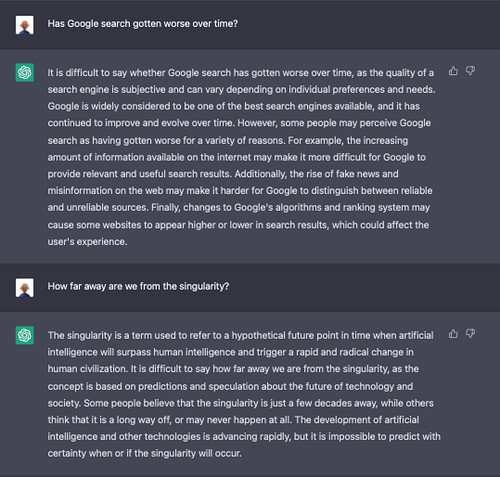
I have shared a picture of some of the better responses I had from the service. I started off with a certain amount of ambition. I asked it about who it felt might win the current war in Ukraine. I found that the training set of data used to power it was finished in 2021. This was obviously done to filter out the worst of the internet from the content, getting around rather than solving problems that previous chatbots have suffered from like Microsoft’s Tay project.
Eventually I managed to get on to safer ground for ChatGPT. It answered questions about what an AI winter was, whether fuzzy logic is a form of artificial intelligence (it is), whether Baye’s Theorem was a form of AI (it isn’t per se, but it is employed to solve some AI problems there similar to the kind of uncertainty challenges fuzzy logic solves.
ChatGPT said that AI (like Bayes Theorem) could be used to provide a solution to buffer bloat – which massively increases the latency on data networks.
I found out quantum computers could make an optimised AI more power efficient and the business expert systems popularised in large companies during the 1980s and 1990s were analogous to modern day AI systems.
It reminded me a lot of content I had read on Summly, the mobile news app that mashed up an AI service API with news sources to summarise articles. This start-up was bought by Yahoo! a decade ago.
In this respect, I do wonder whether ChatGPT is truly the quantum leap forward that many seem to think, or is it merely a reminder of how well understood technology can be applied in different ways?
Can India build a military strong enough to deter China? | Financial Times – I think that this is down to the lead China has in manufacturing capability and innovation as much as anything else. There is a substantial risk that India could lose many of its northern provinces in theory. In theory being the operative phrase here. Ukraine has show what’s possible with people fighting for their homes. It makes more sense for India to think about assymmetric and grey zone tactics at scale to bleed China’s financial and human lifeblood. From hacking well in advance of a conflict, to militias trained and equipped for guerrilla actions allowing for attack in depth once China crosses the threshold.
China boosts military aid to Africa as concerns over Russia grow – Nikkei Asia – China has kept its forces from direct engagement in crises in Africa as part of its noninterference policy, it has also taken an increasingly high profile in United Nations peacekeeping missions. It has sent more than 1,000 troops, police and specialists to oil-rich South Sudan, for example. “When Chinese interests were threatened by insurgencies in Nigeria, China issued a statement, as it still lacks the military commitment. This can, however, change in the future,” Ali said. Experts say China is more focused on economic and national security interests than on peacebuilding. Beijing prefers strategies centered on development that help to alleviate poverty and provide stable governance, but do not necessarily advance protection of individual rights and free markets. But this growth-first attitude may be counterproductive over the long term. In the Democratic Republic of Congo, China has a very close relationship with the government, but attacks in the resource-rich east of the country by a number of rebel groups pose threats to its mining interests. “Insurgencies happen as the product of social exclusion,” Nte said. “There must be a stable political climate to address economic degradation caused by the wrong policies.”
UK economy rebounds by more than expected in October | Financial Times – the second largest contributor to growth in October was performance of the health sector in administration of vaccine boosters and flu shots, the biggest sector was construction. But construction has started to slow since then with sites halting work in November
How Putin’s technocrats saved the economy to fight a war they opposed | Financial Times – tough moral questions to be asked. However, Central Bank governor Nabiullina’s moral calculus reminds me a good deal of convicted German war criminal Albert Speer, in particular the “Speer Myth”: the perception of him as an apolitical technocrat responsible for revolutionising the German war machine. The close alliance with Iran should allow both countries to pool expertise in sanctions busting.
Meanwhile air travel is going great guns according to airlines like Lufthansa who are bringing back their Airbus A380 jumbo jet airliners.
Hong Kong media mogul Jimmy Lai’s sentence casts chill over relaunch, analysts say — Radio Free Asia – “If you can’t say anything anyway, then you might as well locate [your office] in mainland China,” Chow said. “Using Hong Kong as a jumping-off point to the mainland is a waste of money, because rents are much more expensive than in mainland China.” – there is also the tax aspect (expats pay much more tax in Mainland China) and a transferrable currency, but otherwise the point is pretty valid
A Vibe Shift Is Coming. Will Any of Us Survive It? – In the culture, sometimes things change, and a once-dominant social wavelength starts to feel dated. Monahan, who is 35, breaks down the three vibe shifts he has survived and observed: Hipster/Indie Music (ca. 2003–9), or peak Arcade Fire, Bloc Party, high-waisted Cheap Mondays, Williamsburg, bespoke-cocktail bars; Post-Internet/Techno Revival (ca. 2010–16), or the Blood Orange era, normcore, dressing like The Matrix, Kinfolk the club, not Kinfolk the magazine; and Hypebeast/Woke (ca. 2016–20), or Drake at his Drakest, the Nike SNKRS app, sneaker flipping, virtue signaling, Donald Trump, protests not brunch
Amazon’s heroic phase is over | Amazon Chronicles – My first theory is that capitalism doesn’t stop evolving. The evolution of the microprocessor, digital computing, the internet, the personal computer, the World Wide Web, and the tech giants that have emerged in their wake are all transforming capitalism as we experience it and the culture produced by it in ways we don’t even fully understand. These are the biggest companies in the world and the ones with the greatest impact on how we think, work, shop, and communicate. You can’t understand capitalism in the twenty-first century without understanding how technology is changing it. I think this theory is pretty uncontroversial. It’s certainly not new. My second theory is that the arc of capitalism traced by Marx and Lukács and others writing in their tradition can also be retraced on a smaller scale. Like those early modern bourgeoisie, big tech has moved from its initial chaotic and subterranean strivings, to a heroic universalist phase where it championed political and economic liberation. Now these companies are consolidating their dominance by reducing or eliminating their workforce, shifting away from consumer goods, and brokering compromises with state power.
IEDM: DTCO & More than Moore – by Doug O’Laughlin – The future is about Design Technology Co-optimization (DTCO), and Backside Power Deliever Networks (BSPDN) is a huge part of the roadmaps forward post-gate-all-around. A good place to start on what exactly Backside Power Delivery Networks (BSPDN) is is my post I wrote a few months ago about the bold bets Intel is making there. The big takeaway is that BSPDN is clearly going to be inserted in the design processes, and there is a small roadmap of improvements afforded by BSPDN. But after that, BSPDN will change the design process to allow adding more features, like moving functions on to the backside of the chip. By splitting the signal and power layers, there’s a whole new set of ideas of how to design chips with the space afforded from the power layers. This is Design Technology Co-optimization (DTCO) and System Technology Co-optimization (STCO) at it’s best. BSPDN looks like it has several years of obvious scaling potential, so it will be a huge part of the incremental semiconductor process from here until 2030. It will not only improve the energy delivered to the chip, but actually shrink the cell size. Think about it like a new way to organize the room, and now we can fit more in less even though its the same room filled with the same objects. Next, the roadmap in the long term after we have fully achieved backside power contact networks means we could open up the wafer on the other side of the chip. If we are opening up the other side to be a functional signal layer, there’s a potential we can start adding backside devices to the chip! This blew my mind, and the options for stacking layer, memory, and other devices (like energy capacitors) is endless! This is huge! – BSPDN is a key part of Intel’s technology roadmap. BSPDN is a mix of process lithography and logic technology to decouple the power grid from the design.
The proposed technique delivers power from the backside of a thinned device wafer, which allows for greater wafer sizes in terms of the amount of logic in a chip
Business
Jeep-Maker Stellantis Is Laying Off 1,350 Workers, Blaming EVs | Business Insider – interesting and complex picture being painted. In general, electric cars have less parts for assembly than their internal combustion engine powered equivalent cars. The costs must be coming in component costs and or research and development
China
Fashion factory: Mango brings production closer to home in rethink on China | Financial Times – “In this debate about whether 30 years of globalisation will continue or go backwards, the most important thing for us to follow in detail is the China issue,” he said. Asked if Mango would reduce the proportion it buys from the country, Ruiz replied: “I would say yes, but we’ll be very alert to how things evolve.” Mango gains some freedom from the fact it has only six stores in mainland China and consumers there contribute little to total sales, which it predicts will this year surpass its 2019 record of €2.4bn. Other brands have already moved more decisively. The US jeans maker Levi’s and UK bootmaker Dr Martens have been reducing their sourcing from China since before the pandemic.
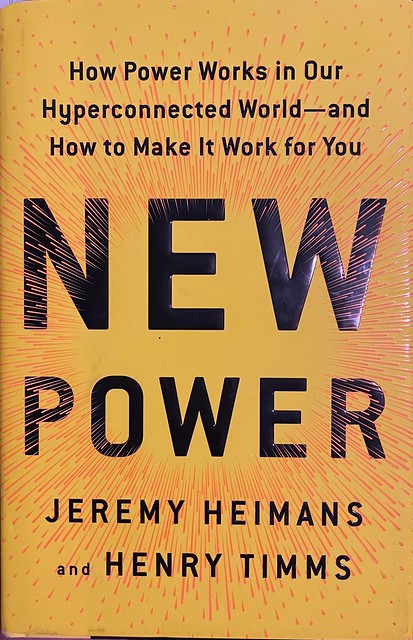
New Power by Jeremy Heimans and Henry Timms was recommended to me by a friend of mine who works with a number of campaigning organisations. It took four years after it was published for me to take it down from the shelf and get stuck in.
Since then, we have had the Hong Kong protests, January 6 disturbances in the US Capitol building where both of their legislative houses operate from. We’ve also had movements around cryptocurrency and the infamous OneCoin scam.
The book promises to reveal:
How Power Works in Our Hyperconnected World – and How to Make It Work for You
Front cover of New Power by Jeremy Heimans and Henry Timms
Jeremy Heimans
Heimans is an ex-McKinsey consultant who now runs a social impact agency called Purpose. So one could think that New Power is basically part of Heiman’s marketing strategy. Make of that what you will.
Henry Timms
Timms heads up the Lincoln Center for the Performing Arts in New York and has been heavily involved in promoting philanthropic donations.
Old Power and New Power
Heimans and Timms provide a model for what they think old power is. A top down power structure, think everything from mainstream advertising, government responses to the COVID-19 epidemic, authoritarian regimes like China’s crushing of dissent or the Russian invasion of Ukraine.
By comparison, new power is participatory in nature and more of a peer to peer relationship. Examples include memes, crypto bros, the leaderless movement that fuelled the 2019 Hong Kong protests, support for populism and ISIS. ISIS recruitment is actually used as an example in the book.
How power works in our hyperconnected world
Heimans and Timms provide an analysis on the general thinking behind how campaigning works in a way that would be most familiar to anyone who has run a social media marketing campaign. I would describe it as a primer for typical corporate management types.
How to make it work for you
I personally think that this is where the book falls down. New Power isn’t replicable in the same way that a business process rengineering exercise might be. Sometimes these things take off, sometimes they don’t. They talk about some of the factors in the book, but movements often need a catalysing event like the recent apartment fire in Urumqi, Xinjiang that sparked anti-zero COVID lockdown protests in China.
You can try and create a catalysing event, but too often it’s astro-turfing that no one ever sees, particularly if you are relying on a dominant platform algorithm. Your new power is actually reliant on old power held by the likes of Mark Zuckerberg or Elon Musk. Instead these platforms have been successfully mastered by authoritarian regimes including the Chinese government who manage to demonetise and have content taken down on western platforms.
Secondly, the authors try to claim showing a bit of moxie is new power. The example they give is a junior employee speaking to a senior executive that they manage to meet by chance.
Finally, the book lacks the intellectual rigour and scientific method of Mark Ritson or Byron Sharp’s work, instead relying anecdotal evidence, similar to Malcolm Gladwell’s body of work or Paul Polman’s Net Positive.
So, should you buy this book?
If you like TED talks model of learning a little bit about a lot of things and are reading for your own personal interest or to get a high level understanding of campaigning organisations might work, buy New Power. If you are thinking about changing your business into a more purposeful organisation, read this first instead (and its free).
You you can find out more about New Powerhere, find the rest of my book reviews here, and the books that I find most useful here.
The heat from radioactive processes within the planet’s interior causes the plates to move, sometimes toward and sometimes away from each other. This movement is called plate motion, or tectonic shift
German Chancellor Olaf Scholz declaration of a zeitenwende or epochal tectonic shift following the Russian invasion of Ukraine. Part of this tectonic shift is Germany’s desire to become a security guarantor in Europe. A lot of coverage has focused on how far away Germany is from this aspiration in terms of military preparedness and over-reliance on the very countries likely to threaten European security.
In an opinion piece Chancellor Scholz asked a rhetorical question
How can we, as Europeans and as the European Union, remain independent actors in an increasingly multipolar world?
Scholz implies that the tectonic shift also adversely affects the United States efforts to jumpstart green industries and contain a globally more aggressive China. One could argue that Scholz’s approach is business as usual. For decades, large German enterprises have encouraged the government to work with authoritarian regimes, creating a Germany highly dependent on bad actors.
Indonesia set to penalise sex outside marriage in overhaul of criminal code | Reuters – the new code could be passed by as early as next week. The code, if passed, would apply to Indonesian citizens and foreigners alike, with business groups expressing concern about what damage the rules might have on Indonesia’s image as a holiday and investment destination. – the question is if this is going to take Indonesia on a similar path of economic stagnation as Malaysia has taken?
Twitter’s decline continues. I noticed this morning that Twitter allowed me to post the exact same Twitter post twice. That isn’t something that was possible previously and I could see how it could be used for nefarious reasons.
My twitter account this afternoon when I checked it
Shein Confusion: The Fast-Fashion Giant’s New Resale Site Doesn’t Make Buying Easy — The Information – Annie tries out Shein Exchange, the e-commerce brand’s foray into the bustling resale market. On its face, the platform seems like a good idea, given the ongoing controversies over Shein’s cheap, disposable, landfill-clogging apparel. But there is something distinctly off about the brand’s effort to sell used clothes
Amazon’s new AI tool may take over work from employees facing layoffs and buyouts – Vox – the tech giant has been working for at least the last year to hand over some of its recruiters’ tasks to an AI technology that aims to predict which job applicants across certain corporate and warehouse jobs will be successful in a given role and fast-track them to an interview — without a human recruiter’s involvement. The technology works in part by finding similarities between the resumes of current, well-performing Amazon employees and those of job applicants applying for similar jobs