Category: ideas | 想法 | 생각 | 考える

Ideas were at the at the heart of why I started this blog. One of the first posts that I wrote there being a sweet spot in the complexity of products based on the ideas of Dan Greer. I wrote about the first online election fought by Howard Dean, which now looks like a precursor to the Obama and Trump presidential bids.

I articulated a belief I still have in the benefits of USB thumb drives as the Thumb Drive Gospel. The odd rant about IT, a reflection on the power of loose social networks, thoughts on internet freedom – an idea that that I have come back to touch on numerous times over the years as the online environment has changed.

Many of the ideas that I discussed came from books like Kim and Mauborgne’s Blue Ocean Strategy.

I was able to provide an insider perspective on Brad Garlinghouse’s infamous Peanut Butter-gate debacle. It says a lot about the lack of leadership that Garlinghouse didn’t get fired for what was a power play. Garlinghouse has gone on to become CEO of Ripple.

I built on initial thoughts by Stephen Davies on the intersection between online and public relations with a particular focus on definition to try and come up with unifying ideas.

Or why thought leadership is a less useful idea than demonstrating authority of a particular subject.

I touched on various retailing ideas including the massive expansion in private label products with grades of ‘premiumness’.

I’ve also spent a good deal of time thinking about the role of technology to separate us from the hoi polloi. But this was about active choice rather than an algorithmic filter bubble.


  • The Inevitable by Kevin Kelly

    I re-read Kevin Kelly’s What Technology Wants and then decided to revisit The Inevitable: Understanding the 12 Technological Forces That Will Shape Our Future. The books make sense as ideal companions for each other, despite some overlap in terms of proof points.

    On the face of it The Inevitable is a less ambitious book than What Technology Wants. And when I started reading the book I didn’t get the kind of electrifying feeling that a big idea can bring, like when I read What Technology Wants.
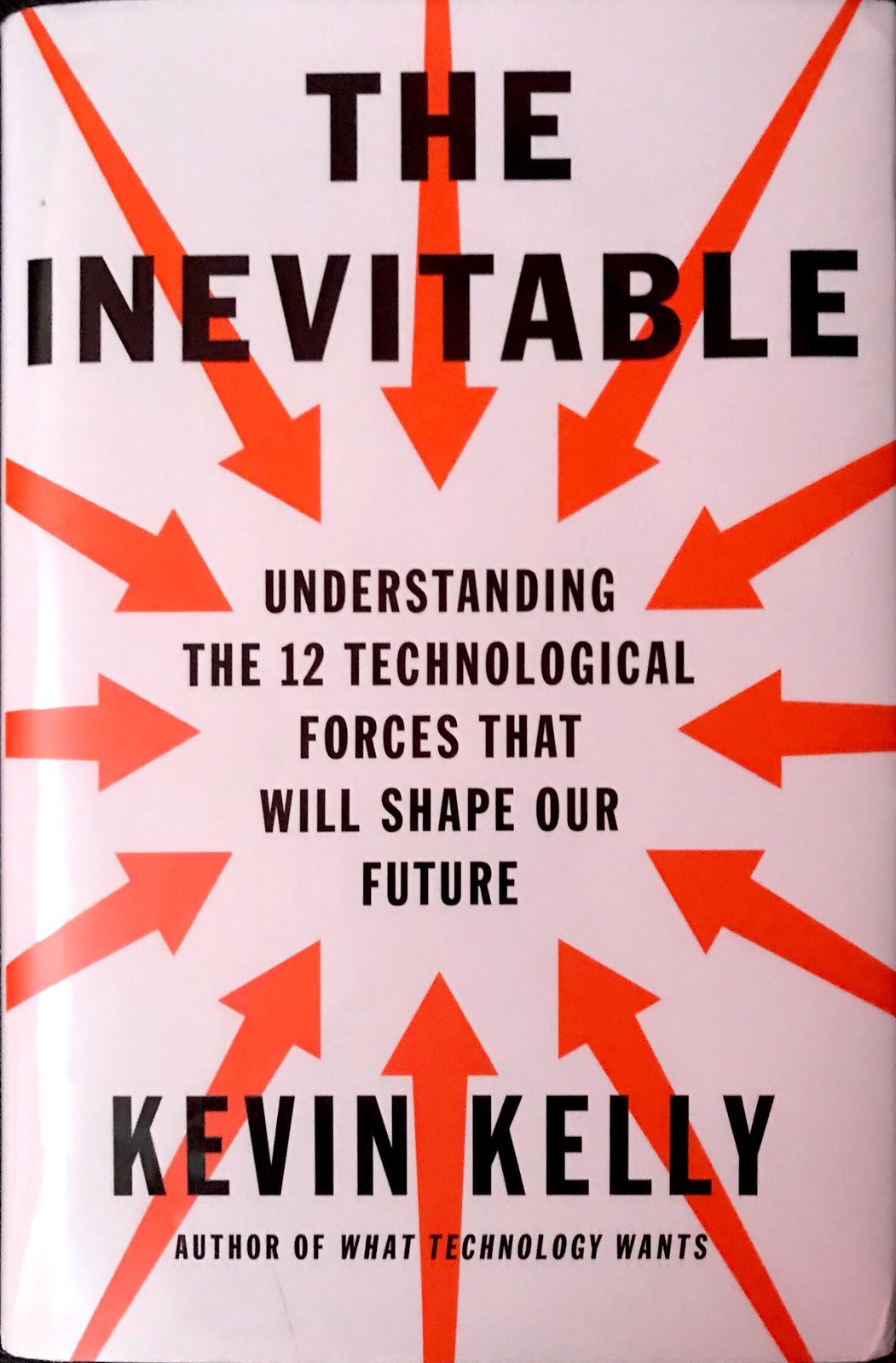
    The inevitable

    In the book Kevin Kelly touches on the kind of areas one would expect in  typical presentation given by an innovation team at an advertising agency. He is an unashamed techno-optimist, but the key difference in his thinking is two-fold:

    • Kelly pulls it together as a coherent idea rather than 12 slivers. He provides in-depth cogent arguments that bind the trends together
    • Kelly argues that transparency in governments will compensate for the erosion of privacy. While I understand where the idea has come from, I don’t agree with this particular viewpoint at least as it would manifest itself in the west. I certainly don’t think that would be the case in the East either. The Nazis use of IBM technology damn near destroyed the world as we know it. The level of trust between the government and the governed is in decline

    There is a clear line of progression in Kevin Kelly’s works from Out of Control written at the start of the modern internet age through to The Inevitable.  If you are interested in how technology is shaping our world buy What Technology Wants; if you are still hungry for more follow it up with The Inevitable: Understanding the 12 Technological Forces That Will Shape Our Future.

    More book reviews here.

  • Marketers: you are not a goldfish and neither is anyone else

    I have grown tired of a ridiculous statistic being used so frequently that it becomes marketing truth. It’s regurgitated in articles, blog posts, social media and presentations. The problem with it is that affects the way marketers view the world and conduct both planning and strategy. The picture below is a goldfish, his name is Diego. If you’ve managed to read this you aren’t Diego.

    Diego

    I realise that sounds a little dramatic, but check out this piece by Mark Jackson, who leads the Hong Kong and Shenzhen offices of Racepoint Global. It’s a good piece on the different elements that represent a good story (predominantly within a PR setting). And it is right that attention in a fragmented media eco-system will be contested more fiercely. But it starts with:

    Over the course of the last 20 years, the average attention span has fallen to around eight seconds; a goldfish has an attention span of nine! The challenge for companies – established and new – is to figure out how to get even a small slice of that attention span when so many other companies are competing for it.

    Mark’s piece is just the latest of a long line of marketing ‘thought leadership’ pieces that repeat this as gospel. The problem is this ‘truth’ is bollocks.

    It fails the common sense test. Given that binge watching of shows like Game of Thrones or sports matches is commonplace, book sales are still happening, they would have to be balanced out with millisecond experiences for this 8-second value to make any sense as an average. The goldfish claim is like something out of a vintage Brass Eye episode.

    To quote DJ Neil ‘Doctor’ Fox:

    Now that is a scientific fact! There’s no real evidence for it; but it is scientific fact

    Let’s say your common sense gets the better of your desire for a pithy soundbite and you decide to delve into the goldfish claim a bit deeper.  If one took a little bit of time to Google around it would become apparent that the goldfish ‘fact’ is dubious. It originally came from research commissioned by Microsoft’s Advertising arm ‘How does digital affect Canadian attention spans?‘. The original link to the research now defaults to the home page of Microsoft Advertising. Once you start digging into it, the goldfish wasn’t actually part of the research, but was supporting desk research and thats when its provenance gets murky.

    PolicyViz in a 2016 blog post The Attention Span Statistic Fallacy called it out and provided links to the research that they did into the the goldfish ‘fact’ in 2016 – go over and check their article out. The BBC did similar detective work a year later and even went and asked an expert:

    “I don’t think that’s true at all,” says Dr Gemma Briggs, a psychology lecturer at the Open University.

    “Simply because I don’t think that that’s something that psychologists or people interested in attention would try and measure and quantify in that way.”

    She studies attention in drivers and witnesses to crime and says the idea of an “average attention span” is pretty meaningless. “It’s very much task-dependent. How much attention we apply to a task will vary depending on what the task demand is.”

    There are some studies out there that look at specific tasks, like listening to a lecture.

    But the idea that there’s a typical length of time for which people can pay attention to even that one task has also been debunked.

    “How we apply our attention to different tasks depends very much about what the individual brings to that situation,” explains Dr Briggs.

    “We’ve got a wealth of information in our heads about what normally happens in given situations, what we can expect. And those expectations and our experience directly mould what we see and how we process information in any given time.”

    But don’t feel too bad, publications like Time and the Daily Telegraph were punked by this story back in 2015. The BBC use the ‘fact’ back in 2002, but don’t cite the source.  Fake news doesn’t just win elections, it also makes a fool of marketers.

    This whole thing feels like some marketer (or PR) did as poor a job as many journalists in terms of sourcing claims and this ‘truth’ gradually became reinforcing. Let’s start taking the goldfish out of marketing.

    SaveSave

    SaveSaveSaveSave

    SaveSave

    SaveSave

    SaveSave

    SaveSave

    SaveSave

    SaveSave

  • Can too much ‘design thinking’ be a bad thing?

    First of all, what’s ‘design thinking’?

    It’s a term that has been popularised by IDEO to encapsulate user-centred thinking. Wikipedia does a good explanation of how it differs from the scientific method

    Design thinking differs from the “Scientific method”, which begins by stating a hypothesis and then, via a feedback mechanism, continues iteratively to form a model or theory, by including consideration of the emotional content of the situation. While feedback in the scientific method is mostly obtained by collecting observational evidence with respect to observable/measurable facts, design thinking feedback also considers the consumer’s emotional state regarding the problem, as well as their stated and latent needs, in discovering and developing solutions. In scientific methods with a heavy emphasis on math or physics, emotional elements are typically ignored. Design thinking identifies and investigates both known and ambiguous aspects of the current situation in an effort to discover parameters and alternative solution sets which may lead to one or more satisfactory goals. Because design thinking is iterative, intermediate “solutions” are potential starting points of alternative paths, allowing for redefinition of the initial problem, in a process of co-evolution of problem and solution

    So design thinking builds on the scientific method to also include human factor consideration (beyond physical ergonomic considerations of industrial designers).

    The attraction for businesses is that it allows a wider range of intellectual tools to be thrown at a problem. Business problem solving traditionally has borrowed from the scientific method: data is used to form a hypothesis, which is then tested. The lack of consideration of human factors becomes a problem as an organisation tries to become marketing or customer-orientated.  In digital organisations the iterative nature of design thinking mirrors modern approaches to development on software and digital services. Short bursts of iterative work that are then refined regularly. Digital products and services don’t necessarily need to be built by the organisation; banks don’t need to build their bank statement system, restaurants their digital menus or phone companies their billing design interface.

    The blind spot that I see in the process is when we forget that the promises made through a proposition built via design thinking has to be delivered in the real world.

    Here’s a case in point.

    By the 1970s Japanese quartz watch movements with miniaturised watch batteries  had proved an existential threat to the Swiss watch industry. The Swiss had embraced quartz technology alongside their tradition offerings as far back as 1969. 20 Swiss manufacturers came up with the beta21 movement which they released soon after Seiko’s Auctron. Overall the industry was slow to go into large commercial production of quartz watches.

    By Museumsfoto (Deutsches Uhrenmuseum) [CC BY 3.0 de (http://creativecommons.org/licenses/by/3.0/de/deed.en)], via Wikimedia Commons

    By 1974, the price of gold shot up fourfold and the dollar dropped by 40%. These two factors hit the premium market hard. From the end of the war until the rise of China, America was the largest single market for luxury goods, though the Japanese gave them a good run for it. Luxury watchmakers were hit by both rising costs and dollar price inflation in their largest market. Low-end and premium brands disappeared left, right and centre.  In 1978, the number of quartz watches manufactured passed that of mechanical watches as part of what the watchmaking industry still calls the ‘quartz crisis’.

    IWC ended up being bought by VDO. At the time VDO was an independent German company that specialised in making speedometers and gauges for both cars and the marine sector. It still makes electronics and instrumentation, but is now owned by Continental (of Continental tyres fame). It was the VDO connection which connected IWC with Porsche Design.

    Porsche Design had a reputation for making watches that had a focus on user experience. They adopted a focus on minimal design, legibility and innovative materials.  Their first design was a chronograph which had an innovative  first black steel watch, they used PVD (physical vapour deposition) to provide a stronger surface than paint. They made an innovative model with a compass hide underneath its watch, the watch lifted up

    The next watch would be a dive watch, it was partly aimed at a German Navy requirement for dive watches that had a sufficiently low magnetic signature that combat divers could safely work with naval mines.  IWC had invested in machines for working with titanium. Dive watches that perform are usually pretty chunky products.

    Panerai PAM 347 + Rolex Sea-Dweller Deepsea 116660

    These two designs by Panerai and Rolex respectively are good examples of the typical design approach. Enough metal is used to keep the immense pressures under control.

    IWC Ocean 2000
    IWC Ocean 2000
    IWC Ocean 2000

    Porsche Design took a radically different approach. They managed to make a smaller device by using the water pressure to improve water resistance. The pressure would squeeze the case tighter and tighter. This made it slimmer and necessitated the design of curves. This also make it exceptionally comfortable to wear.

    It was a nightmare to the manufacturing function at IWC. Titanium is exceptionally hard to work; to the point that these watches were sold at or below the cost of sale (manufacturing, marketing, logistics etc). The Porsche design literally had no straight edges on the case making it exceptionally hard to manufacture.

    In subsequent models of dive models IWC went back to more muscular hard edged designs that make life easier for the manufacturing line.

    IMGP0695.JPG
    IMGP0701.JPG
    IMGP0707.JPG
    IMGP0704.JPG

    What becomes apparent is that Porsche design was very focused on the end customer experience, but it was at the expense of business considerations. This brings us back quite neatly to design thinking which loses that process function over time.

    Apple’s design team not only focus on the product design, but how it can be made. It mean’t thinking laterally about possible process improvement. They went to sweet factories in order to work out how to cast seamless transparent  plastic surfaces. Apple spent large amounts of its cash pile to forward purchase in-demand components and machine tools for factories. Foxconn had thousands of CNC machines working cranking out iPhone cases that would have been unthinkable from other manufacturers.

    But most companies aren’t organised like Apple. They have limited resources to implement processes for customers. Conventional business thinking usually tries to reduce costs or outsource as a non-core product.

  • Shoreditch and other things

    I’ve been a bit quiet on here this week, I was freelancing in Shoreditch, living the Nathan Barley dream with smoked salmon coffee. Here’s the things that made my day this week. It is strange that a whole area can become cliche in the way that Shoreditch has. The truth is Shoreditch isn’t even that great a location. There is no central proposition to the Shoreditch area. It just become important by default because it’s relatively cheap.

    乐播报丨七夕节,乐高积木X搜狗输入法送“独家”惊喜啦! – Nice collab between Sogou and Lego on digital assets including stickers and a keyboard. Lego faces some high quality clone products so is trying to build strong brand preference. The challenge is that Lego is no longer made in Denmark, but China – so arguments about safety and Danish brand values are harder to argue.

    Naomi Wu shared this cyberpunk themed maker festival video by Tao Bao – the Alibaba-owned mainland China marketplace. I quite like it, it has a 1980s post-Blade Runner vibe to the visuals – but through the lens of Hong Kong comedy director Stephen Chow. Sit back and enjoy the short film.

    Students Nicci Yin and Nan Hung Tsai  from the ArtCenter College of Design gave this interesting talk on making locative art more social. Like the ARKit stuff, these explorations feel fresh like the computer graphics in the early 1990s and Macromedia (pre-Adobe) Flash. The idea of scanning items with a hand controller into virtual reality and it becoming a virtual social asset is was interesting. There are interesting implications handing off across realities in storytelling. This is a fascinating a talk to take in during your lunch hour.

    Great interview with Action Bronson – I let him speak for himself

    ARKit reminds me of back in the day with start of Macromedia Flash; developers and artists being creative and playful. Check out this brief animation from a Japanese developer

    SaveSave

    SaveSave

  • Function and form

    Form and function of Black Flag

    You can see the nature of function and form everywhere you look I took it out of this great interview with Henry Rollins with BBC Hard Talk from January 2016. The interesting bit after 6:00 is how Rollins talks about his stage image that evolved from the rudimentary circumstances of being on the road with American punk band Black Flag.

    The origin of this function and form derived look of gym shorts and torso look was to cut down on the washing he needed to do in restaurant sinks post-concert. Rollins continues a variant of this form and function approach to his wardrobe, which focuses on limited basics, even now after his sustained success as musician, spoken word artist, poet, comedian, podcaster and actor.

    Dieter Rams

    Dieter Rams was one of the most important industrial designers of our modern world. His view was around form following function. He is also a big proponent of less and more in terms of product design.

    This approach is exemplified by Braun’s product design over the years, from hi-fis to shavers and and kitchen equipment. This look remained timeless with half century designs still being followed today. Rams extended this philosophy to furniture design company Vistoe.

    Whiskas

    Function and form doesn’t end with stage outfits. While doing my weekly shop I noticed that Whiskas had upped its packaging game. When I was a child Whiskas came in a tin that was indistinguishable from other tins. If the paper wrapper fell off, you wouldn’t know what was in the tin. It was also inconvenient to use and required a can opener. They like other pet food manufacturers moved to a plastic container with a foil lid that was lighter, an important consideration for supply chains. Now they have added a bit of personality to the container design with ears. It cut through the tins, oval plastic trays and aluminium trays usual in cat food packaging. It acts as great brand signage and also helps the human to open foil lid in order to feed their canine overlords.

    Whiskas packaging

    More related content to function and form can be found on my blog here.