Category: jargon watch | 術語定義 | 용어의 정의 | 用語の定義

Jargon watch as an idea was something that came from my time reading Wired magazine. I found that in my work terms would quickly spring up and just as quickly disappear. So it made sense to capture them in the moment.

The best way of illustrating jargon watch is by example. I came across the term black technology through mainland Chinese friends. One of the key things that Chinese consumers think about technology products is the idea of ‘black technology’. This makes no sense to your average western reader. It equates to cool and innovative.

The term itself comes from a superior technology featured in a Japanese manga series plot. As an aside the relationship between Chinese and popular Japanese culture is becoming increasingly attenuated due to Chinese nationalism.

What might be black technology this year might be humdrum in six months as the companies quickly catch up. Black technology is a constant moving target, but generally its sophisticated and likely has a cyberpunk feeling to it.

I keep an eye out for jargon like this all the time, hence jargon watch. I find this content in my professional reading and in the sources that I follow online. What makes something worthwhile to appear here is purely subjective based about how I feel about it and how much I think it resonates with my ideas or grabs my attention. A lot of British youth culture doesn’t make it because it doesn’t have that much of an impact any more beyond the UK.

  • qCPM

    qCPM is emblematic of the state of online advertising. qCPM stands for quality cost per mille. It is used interchangeably with vCPM – valuable cost per mille. The implication being that normal advertising impressions are tainted or of little value.

    Librarian at the Card Files at Senior High School in New Ulm Minnesota ..., 10/1974

    Tainted by advertising fraud, click bots, bad neighbourhoods and faulty data. It is estimated that What other industry would sell its seconds products as the norm?

    So why do you need qCPM? Here is are some examples of the kinds of fraud it would look to catch out

    • Connected TV fraud. Banner ads on a mobile app are spoofed to make it look as if they are video ad placements on connected TV platforms. These were then sold on over ad exchanges
    • Fake pages – Bid requests that included the URLs of pages that didn’t exist
    • Bot networks – impersonate people and generate ad requests on platforms.
    • Plagarised fake versions of news sites

    These were just some of the techniques used by the largest ad frauds.

    There is a constant game of hide-and-seek going on as marketers try to keep up with the criminal activity in online advertising. The criminals always remain at least one step ahead at all times.

    Things are going to get worse. Privacy settings and ad blocking is creating biases in audience data and access that will only get worse with time. More related posts here.

    Scott Galloway claims that Apple’s anti-privacy measures against online advertising are part of a luxury industry in privacy.

    More information

    The Rise Of The qCPM: Rewarding Quality In Programmatic Buying | AdExchanger

  • ICE-ing

    ICE-ing – a method of protest using vehicles with internal combustible engines

    Sometimes writing posts are a matter of serendipity. I was out walking in Stepney Green and came across a series of electric vehicle charging points. I hadn’t paid any attention to them before.

    Right about the time that I noticed them; I saw that the parking bays in front of the charging points were all taken up by petrol or diesel engined vehicles. This being London were parking spaces tend to be a premium, I took a picture of the dissonant scene and quickly moved on.

    Untitled

    I came in and then read a piece of how truck owners in the US were trolling Tesla supercharging points. Car culture is still huge and overwhelmingly celebrating petrol engined vehicles. But in the US there is a definite sub-text to the protests; one of class war. Metropolitan elite Democrats versus middle America truck-owning Republicans hence ice-ing.

    I revisited the photo that I took earlier in Stepney Green. All the vehicles in the photo were mid-range Mercedes cars with the exception of the Nissan pick-up truck. What would the odds have been of a super-mini in the row of parked vehicles if this was just about parking spaces? Was it British ice-ing

    It didn’t seem organised; but more of an organic system. Some first ‘person like me’ committed the transgressive act of parking in a charging bay. This then gave ‘permission’ for others to do it as well and the spaces filled up.

    There are a number of reasons for a consumer to not want to purchase an electric car when looking for a vehicle:

    • Cost
    • Energy density / range
    • Speed of recharging
    • Charging point network
    • Vehicle choice

    A bigger and harder to crack issue for vehicle manufacturers is one of values. Electric cars don’t have a culture behind them. They may have good road performance but they are the wholemeal bread of the automotive world. Something you should so, rather than something you are passionate about driving. Internal combustion engines won’t go quietly into the night.

    BMW going into formula E and launching the i8 using the design language from the M1 was a nod towards making electric sexy. But on its own its like spitting in a hurricane. One Japanese vehicle manufacturer knew how to make electric (and petrol) vehicles exciting through

    • Customisation
    • Tinkering
    • Community
    • Noise
    • Spectacle

    Unfortunately for the automotive industry that vehicle manufacturer is Tamiya. Tamiya is a Shizuoka based manufacturer of remote control cars for hobbyists.

    Maybe the answer isn’t about marketing but about engineering?

    You can change the fuel without changing the excitement, noise or spectacle.

    Hydrogen powered combustion engines offer similar energy density and performance to petrol cars, but with water as the waste product rather than carbon monoxide. Battery technology currently relies on a lithium and most of the world’s supply comes out of a high desert in Chile – we’ve replaced one finite resource (oil) with another (lithium and rare earth metals).

    Toyota is already experimenting with hydrogen in Japan. BMW have done pilot programmes in the past and hydrogen as been trialled in heavy goods vehicles.

    More consumer behaviour related posts here.

  • Most popular blog posts of 2018

    It’s that time of year again when I reflect on the things that I’ve done and what I can learn from the year. I wanted to get this out there whilst I still have a bit of respite from the holiday cheer. 

    In reverse order

    Reuse, re-edit and remix – the quality and impact of creative is a key question that is being asked at the moment. Marketers have finally woken up to the power of brand building as well as performance media. Which then begs the question what’s the minimum viable creative tweaks to effective creative that can be used?

    Apple – special event (September 2018) – trying to cut through the formulaic delivery of the company’s new products to understand what where the key salient points. I was surprised that this generated far more interest than a similar keynote at Apple WWDC which was much more interesting. 

    Enron and the net in 2000 – pre-Facebook the net was a much more decentralised place. Enron failed in their vision of a real time market for broadband, so I decided to work out what happened to some of their ‘partners’ at the time.

    Ramblings on consumption – this started off as a collection of disjointed notes I made whilst travelling to see the family in Ireland 

    Recommendations for a marketers bookshelf – you can’t dismiss the power of a good listicle. 

    This wasn’t the internet we envisaged – looking at the media of the 1990s we were promised an immersive visually stimulating interactive experience. Unfortunately we ended up with Instagramers and Facebook

    Throwback gadget: Bose Wave system – I still use a Bose Wave stereo due to the big sound that you get from a compact size. Its modular nature meant that it has weathered the iPod, DAB broadcast radio and internet streaming extremely well

    Jargon watch: zhuang bi (装b) – an exploration into Chinese l33tspeak. 

    Oprah time: Operation Elop – Nokia accounted for 25% of the Finnish economy at one stage and then spectacularly fell from grace, with the iconic phone business being sold to Microsoft. Yet the definitive history of what happened has never been licensed and translated by business publishers. I got to read a crowdsourced translation instead. 

    Things I’d like to see in 2018 – included in this list was innovation in smartphone experience (which we don’t have at the moment), a leaner web and critical thinking around the hype of crypto currencies. 

    My web toolbox – some of the tools that I was using in early July this year. 

    How to use RSS – with so many people now getting algorithmically selected, part of the solution is by going back to RSS and Atom feeds from trusted sites. So I threw together a guide to getting started with Newsblur

    The advertising industry post prompted by WPP’s 2017 financial results – how much of WPP’s difficulties are due to changes in the client and media environment versus WPP’s business?

    Social networks 10 years ago – 2018 will be looked back on in internet history as when the elites finally woke up to the dominance (ex-China) of Facebook, Google, Amazon and Apple. Looking back at 2008, it is hard to believe how much the social network eco-system changed

    Mercedes Benz China Syndrome – Chinese netizens are still jumping the Great Firewall to vilify western brands who reflect views that ‘offend the Chinese people’ – even when this content is aimed at non-Chinese audiences. Mercedes’ offence was an Instagram image with one of their cars and a quote from the exiled Dalai Lama. Dolce & Gabbana didn’t learn from the Mercedes experience. Mercedes and other brands saw the Chinese government get involved in what would be considered to be extra-territorial exceptionism. This mirrors and contrasts with the Chinese reaction to the Canadian arrest of Meng Wanzhou. The Chinese foreign ministry accused the US and Canadian governments of overreach. 

    Oprah time: Directorate S by Steve Coll – book review of Directorate S which discusses the complex relationship between the US war on terror and Pakistan

    Personal online brand – the perennial debate of should you own your own site or build your reputation on someone else’s platform?

    Out and about: Sicario 2: Soldado – I was so looking to this film and felt so disappointed when I got to watch it and was presented with a grand vision at the start that quickly fizzles out to a mediocre homage of the original, with one eye on building a franchise. 

    Dawns Mine Crystal by Yunchul Kim at Korean Cultural Centre – amazing art installation that I was fortunate to see. It moulded art and science as part of the Art @CERN project. 

    The influencers post – a post on the irrational exuberance associated with influencer marketing. I suspect that we’re close to peak influence.

    Chinese smartphone eco-system for beginners – I presume that its very Googleable – this post was inspired and featured a video on smartphones in China by Winston Sterzel earlier in the year. I then put accompanying background information to give it more context for marketers. China is changing a lot, one consequence of this is that Winston is looking to move to the US and visit China occasionally rather than live there, like he has been for the past decade.

    The long and the BBH of it – Binet’s The Long and the Short of it has been a strategists go to reference for a while. BBH pointed out the benefits of expanding the data set. However its easier to snipe from the sidelines rather than doing something meaningful about it.

    App constellations 2018 research – this built on research that I had done in 2014 and 2016. It was the most trafficked post for the first half of the year. It was also the post that took me the longest to research and I managed to lose my archive data file soon afterwards. I will revisit it, but will have to try and pull the data from these images for the basic numbers!

    Innovation: a few thoughts – this post came from the coalescence of many things that were kicking around in August and early September. My friend Nigel Scott had come up with some interesting research on venture capitalists; disabusing any illusion of science in their investment selection. You had ‘struggle porn’ being championed on LinkedIn; which made the wrong correlation between effort and innovation. Finally you have big technology companies with an inflated sense of their manifest destiny a la ‘software is eating the world’ and the hubris of Google, Facebook, Amazon, Tesla and Apple. I pulled ideas from across the board, borrowing a lot from Kevin Kelly’s concept of The Technium

    What if stories are brain code – storytelling is treated as a science within the creative  sector. The reality is that its based a pretty shaky base. Whilst the formulation of storytelling is suspect; psychological research indicates that stories are even more powerful than we previously realised. 

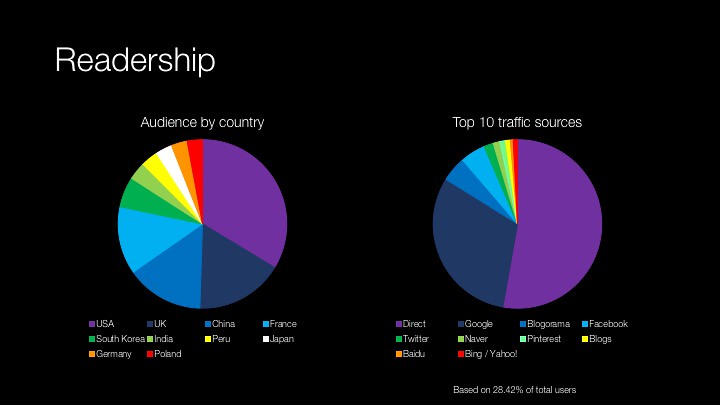
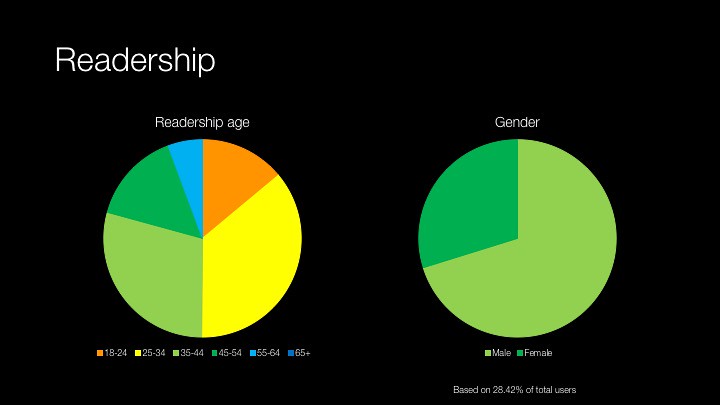
    Some data points

    30 percent of the top posts from the first half of the year made the cut through the whole of the year, which surprised me as I thought that they would benefit from additional ‘evergreen’ search traffic.  
    Slide3

    Slide4

    Lessons learned

    • There is still an interest in long form content and research
    • There was less of an interest this year in purely social platform based subject matter materials
    • Evergreen content doesn’t seem to work as well as previously

  • Kickstarter

    If you’re reading this blog, you will have heard of the crowdfunding platform Kickstarter. Kickstarter has become synonymous with crowdfunding and has become a verb. There are several crowd funding platforms out there including Indiegogo and China’s Demo Day but none seem to have caught the public imagination in the same way Kickstarter seems to have.

    Major companies like Sony have trialed offerings of products on crowdfunding platforms as a way of accessing market size and viability for new products. Bands from Public Enemy to unknown artists have financed their album recordings and production in a similar way

    Kickstarter failure rate

    I’ve personally subscribed to projects with very mixed results with Kickstarter projects that I have funded. My experience of my first couple of projects were very positive. My most recent experiences have been one of disappointment to the point that I no longer use it. They failed. There was production problems, the timelines over ran. And at least one of them looked as if they took the money and ran when the project seemed more difficult than they originally assessed it to be. 

    Therefore it was interesting to hear Kickstarter used in a different context, that reflects my experience with the platform.

    I like the Techmoan YouTube channel as a good deal of its content introduces retro technology, many of which is is equipment or media formats that I hadn’t come across previously.

    The channel host Mat used Kickstarter not as a brand, but as a verb to imply that a product was somehow inferior and lacking in quality. It has become synonymous with an amateurish effort. Just because technology and globalisation have democratised access to manufacturing; doesn’t necessarily mean better quality products. That can’t be good for the brand.

    This is on top of crowdfunding’s high degree of funding failures, product failures and increasing numbers of alleged fraud.

  • Bullshit job + more news

    Is Public Relations A ‘Bullshit Job’? | Holmes Report – If you find yourself in a company that doesn’t use public relations in a way that you find meaningful, and even occasionally inspiring, you’re in the wrong place. That doesn’t mean public relations consulting is a “bullshit job” but it may be an indication that you’re working for a shitty organization. – when I started in agency life I wondered if my new career was a mistake: was it a bullshit job? It didn’t help that I was working with a bunch of dot com startups and enterprise software companies.

    I’d previously worked in industry formulating plastics and in the petrochemical industry. The chances are that if you drove a car from the early 1990s to the 2000s, I’d either helped develop part of your car, or helped provide the road surface that you drove on. 

    Agency life isn’t like that. It took me years to become comfortable on whether I had a bullshit job. That came as I started to see the difference to businesses that my work did. More related content here

    Folli Follie folly | FT Alphaville – interesting read, QCM used the companies own store finder function on their website – in order to determine that Folli Follie’s distribution wasn’t as healthy as claimed

    The Brazen Bootlegging of a Multibillion-Dollar Sports Network – The New York Times – interesting article on how Saudi Arabia is bootlegging live sports content as part of its conflict with Qatar. More worryingly it is spreading its piracy into other franchises because it can

    Apple’s Jony Ive discusses his ‘best friend’ and the origins of the Apple Watch – Business Insider – interesting that it is ‘un-Jobsian’ as a product

    The Great Disappearing Act of the ‘Most Downloaded Woman in the World’ | Mel Magazine – when adult entertainment led the way in profitable business models for the web

    Swiss Watchmakers Are Targeting Teens | News & Analysis | BoF – the challenges of dealing with customers too early for brands is an interesting one

    Instagram quietly launches payments for commerce | TechCrunch – makes perfect sense

    Facebook’s Double Standard on Privacy: Employees vs. Everyone Else – WSJ – just a little bit of old school geekery exists in the Facebook yuppie farm with ‘Sauron’ technology that lets FBers know if someone else has accessed their accounts

    Keeping your account secure | Twitter Blog – Twitter dropped the ball big time