Over the space of 20 years, luxury changed enormously. The Japanese had been a set of new consumers for luxury, but in terms of numbers they hadn’t eclipsed the US as the biggest market for luxury.
China’s ascent into the WTO (World Trade Organisation) made a lot of business people and politicians a lot richer. China challenged the US in terms of luxury market size. On their rise, Chinese consumers changed a lot in their sophistication as they educated themselves on luxury consumption.
These new consumers picked up new traits such as wine drinking. This also meant that luxury goods became new asset classes as Chinese money looked to acquire only the best. Chinese culture in turn impacted luxury design. Chinese new year became more important than Christmas.
Then there was the second generation money. Young rather than old consumers. Consumers who were looking for something less formal, either because they didn’t wear anything but streetwear or they worked in the creative classes rather than the traditional professions and high finance.
The industry had traditionally avoided rap artists and R&B singers, now Jay Z and Beyonce are the face of Tiffanys and Fendi had collaborated with Rihanna.
They no longer wanted to have to wear a jacket and tie to have afternoon tea at the Mandarin. They took an eclectic look more attuned to the Buffalo Collective than Vogue Italia.
You had hybridisation with the street to create a new category of luxe streetwear in a way that also owes a debt to football casual terrace wear and the pain.
Now you have Zegna badge engineering approach shoes from alpine brand La Sportiva and Prada has done a similar thing with adidas’ iconic Stan Smith tennis shoes. Balenciaga with their Speed Sock looks like a mix between Nike’s flyknit football boots and the Nike Footscape sole.
Luxury has traditionally reflected status. Goods of a superior nature that the ‘wrong sort’ of people would never be able to afford. Luxury then became a symbol that you’d made it. In Asian markets, particularly China, luxury became a tool. People gifted luxury products to make relationships work better. It also signified that you are the kind of successful business person that partners could trust. You started to see factory managers with Gucci man bags and premium golfwear to signal their success. Then when the scions of these business people and figures in authority were adults, luxury has become about premium self expression.
Old money style has been a pre-occupation behind the recent fascination with quiet luxury a la Zegna and Loro Piana.
Loro Piana advertising
The fascination with old money style isn’t new. Streetwear brands and hip-hop culture borrowed from preppy style over the years. Brands like Stüssy, A Bathing Ape, Phat Farm and Sean Jean had pieces that aped preppiness – a second old money style. Prior to Phat Farm, Ralph Lauren had trodden the same path and it inspired ‘Dad style’ in Japan.
Barbour jackets moved off the grouse moors and on to the backs of yuppies in the 1980s and 1990s UK – an urban preoccupation that is still maintained today.
Normcore is the practice of wearing great fashion basics that aren’t heavily branded. More related content can be found here and here.
Harry Farrell and Abraham Newman on the weaponisation of the global financial and trade system highlighted in their book Underground Empire. If I had one criticism it would be viewing this purely as an American trait. A classic example would be Chinese policies (cyber-sovereignty, shadow trade sanctions, coerced technology transfer), Russian food terrorism or EU sanctions on Russia.
Bill Gates feels Generative AI has plateaued, says GPT-5 will not be any better | Technology News – The Indian Express – Gates also predicted that in the next two to five years, the accuracy of AI software will witness a considerable increase along with a reduction in cost. This will lead to the creation of new and reliable applications. Interestingly, he also said that he anticipates a stagnation in development initially. The billionaire said that, with GPT-4, the company has reached a limit, and he does not feel that GPT-5 will be better than its predecessor.
Omakase is a Japanese term that has become popular in Korea. Omakase as a phrase comes from the term ‘makaseru’ meaning to entrust. In a sushi restaurant omakase meant the customer turned over responsibility for choosing their menu to the sushi chef. The chef would choose the type of fish and the cut. They would assemble the sushi in front of the customer, tell them what it was and choose the next piece, based on what they think the customer should try next. It is likely to have developed sometime in the last two centuries when nigiri sushi became popular. This was sushi that could be quickly assembled in front of the customer – which is essential for the way omakase operates.
Omakase experience
The personalised nature of the experience and the choice of ingredients by the chef rather than the customer means that omakase is an expensive experience. The ingredients will be seasonal in nature and the chef will select the finest ingredients available.
A short trip across the Sea of Japan (or what the Koreans call the East Sea) is South Korea. And it was inevitable that this particular type of sushi experience would cross the waters as well, given that it has already made it the best sushi restaurants in the US and Europe.
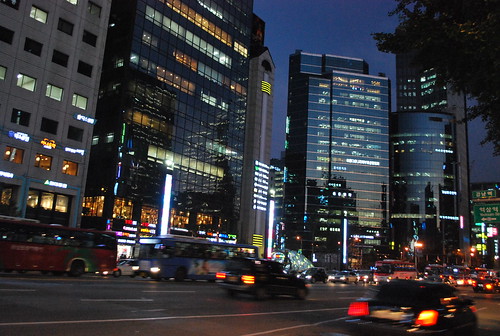
Gangnam at night by laurabl
Expansion of Omakase
In Korea omakase took off some time before 2020. At first it was in upscale sushi restaurants. Then it extended itself into tempura in the Japanese restaurants of high end hotels in Seoul, you see this in some restaurants in Japan as well.
It started to spread throughout the country beyond Seoul and as it grew geographically within Korea, it was extended beyond Japanese cuisine.
Western dessert tasting menu as an omakase experience
Coffee tasting with your own barista. Coffee fuels Korean work life and is immensely popular.
Champagne tasting with a personalised experience from a sommelier.
It has been even extended to grilled pork belly – a stable dish of Korean neighbourhood restaurants. Rather than barbecuing it yourself, pieces are selected and grilled for you by a personal chef.
Why ‘Korean omakase’ happened?
In Korea you have a confluence of factors affecting young consumers.
Korea is known for its luxury consumption. On a per capita basis, Koreans spend more on luxury personal goods than any other country. Harrods has been surpassed as the number one retailer in luxury goods by the Shinsegae department store branch in Gangnam-gu, Seoul, Korea with $2 billion dollars of sale in 2021.
Like young consumers in many developed markets, young Koreans have money in their pocket but are unlikely to be able to afford to buy their own home. Korea’s ultra-wealthy have a good deal of their wealth in buy to let property.
The Jeonse system of home rental exasperates the home ownership problem. A Jeonse tenancy begins with the initial security deposit of a single amount which is usually about 40% to as much as 80% of the current market value of the property. Unlike in most of Europe, the interest yield on the deposit will not be paid to the tenant, but the landlord can keep this as income. No additional monthly rent is paid. On expiry of the contract period, the original deposit will be refunded in full.
This leaves young (and not so young) Koreans heavily indebted and makes it hard to plan for the future.
Live for today, the future is lost anyway
So young Koreans spend on luxury consumption now, rather than save for a future that they believe is unaffordable. While Korean is a developed economy with successful industries, one in ten of young Koreans are unemployed. When they look at the generation of Koreans who built the country over from the post-war years into the developed economy it is today; 45% of these elderly live in poverty.
Omakase as social standing
Luxury consumption is used to reflect a higher social standing. Korea is known for a high degree of conformity, which creates big fashion winners. Once a trend picks up, it goes everywhere, but then also has a finite life as brands like The North Face have found to its cost in the past as consumers move with the crowd.
But Korea is also a Confucian society which means that social standing matters, and this is where the luxury consumption comes in. The quest has moved into online channels as well, with these channels showing to your peers your social standing.
Jeong
The social platforms act as a pressure point in modern Korean life. Because of social, luxury experiences like omakase become as important as having luxury goods.
In Korea, the power of social is amplified by jeong (정) – can be considered to be a sense of social responsibility. Jeong is a positive force for conformity and community in a collectivist society. Historically, jeong is built through shared experiences, such as eating together and a sense of community bond is formed.
Aspects of jeong include
Scheduling quality time with loved ones.
Create meaningful shared experiences.
Expand and engage with your community.
Modern urban and digital life has disrupted Korean society which has meant that values like jeong manifest themselves in new ways.
Mukbang aside
The principles of jeong is where mukbang videos originally came from. Mukbang started as streaming videos where the host would share a virtual meal with the viewers and interact with them. Korean meals are designed to be shared, yet a third of Koreans live in single person households. Mukbang provided the lonely with shared experiences that had a degree of meaning in their lives – creating a kind of virtual jeong between the host and the audience. Now they are genre of video content that’s carefully edited and removed from the original social context that they came from.
Getting back to jeong, think about your Instagram feed for a moment, think about how you might feel if you have had a mediocre day and your feed is filled with people you know living their best lives. Now dial that up to 11.
Sharing content is engaging with your wider community and growing your community and sharing experiences with them. There is a corresponding pressure to share experiences back within your feeds. This has driven a demand for luxury products and experiences including omakase.
Omakase is a rational economic response. There are only so many times that you can share a new bag or watch costing thousands of pounds. But you can share omakase each time you go, with the price being in the hundreds of pounds instead.
So where does the money come from?
Omakase experiences aren’t an everyday thing for young Koreans; they would think its perfectly fine most days to eat a lunch bargain meal from a convenience store and then do an omakase experience every so often that they can document it on social media.
Korean households have the highest amount of debt in the world, and over 21% of young Koreans have personal debt that at least three times their salary. A decade earlier, the rate was 8.2%.
So what?
Korea today is a cultural powerhouse. Trends that start here go worldwide. Korea is involved in all aspects of global culture:
Cinema.
Television series.
Beauty.
Fashion.
FMCG products.
Food.
Korea’s role as a global trendsetter has not gone unnoticed, Christian Dior opened its flagship store in Seoul and held its collection debut in Korea over China or France.
Luxury businesses already realise that consumers want status experiences as well as status goods. LVMH has been actively exploring the hotel and restaurant business, as has Kering. But these businesses have lower margins than their existing businesses. The way to increase these margins would be to address less customers and charge even more.
Luxury is being redefined into highly personalised experiences by consumers and it makes commercial sense for luxury businesses to meet their needs.
While luxury groups are looking at cutting edge technology like generative AI, NFTs and metaverse experiences, the future of luxury might be more human, as well as more technology.
I started thinking about Canon semiconductor manufacturing disruption when I read this article: Canon looks to nanoimprint tech for 2nm lithography | EE News Europe. Canon semiconductor manufacturing disruption looked on the horizon with the announcement of its nano imprint technology. Nano imprint approach is something that has been explored for a a couple of decades, but had so far been rejected due to challenges of implementation.
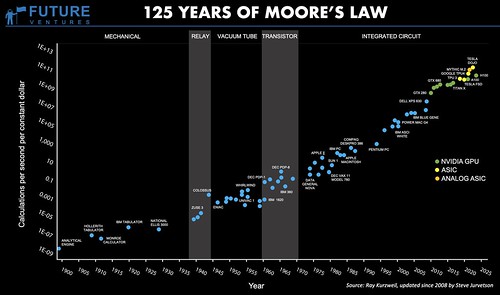
Future Ventures on Moore’s Law
Canon now claims that they have it ready for production on middle edge processes with a potential address current leading edge processes. Canon has stuck with nano imprint as a development approach because it is adjacent to Canon’s core technology expertise in inkjet printing.
Canon semiconductor disruption depends on whether it can change the technology roadmaps of memory chip makers and other fabs. This is going to be unlikely, but Canon semiconductor manufacturing disruption could disrupt the outlook for other vendors, notably Dutch equipment maker ASML.
Canon semiconductor disruption seems to be part of a wider movement to rethink how semiconductors and adjacent products are manufactured to better facilitate further scaling at reduced capital costs, but few if any will be successful: Dracula plans Europe’s largest OPV plant with inkjet printing | EE News Europe
A New Age Of Genderless Brands? – Branding Strategy Insider – Mikimoto pearls managing to attract men. I see this as an extension of century’s old ‘dandy’ culture from the pearly kings and queens, to 1970s African American style in Detroit and some of Dapper Dan’s work that looked to come up with ostentatious looks.
Chinese Bloggers Might Soon Be Required to Display Their Real Names on Social Media Platforms – the government already knows who they are, this seems to be an effort to expose them more to the general public – which can be volatile and vindictive. And so, this is likely to be an effort to use crowd pressure to reduce divergent or innovative opinions, so the party becomes the originator.
Amazon is thinking about quantumcomputing | Patent Drop – Amazon’s tech essentially acts as a middleman between a quantum computer and the user interface. First, a user makes a request with this service through an “edge computing device” — their own device that isn’t connected to the quantum computer itself. Then the system will “automatically translate the quantum task, quantum algorithm, or quantum circuit” into a representation that a quantum computer can understand. This system will then pick the right quantum computer for a certain job, and work with it on the back end to complete the request
You’re still reading? Great! Welcome to my November 2023 newsletter which marks my 4th issue.
I am not excessively superstitious – but living in Hong Kong rubbed off a bit on me.
I developed a love of milk tea, found the ‘hit women’ cathartic and am still leery of the number 4.
The number 4 is considered unlucky. In Hong Kong buildings, there is no fourth floor – in a similar way to their being no 13th floor in the UK high rise and office blocks. So I hope that this fourth issue doesn’t bring misfortune.
The clocks have gone back and the sun rises reluctantly over the horizon every morning, disappearing earlier each afternoon, but that doesn’t mean that inspiration stops. And it will be Christmas before you know it.
New reader?
If is your first time reading, welcome to my November 2023 newsletter! You can find my regular writings here and more about me here.
Things I’ve written.
Dimensions of Luxury based on a mix of stuff that I have read from Sense Worldwide, Horizon Catalyst and books on luxury trends.
Every wondered why its dot com rather than full-stop com? So did I.
Analysis on IPSOS research on the value to brands of reputation.
MCN – multi-channel networks. A business type popular in China and Japan is taking a record label approach to a stable of influencers.
Material World: A Substantial Story of Our Past and Future by Ed Conway. Prior to working in advertising, I had a background in manufacturing and consider myself reasonably well read, but some of the material in Conway’s book was completely new to me. Its narrative approach reminds me of the vintage TV documentary series Connections presented by James Burke, that can be found on YouTube.
Beyond Disruption by W. Chan Kim and Renée Mauborgne. This book looked at non-disruptive innovation. This is diametrically opposed to the way innovation is discussed in Silicon Valley and the mainstream media. More on my view of it here.
The New Working Class by Claire Ainsley. In the advertising industry, we have an acute perception that we might not understand life outside the M25 as we think we do. I thankfully have friends and family in the North to keep me somewhat grounded from the metropolitan elite lifestyle that I lead. Until I read this book, I didn’t realise how grounded the advertising industry was compared to our counterparts in national politics. That this book had to be written is a damning indictment of how out of touch politicos actually are.
Things I have been inspired by.
Project Gutenberg Open Audiobook project – Microsoft, and MIT have worked together to create thousands of free and open audiobooks using text-to-speech technology and Project Gutenberg’s open-access collection of e-books. Via Matt’s Webcurios newsletter.
IPSOS research video seminar on Unlocking The Value of Reputation. This is the closest I have seen to making the case for earned media activities. The full whitepaper is available here. Thanks to Stuart Bruce for the link!
My friend Ian recommended the Honest Brokernewsletter to me and I have found it to be a great read alongside my long time subscription to Bill Bishop’s Sinocism.
DDB Remedy’s meta analysis of marketing science work and academic scientific research on how emotion work for effective campaigns. How The Unexpected and Emotion Work to Influence Behaviour Change – focuses on how surprise when paired with emotion led creative had an increased impact. It all makes sense when you think about the power of salience and distinctiveness in communications; but it’s great to see that someone has drawn the multi-disciplinary research together in a cogent argument.
SEMRush have published a report for 2024 trends in social media platforms: The Vision in a Social Era that is worth downloading and pillaging for ideas that can be sold into clients.
I don’t know if inspired was the right term to use but I noticed 2023 Girlguiding Girl’s Attitudes survey thanks to a former colleague of mine from the start of my agency career. This is a survey that the Girlguiding movement has run over 15 years. Having freelanced on Dove’s ‘Real Beauty‘ campaign back in the day, this one statistic stood out to me.
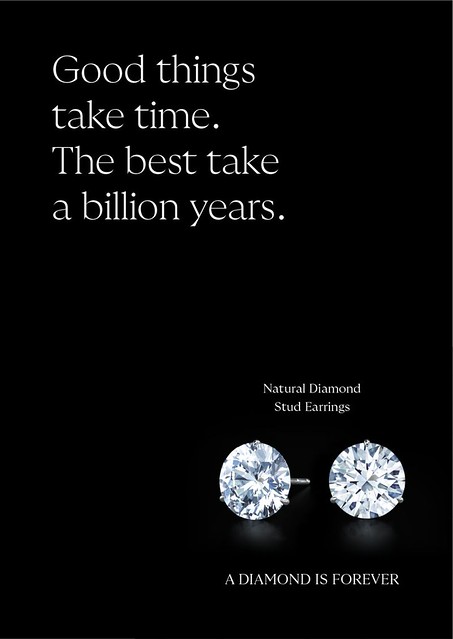
DeBeers is returning to its ‘A Diamond Is Forever’ campaign. The print campaign image is beautiful with a great use of negative space. DeBeers is spending 20 million dollars on media in the US in China. In the US, I think this makes total sense.
DeBeers
I don’t know how well it will work in China? There isn’t the mental model built up in west over decades around the campaign theme. While the wealthy in China realise that diamonds are recognised as a store of wealth – the guo chao mindset may see gold (and possibly jade) jewellery favoured by at least some younger consumers.
This has been exacerbated by a decline in the number of marriages by just under 11% and a trend to prefer gold has an 18% reduction in diamonds sold in China over the past 12 months. In the meantime the sale of gold has risen by 12%.
I look forward to seeing how the campaign goes.
According to Numerator, online retail platforms will be the big winners from Christmas shopping. The news for the food and beverage services sector isn’t so great.
Finally ‘Knowledge is Power with Kidney Disease took me back to 1988. Rob Base has remade It Takes Two for Bohringer Ingelheim in the US to highlight the linkage between kidney disease and type two diabetes. The message is poignant as Base’s creative partner DJ EZ Rock died in 2014 and suffered from diabetes.
Producer DJ EZ Rock was responsible for the hype backing track based around Lynn Collins ‘Think (about it)’ and backing vocals from Rhonda Parris. (Parris has a short-lived recording career, releasing just one solo single No, No Love – a bit of a proto-House banger heavily influenced by freestyle if you like that kind of thing). Those that knew also had the Derek B remix of It Takes Two, with a heavy kick drum underpinning from a Roland TR-808 drum machine.
Things I have watched.
It’s cold and dark and I make no apology for my films being unapologetically escapist and and entertaining to try and counterweight the drab conditions. I do have some standards through and got material for this November 2023 newsletter.
Zerozerozero – follows a single drug deal between the Mexican cartel and the ’Ndrangheta. However things don’t go according to plan, so as the conspiracy unfolds we get a walk through the international drug trafficking trade across Latin America, Africa and Europe. This was done as a limited series, but I watched it as a boxset. It is directed by Stefano Sollima who did the Sicariofilms and Subarra.
Novembre – A French fictional dramatisation of the government response to coordinated terrorist attacks in Paris at Stade de France and the Bataclan concert venue through to the Saint Dennis raid that resulted in the death of police dog Diesel, which trended on social media with the #jesuisdiesel hashtag. Jean Dujardin shows the range of his ability as an actor from the comedy of his OSS117film series, to the deadly seriousness of this film.
Diva – I originally watched Diva as part of the Moviedrome series of curated films introduced by Alex Cox. At the time Cox personally disliked the film due to it being ‘a film of style’ rather than narrative. I loved it and revisited it on Blu-Ray. It was sharper and I got to appreciate the Vladimir Cosma soundtrack with its mix of opera, classical music and avant-garde compositions.
Alex Cox’s introduction to Diva for the much missed Moviedrome film seasons that used to run on BBC 2.
The Continental – Amazon Prime Video has some great tentpole content and The Continental adds to this. It’s a prequel of sorts to the John Wick universe and starts with a beautifully made feature length pilot. The action would find it hard to live up to the John Wick films, but the impeccable soundtrack manages to surpass them. The alternative past New York of the film has similar vibes to shows like Pennyworth and Gotham.
Useful tools
Better Miro, Mural or Figjam alternative
I have started using Milanote as an alternative to Miro for personal projects. Like Miro it has a mix of templates to get you started. There is an iPhone app and a native Mac app, so you don’t have to rely on running resource hungry pages in your internet browser of choice. It might even replace Omnigraffle in my personal software stack for some of the tasks that I do.
The sales pitch.
It was great to collaborate this month with my Hong Kong and Shanghai-based friends at Craft Associates on a prospective exciting new project. Now taking bookings for strategic engagements or discussions on permanent roles. Contact me here.
The End.
Ok this is the end of my November 2023 newsletter, I hope to see you all back here again in a month. Be excellent to each other. Let me know what you think or if you have any recommendations to be featured in forthcoming issues.
The Whole Earth Catalogue was a publication that sat at the centre of so many movements over the past six decades and its influence is still with us today. The publication was founded by Stewart Brand in 1968. Brand had been a participant in the counterculture and environment movement that sprang out of Rachel Carson’s book Silent Spring. Brand was particularly interested in a strand of counterculture that saw hippies follow in the footsteps of pioneers in America and go back to the land.
In order to do this and become more self sufficient, Brand looked to collate and share knowledge on how to do things and the best products to get in order to facilitate it. This became The Whole Earth Catalogue which provided access to tools and knowledge.
The marble in space
The first issue published in 1968 featured a NASA satellite picture of the earth in space, the first picture of its kind.
Colour photograph of the whole Earth (western Hemisphere), shot from the ATS-3 satellite on 10 November 1967.
The publication of the photo of the earth floating like a marble in a black void gave emphasis to how fragile the earth was to environmentalists.
The Whole Earth Catalogue stopped publishing on a regular basis in 1972 and instead went to a sporadic mode of publishing until 1998 including related publications like Coevolution Quarterly, various Whole Earth Catalogue compilations and Soft Tech which predicted the empowering role of technology that influenced early netizens including The Grateful Dead. While The Whole Earth Catalogue stopped, its influence lived on through The WeLL, the Global Business Network (acquired by Monitor Deloitte), Wired magazine and The Long Now Foundation.
Stewart Brand revisited some of the underlying philosophy around the environment that begat The Whole Earth Catalogue with his 2009 book Whole Earth Discipline. Now The Whole Earth Catalogue lives on as an almost complete online archive of its issues and related publications.
Why note-taking apps don’t make us smarter – The Verge – “Thinking is an active pursuit — one that often happens when you are spending long stretches of time staring into space, then writing a bit, and then staring into space a bit more. It’s here that the connections are made and the insights are formed. And it is a process that stubbornly resists automation.”
They Studied Dishonesty. Was Their Work a Lie? | The New Yorker – “‘When you look at [Gino’s paper], it just makes no sense,’ [one professor] said. But, he added, ‘even in safe spaces in my world, to bring up that someone is a data fabricator—it’s, like, ‘Our friend John, do you think he might be a cannibal?’” – on Dan Ariely and Francesca Gino’s research
Neil Shen plots global expansion for Sequoia’s China spin-off | Financial Times – venture capital giant HongShan, which announced its split from Sequoia Capital this year, is establishing a global footprint as a slowdown in the domestic economy pushes it overseas. Neil Shen, the group’s founding partner, who led Sequoia’s China business for 18 years until it was forced to separate under political pressure in June, is seeking business opportunities and investments worldwide to benefit HongShan’s Chinese portfolio companies, according to seven people familiar with his plans – expect regulatory roadblocks in the west
Goldberg: The fracturing of the U.S. political left over Israel, Hamas – San Jose Mercury News – Many progressive Jews have been profoundly shaken by the way some on the left are treating the terrorist mass murder of civilians as noble acts of anti-colonial resistance. These are Jews who share the left’s abhorrence of the occupation of Gaza and of the enormities inflicted on it, which are only going to get worse if and when Israel invades. But the way keyboard radicals have condoned war crimes against Israelis has left many progressive Jews alienated from political communities they thought were their own. – I am not surprised that this has happened. The left wing terrorists of the cold war era trained in the middle east and there is a latent sympathy on the left
The End of an Era: Update on the Johnny’s Idol Scandal | J-List Blog – TL;DR – Japan’s equivalent of Simon Fuller turns about to be Japan’s equivalent of Jimmy Saville. The Japanese media was complicit, but have so far come out unscathed, and hundreds of people in the entertainment industry are struggling to work. Johnny’s victims are still scarred.
The return of Mansur Gavriel | Vogue Business – Mansur Gavriel is launching MG Forever, a resale programme for customers to buy and sell used handbags and for the brand to sell off samples. It’s the first big launch since co-founders Rachel Mansur and Floriana Gavriel reclaimed the brand, resuming their roles as co-creative directors this year. And, it’s a statement: Mansur Gavriel is not trend-led, its products are timeless – this sounds like a definition of classic luxury rather than new luxury. Read with Platforms race to take a slice of the vintage jewellery market | Financial Times
Kazakh telco provider Altel gets AI-nnovative in new campaign | Analysis | Campaign Asia – Faced with dwindling market shares and an over-saturation of foreign imagery making up their key brand campaigns, Kazakhstan’s oldest telco provider revamps their brand persona by using AI to tap into the look, feel and desires of their national consumers. – this is going to be a problem with Image libraries (iStock Photos, Getty Images etc). When I think of the number of campaign assets I have worked on in the last 18 months alone that relied exclusively on image libraries rather than campaign photoshoots – the impact will be huge.
Driving Impact through Inclusive Advertising: An Examination of Award-Winning Gender-Inclusive Advertising: Journal of Advertising: Vol 0, No 0 – Theoretical and managerial contributions include (1) identification of how social impact is conceptualized in award-winning inclusive advertising and how impact functions through awards, (2) development in the definition of inclusive advertising to include social impacts as an outcome, and (3) a reimagining and expansion of the concept of inclusive advertising through a proposed Inclusive Advertising Spectrum, which encompasses representation
How the attacks in Israel are changing Threads | Platformer – In my dim and distant memory, I can recall how not being able to log into Friendster drove early social media users to MySpace and Facebook. Twitter has a similar issue, not in terms of being able to physically log-in, but in being able to discuss topics in a less toxic environment on other platforms. This could be Twitter’s Friendster moment.
How to use Japan’s new self-checkout supermarket carts | SoraNews24 -Japan News- – We found the system to be very convenient, but it doesn’t come without concerns for locals. One of the most glaringly obvious worries is the chance that some customers might fail to scan items, leading to a loss for the supermarket that might result in price hikes that would negatively impact all customers – but would still be far less prevalent than in the UK
BMW’s Next Car Launch Is Happening In Fortnite | Jalopnik – alignment between buyers and channel is poor, BUT, if you think about this more as aspirational brand building its spot on. And probably a better decision than a motorsports programme nowadays