Category: media | 媒體 | 미디어 | メディア

It makes sense to start this category with warning. Marshall McLuhan was most famous for his insight – The medium is the message: it isn’t just the content of a media which matters, but the medium itself which most meaningfully changes the ways humans operate.

But McLuhan wasn’t an advocate of it, he saw dangers beneath the surface as this quote from his participation in the 1976 Canadian Forum shows.

“The violence that all electric media inflict in their users is that they are instantly invaded and deprived of their physical bodies and are merged in a network of extensions of their own nervous systems. As if this were not sufficient violence or invasion of individual rights, the elimination of the physical bodies of the electric media users also deprives them of the means of relating the program experience of their private, individual selves, even as instant involvement suppresses private identity. The loss of individual and personal meaning via the electronic media ensures a corresponding and reciprocal violence from those so deprived of their identities; for violence, whether spiritual or physical, is a quest for identity and the meaningful. The less identity, the more violence.”

McLuhan was concerned with the mass media, in particular the effect of television on society. Yet the content is atemporal. I am sure the warning would have fitted in with rock and roll singles during the 1950s or social media platforms today.

I am concerned not only changes in platforms and consumer behaviour but the interaction of those platforms with societal structures.

  • Smooth jazz & things that made last week

    I tried to keep the crazy in the week under control listening to smooth jazz. However the week has been just as insane as last week. Huawei’s Meng Wanzhou is out on bail, but Donald Trump cast a shadow on the whole process by a saying that he was quite prepared to use her freedom as a pawn in his trade dispute with China. Telling China that the rule of law is malleable isn’t a good move from a strategic point-of-view. Suddenly everything is negotiable, which incentivises bad actor behaviour. 

    As for Brexit, the words of Danny Dyer still ring true:

    Who knows about Brexit? No one has got a fucking clue what Brexit is… You watch Question Time, it’s comedy. No one knows what it is. It’s like this mad riddle…

    Danny Dyer, Good Morning Britain – ITV (June 28, 2018)

    How smooth jazz originated and took off

    How habit-forming products are made by Nir Eyal. This is all pretty dark and illustrates how modern apps are and web services are made habit forming.

    There are a series of Christmas themed adverts at the moment that riff on Christmas animation The Snowman by Barbour and Irn Bru’s original and belated sequel ad.

    Uber has got into the Christmas spirit by putting a limited amount of toy themed cars out on to the streets of Paris.

    Matt Farah’s Watch and Listen podcasts is one of the better YouTube channels out there. Their interview with Jean-Marc Pontrué, the CEO of Panerai is a level of insight that you wouldn’t normally have. One key observation is that Richemont has turned SIHH into a fan event for their brands as other houses have withdrawn. It is part of a wider more engaged attitude that Panerai takes with its fans compared to the likes of Rolex. I think that its a smart move as luxury is still about experiences.

  • New Yorks information for Amazon + more

    New Yorks information for Amazon – crazy number of data points and a must see for any planner looking at campaigns targeting New Yorkers (PDF). From a more sinister point of view about New Yorks information for Amazon – it shows a corporate culture that’s out of control.

    Marriott Data Breach Is Traced to Chinese Hackers as U.S. Readies Crackdown on Beijing – The New York TimesThe Trump administration also plans to declassify intelligence reports to reveal Chinese efforts dating to at least 2014 to build a database containing names of executives and American government officials with security clearances – (paywall)

    ‘Agencies are shitting themselves’: SCA dean Marc Lewis on tutoring for today’s ad world | The Drum One of the biggest pitfalls in the industry is “worshipping at the altar of wanky new tech”

    Just who is Huawei listening to? | Business | The Sunday Times – “In the event of an international crisis — say, if the Chinese were to invade Taiwan — if you own a fleet of thousands and thousands of routers, you can launch service-denial attacks on a massive scale,” said Ross Anderson, professor of security engineering at Cambridge University. “You can potentially make the internet unavailable for days or weeks.”

    A bunch of millennials explained in a survey why they despise phone calls – BGR – basically poor social skills

    Researchers Found a Way to Shrink a Supercomputer to the Size of a Laptop | Futurism – interesting, though parallelism presents problems for software

    Honda, CalTech and NASA’s JPL might have a real alternative to Li-ion batteries – Roadshow – great opportunity in terms of energy density but copper and more particularly lanthanum are a materials supply chain bottle neck. One can see how China disrupted Japan’s access to rare metals years ago which affected the use of magnets in high-technology products

    The Chinese Social Network – Hacker Noon – the story of Pony Ma

    Jack Poulson, ex Google, says management obsessed with stopping leaks – Business Insider – indicating a crisis in culture and leadership. The way Google is dealing with it is by stopping people knowing about the issues

    More technology related content here.

  • Most popular blog posts of 2018

    It’s that time of year again when I reflect on the things that I’ve done and what I can learn from the year. I wanted to get this out there whilst I still have a bit of respite from the holiday cheer. 

    In reverse order

    Reuse, re-edit and remix – the quality and impact of creative is a key question that is being asked at the moment. Marketers have finally woken up to the power of brand building as well as performance media. Which then begs the question what’s the minimum viable creative tweaks to effective creative that can be used?

    Apple – special event (September 2018) – trying to cut through the formulaic delivery of the company’s new products to understand what where the key salient points. I was surprised that this generated far more interest than a similar keynote at Apple WWDC which was much more interesting. 

    Enron and the net in 2000 – pre-Facebook the net was a much more decentralised place. Enron failed in their vision of a real time market for broadband, so I decided to work out what happened to some of their ‘partners’ at the time.

    Ramblings on consumption – this started off as a collection of disjointed notes I made whilst travelling to see the family in Ireland 

    Recommendations for a marketers bookshelf – you can’t dismiss the power of a good listicle. 

    This wasn’t the internet we envisaged – looking at the media of the 1990s we were promised an immersive visually stimulating interactive experience. Unfortunately we ended up with Instagramers and Facebook

    Throwback gadget: Bose Wave system – I still use a Bose Wave stereo due to the big sound that you get from a compact size. Its modular nature meant that it has weathered the iPod, DAB broadcast radio and internet streaming extremely well

    Jargon watch: zhuang bi (装b) – an exploration into Chinese l33tspeak. 

    Oprah time: Operation Elop – Nokia accounted for 25% of the Finnish economy at one stage and then spectacularly fell from grace, with the iconic phone business being sold to Microsoft. Yet the definitive history of what happened has never been licensed and translated by business publishers. I got to read a crowdsourced translation instead. 

    Things I’d like to see in 2018 – included in this list was innovation in smartphone experience (which we don’t have at the moment), a leaner web and critical thinking around the hype of crypto currencies. 

    My web toolbox – some of the tools that I was using in early July this year. 

    How to use RSS – with so many people now getting algorithmically selected, part of the solution is by going back to RSS and Atom feeds from trusted sites. So I threw together a guide to getting started with Newsblur

    The advertising industry post prompted by WPP’s 2017 financial results – how much of WPP’s difficulties are due to changes in the client and media environment versus WPP’s business?

    Social networks 10 years ago – 2018 will be looked back on in internet history as when the elites finally woke up to the dominance (ex-China) of Facebook, Google, Amazon and Apple. Looking back at 2008, it is hard to believe how much the social network eco-system changed

    Mercedes Benz China Syndrome – Chinese netizens are still jumping the Great Firewall to vilify western brands who reflect views that ‘offend the Chinese people’ – even when this content is aimed at non-Chinese audiences. Mercedes’ offence was an Instagram image with one of their cars and a quote from the exiled Dalai Lama. Dolce & Gabbana didn’t learn from the Mercedes experience. Mercedes and other brands saw the Chinese government get involved in what would be considered to be extra-territorial exceptionism. This mirrors and contrasts with the Chinese reaction to the Canadian arrest of Meng Wanzhou. The Chinese foreign ministry accused the US and Canadian governments of overreach. 

    Oprah time: Directorate S by Steve Coll – book review of Directorate S which discusses the complex relationship between the US war on terror and Pakistan

    Personal online brand – the perennial debate of should you own your own site or build your reputation on someone else’s platform?

    Out and about: Sicario 2: Soldado – I was so looking to this film and felt so disappointed when I got to watch it and was presented with a grand vision at the start that quickly fizzles out to a mediocre homage of the original, with one eye on building a franchise. 

    Dawns Mine Crystal by Yunchul Kim at Korean Cultural Centre – amazing art installation that I was fortunate to see. It moulded art and science as part of the Art @CERN project. 

    The influencers post – a post on the irrational exuberance associated with influencer marketing. I suspect that we’re close to peak influence.

    Chinese smartphone eco-system for beginners – I presume that its very Googleable – this post was inspired and featured a video on smartphones in China by Winston Sterzel earlier in the year. I then put accompanying background information to give it more context for marketers. China is changing a lot, one consequence of this is that Winston is looking to move to the US and visit China occasionally rather than live there, like he has been for the past decade.

    The long and the BBH of it – Binet’s The Long and the Short of it has been a strategists go to reference for a while. BBH pointed out the benefits of expanding the data set. However its easier to snipe from the sidelines rather than doing something meaningful about it.

    App constellations 2018 research – this built on research that I had done in 2014 and 2016. It was the most trafficked post for the first half of the year. It was also the post that took me the longest to research and I managed to lose my archive data file soon afterwards. I will revisit it, but will have to try and pull the data from these images for the basic numbers!

    Innovation: a few thoughts – this post came from the coalescence of many things that were kicking around in August and early September. My friend Nigel Scott had come up with some interesting research on venture capitalists; disabusing any illusion of science in their investment selection. You had ‘struggle porn’ being championed on LinkedIn; which made the wrong correlation between effort and innovation. Finally you have big technology companies with an inflated sense of their manifest destiny a la ‘software is eating the world’ and the hubris of Google, Facebook, Amazon, Tesla and Apple. I pulled ideas from across the board, borrowing a lot from Kevin Kelly’s concept of The Technium

    What if stories are brain code – storytelling is treated as a science within the creative  sector. The reality is that its based a pretty shaky base. Whilst the formulation of storytelling is suspect; psychological research indicates that stories are even more powerful than we previously realised. 

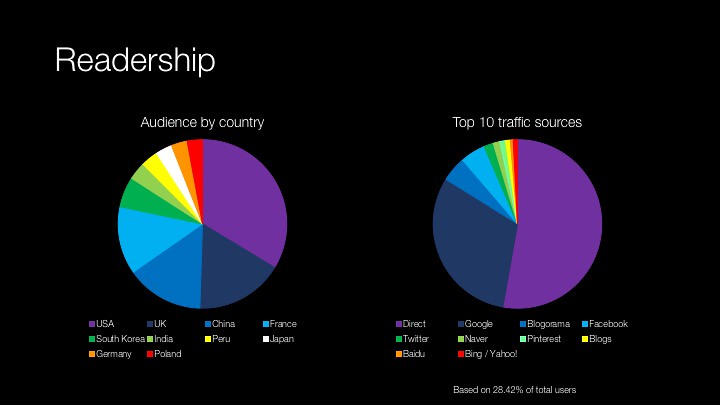
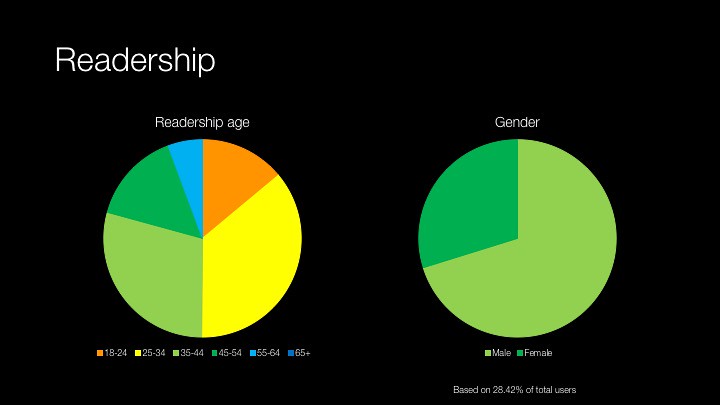
    Some data points

    30 percent of the top posts from the first half of the year made the cut through the whole of the year, which surprised me as I thought that they would benefit from additional ‘evergreen’ search traffic.  
    Slide3

    Slide4

    Lessons learned

    • There is still an interest in long form content and research
    • There was less of an interest this year in purely social platform based subject matter materials
    • Evergreen content doesn’t seem to work as well as previously

  • Aston Martin classics + more things

    Aston Martin Will Make Old Cars Electric So They Don’t Get Banned From Cities – Slashdot – surprised more companies like Porsche aren’t doing this. This upgrade process reminded me of the service that Bristol Cars have provided for years. Like Aston Martin has planned, Bristol Cars has steadily upgraded cars with better brakes, handling, electronic fuel injection and more emissions friendly engines. Their purchase by Fraser Nash is now looking at an Aston Martin like electric upgrade service. More luxury related content here.

    Exclusive: Amazon’s Alexa begins crowdsourcing answers to common quest – reminds me of the original thinking behind Yahoo! Knowledge Search (what begat Yahoo! Answers) when I first heard Jeff Weiner articulate it

    Mark Ritson: The story of digital media disruption has run its course – Marketing WeekIt’s hard to get emotional or feel any of the romance of news media from a home page, but the paper edition carries with it the great cultural power of journalism. Print editions will become the ‘couture’ offering of the news brands – loss-making but important assets for building and retaining authority and influence over the market

    WSJ City | Britain’s stock link to China falls flat – many larger foreign institutions can already access mainland-listed Chinese stocks via trading accounts in Hong Kong. – Not terribly surprising. The big problem is how much hope had been pinned on it from a Brexit point of view

    Unilever’s rules for influencer marketing | WARCthat its influencer efforts focus not just on a product, but on attempts to covey a brand’s purpose – as shown by Dove, the personal care line, focusing on “real beauty”. “We are using influencer marketing for Dove across the whole spectrum. In some cases, we use influencers to talk about the features and benefits of the products,” Di Como said. “But, more and more, we are using them to talk about the idea to buy into – to talk about the brand value, of why the brand exists, and the purpose of the brand.” “There is an obsession that the only KPIs out there are ‘reach’ or ‘number of followers’,” said Di Como. “We need to talk about what the real impact is on brand equity – the real impact on the values of the brand.” – which is interesting as I heard that there were efforts to move away from brand tracking surveys and instead interpolate the equivalent data from social listening

    Apple Offers New iPhone Promo Deals, Trade-Ins to Boost Sales – Bloomberg – I think the market in general for smartphones is over-baked

    Bose Global Press Room – Bose Announces Frames — A Revolutionary New Wearable – this looks interesting, if they get it to work and you have enough connectivity to the cloud

    46 insurgent brands shake up China’s FMCG market – Kantarthe redefinition of consumers, merchandise and stores known collectively as“New Retail.” China’s consumers have growing expectations for tailored and specific offerings, which creates many niche opportunities for insurgent brands to capture. The traditional scale advantages of incumbents, such as large sales forces and large retail shelf space, have in some ways turned into disadvantages by digital disruption. For example, the e-commerce channel can reach millions of consumers without a single sales rep, and online platform advertising can reach millions of consumers with much lower budgets than traditional brands typically spend

    Volvo & Ericsson – Scroogled? – Radio Free Mobile – interesting article looking at Google’s move into automotive systems

  • Dieter Rams handbag + more things

    Buy it now: the Dieter Rams handbag – DisneyRollerGirl – the Dieter Rams handbag reminds me of the kind of thing that would appeal to Chinese millennial luxury buyers. They’ve increased their luxury consumption sophistication in leaps and bounds

    Perspectives on Encryption and Surveillance – Lawfare – great set of essays on the interface of cryptography, privacy and the law

    Autonomous Vehicle Navigation in Rural Environments without Detailed Prior Maps by Ort, Paul and Rus – interesting work being done by MIT and Toyota

    Starwood Reservation Database Security Incident – name, mailing address, phone number, email address, passport number, Starwood Preferred Guest (“SPG”) account information, date of birth, gender, arrival and departure information, reservation date, and communication preferences. For some, the information also includes payment card numbers and payment card expiration dates, but the payment card numbers were encrypted using Advanced Encryption Standard encryption (AES-128). There are two components needed to decrypt the payment card numbers, and at this point, Marriott has not been able to rule out the possibility that both were taken – oh Lordy!

    Time to step away from the ‘bright, shiny things’? Towards a sustainable model of journalism innovation in an era of perpetual change | Reuters Institute for the Study of Journalism – to be fair the same is true across marketing and advertising and client boards that have been seduced by the same management consultancy bullshit about disruption for far too long

    China unveils first satellite that offers free Wi-Fi to entire world | Video | SupChina – Oh really?

    South Korea Charges 11 With Selling Samsung Technology to China – Bloomberg – Samsung spent about 150 billion won over a period of six years to develop the OLED technology that is now considered highly-classified national knowledge (paywall) – US is the least of Chinese worries if they can get other countries China has been stealing stuff from to take action like Germany, France, Italy, Japan and South Korea

    Why is Huawei Out in the Cold? | China Media Project – ignore the mock surprise at Jack Ma being a communist party member and reflect on the  interesting analysis of the Chinese Communist Party’s reform and opening 40th anniversary celebration

    How Amazon Now Shapes What Our Stuff Looks Like | Gizmodo – how e-tailing is affecting FMCG packaging design

    The Next Great (Digital) Extinction | WIRED – how counterculture met digital and failed to meet its full potential

    Jane Wong explains why she uncovers hidden app features that tech giants like Facebook want to keep secret | South China Morning Post – great read, particularly her comments on WeChat

    How Cheap Labor Drives China’s A.I. Ambitions – The New York Times – manually writing rules is more like prior efforts at AI than the kind of machine learning advocated at the moment, but that doesn’t mean that the Chinese won’t have their successes

    Luxury goods group Kering steps up digital strategy with new Apple deals – Reuters – interesting apparent role for Apple in this

    In China’s hinterland, car market growth engine sputters – Reuters – a mix of consumer credit squeeze, move out of legacy industries, healthcare costs and inflation affecting car buyers in lower tier cities