Category: technology | 技術 | 기술 | テクノロジー

It’s hard to explain to someone who didn’t live through it how transformation technology has been. When I was a child a computer was something mysterious. My Dad has managed to work his way up from the shop floor of the shipyard where he worked and into the planning office.

One evening he broad home some computer paper. I was fascinated by the the way the paper hinged on perforations and had tear off side edges that allowed it to be pulled through the printer with plastic sprockets connecting through holes in the paper.

My Dad used to compile and print off work orders using an ICL mainframe computer that was timeshared by all the shipyards that were part of British Shipbuilders.

I used the paper for years for notes and my childhood drawings. It didn’t make me a computer whiz. I never had a computer when I was at school. My school didn’t have a computer lab. I got to use Windows machines a few times in a regional computer labs. I still use what I learned in Excel spreadsheets now.

My experience with computers started with work and eventually bought my own secondhand Mac. Cut and paste completely changed the way I wrote. I got to use internal email working for Corning and internet connectivity when I went to university. One of my friends had a CompuServe account and I was there when he first met his Mexican wife on an online chatroom, years before Tinder.

Leaving college I set up a Yahoo! email address. I only needed to check my email address once a week, which was fortunate as internet access was expensive. I used to go to Liverpool’s cyber cafe with a friend every Saturday and showed him how to use the internet. I would bring any messages that I needed to send pre-written on a floppy disk that also held my CV.

That is a world away from the technology we enjoy now, where we are enveloped by smartphones and constant connectivity. In some ways the rate of change feels as if it has slowed down compared to the last few decades.

  • Populism & more in 2019

    At a macro level, the world is in a pretty strange place at the moment. Populism is at the centre of uncertainty across many countries in terms of political direction, macro economics, technology and consumer uncertainty.

    2016 State of the Union debate

    Populism and nationalism is on the march: Duterte in the Philippines. Trump in the US. The German right wing populism leaning political party AfD is shifting the Overton window in Germany. The yellow vests in France and the UK is channeling anger into political activism along fringe party lines providing an opportunity for populism. The UK has seen a rise in far right grassroots media mirroring the rise of The Canary and similar publications on the left both of which fuel different forms of populism. The Russians don’t need to do it as the populism and divisive politics is homegrown. The Queen’s speech called for unity in the country and the UK government’s Prevent anti-radicalisation programme has more far right cases than Islamic extremists. Even China has been gradually moving to a Han nationalism as part of its more forceful foreign policy. India and Pakistan have both seen a rise in sectarian politics. This has impacts in terms of foreign trade and economic growth. We are already seeing domestic brands rising in China and India; we may see a decline in brands and product SKUs in the likes of the UK – all of which will impact advertising budgets. At an agency office level; the chilling effect of nationalism is going to affect the movement of talent on both client and agency side. It’s hard to articulate the atmosphere of an agency that I was working in the day after the Brexit vote without using the word bereavement. I know people in my family and peers who are moving away. Over time this will impact culture and creativity. It is hard to remember but back in the 1970s the UK was much more parochial and less multi-cultural than it is now. Everyday things we take for granted like good food were much poorer experiences.

    There are so many variables in play we don’t know where populism and divisive politics is going, but there are dark possibilities to the government ‘by the seat of their pants’ which seems to be prevalent.

    Cryptocurrency and block chain: We’ve seen a wide range of crypto currencies decline in values this year. What are the factors might drive a recovery? Why would there be a spike in demand? I don’t know what that ‘X factor’ would be. I suspect that experiments in block chain such as verifying online media spend to prevent online fraud will start bumping up against the limitations of the technology. Blockchain has a relatively low transaction rate compared to legacy payment systems. Decentralisation still isn’t as good as an Oracle database or a mainframe a la the traditional banking system. Some applications just make no sense.

    From Farm to Blockchain: Walmart Tracks Its Lettuce – The New York Times – is a classic example of technology for technology’s sake. How much lettuce would Walmart be selling day in, day out? That data has to be collected across a complex supply chain. Secondly, its a privatised centralised blockchain which negates the technical benefits of Blockchain and makes me wonder why IBM weren’t selling in Db2 or Oracle high transaction speed relational database on a z-series mainframe. It’s announcements like this that makes one wonder if blockchain has jumped the shark.

    Virtual reality hasn’t seen the level of adoption that was predicted. The problem is no longer one of technology hardware (lets ignore battery life for a little while) but content. VR changes the way stories are told and experienced, it makes it hard to build brand experiences and compelling content. Microsoft has managed to build a community of early adopters in Altspace – a Second Life type environment. Augmented reality (AR) has been sporadically adopted and Apple has been putting a lot of work into building creator tools, but the decline of Blippar. Magic Leap’s demo film for its partnership with Cheddar doesn’t currently look like a compelling AR application to me. It does mirror, anecdotal evidence that suggests the most common use of VR is to replicate a big TV experience in a small space through the Netflix application.

    https://youtu.be/xjYE-joYjQs

    If 2017 and 2018 were the years when ad fraud became the bête noire of marketers, 2019 might see harder questions asked of influencer marketing practices. The move from influencers to micro-influencers was down to cost per reach and engagement. The move to nano-influencers implies a similar kind of shift again. Yet it seems to be largely taken on blind faith by marketers at the moment that influencers are good thing. I think many of the challenges that influence marketing faces when I wrote about them earlier are still valid. One question that I haven’t seen seriously considered by marketers is when you’re in a culture where ‘selling out’ has moved from being shameful to gen-x; to a badge of validation in the space of a decade that has to change the value proposition that influence brings? As a marketer the possible answer to that question worries me.

    The focus on ad fraud might be partly responsible for a slight resurgence in the realisation brand advertising is valuable. Performance advertising is about the now, brand advertising is all about sowing acorns that are reaped for decades to come. As a concept it’s easy to grasp at an empirical and research driven level. But when marketers typically stay in a role for a short time, the now becomes of outsized importance. They have to make an impact and then plan their exit strategy in what’s typically a three year cycle. Brand is hard for FMCG (fast moving consumer goods) brands to take on board as they see channel and shelf disruption from the likes of Amazon and Ocado. They have experimented with the direct sales model a la Birch Box and Dollar Shave Club, but that will only work with certain products. Consultants selling disruption are selling chaos; clients hedging against black swans often miss where change isn’t happening – consumer behaviour doesn’t change at the speed of PowerPoint. I’ll leave the last word on digital disruption to Mark Ritson.

    It’s hard to get emotional or feel any of the romance of news media from a home page, but the paper edition carries with it the great cultural power of journalism. Print editions will become the ‘couture’ offering of the news brands – loss-making but important assets for building and retaining authority and influence over the market

    Mark Ritson, The story of digital media disruption has run its course – Marketing Week 

    Validation of traditional media can be seen all around us. Amazon printing catalogues, online brands having flagship stores. Underground and out of home adverts for e-commerce businesses surround me as I go about my daily life in London.

    Stories with everything – I don’t know whether the recent trend of every social platform having a short form video function that disappears a la ‘stories’ is a wider socio-cultural trend or the constant carousel of changing formats as part of a ploy to keep users engagement rate up. For established platforms there is little to be lost by throwing new features agains the wall and seeing what sticks.

    I’ve omitted talking about 5G as it will take more than a year to get up and running. It won’t be clear what its application is until we start to see how effective the network is in practice. Gadgets like fold out phones won’t fundamentally change the pictures under glass interface used in smartphones for the past decade or so. Their impact may be exaggerated due to their high cost that consumers will bear one way or another.

    I realise that these are a series of random thoughts but would be interested to know what you think. Feel free to comment below.
  • Keyboardio + more news

    Keyboardio Blog — December 2018: A startling discovery – one of the worst tales I’ve heard about manufacturing in Shenzhen; this is off-the-hook. Keyboardio have been extraordinarily unlucky. Keyboardio are famous for making custom mechanical keyboards

    Volkswagen ‘readies to write off’ $300m investment in Israeli ride-hailing service Gett – Business – Haaretz.com – digital is a winner takes all environment, or at best an 80-20 duopoly. But I still reckon Uber’s model is BS because they still aren’t profitable. It is an arbitrage play that has failed because it requires public transport to be put out of business.

    Influencers Are Faking Brand Deals – The Atlantic – sounds like a cargo cult, but on social media. Presumably they think some lower tier brands will be impressed and offer them a real deal.

    Ex-Microsoft Intern: Google Deliberately Crippled Edge Browser | ExtremeTech – interesting that Microsoft staff are ascribing behaviour (product bundling) to Google that they did with Microsoft Explorer. Although it also wouldn’t surprise me if they were right on this occasion.

    This Health Startup Won Big Government Deals—But Inside, Doctors Flagged Problems | Forbes – interesting inside tale of Babylon Health. Interesting especially in the light of IBM Watson Health’s failure

    Defiant Xi Jinping Says No One Can Dictate Reforms to China – Bloomberg – depending how you read this statement “No one is in the position to dictate to the Chinese people what should and should not be done.” This could be defending legitimacy of CCP AND OR Chinese firms and people can do what they like abroad with impunity

    Xi Jinping’s Strongman Rule Comes Under Fire as China Celebrates Deng’s Reforms – WSJ – Xi will never be as good as Deng, just like his Dad wasn’t

    Netflix’s Movie Blitz Takes Aim at Hollywood’s Heart – The New York Times – it reminds me a bit of the ‘New Hollywood’ movement of the 1970s (paywall)

  • Dekotora & things that made last week

    Apple’s team in Japan hit it out of the park with this iPhone XS ad that tells the story of a dekotora lorry christened Lady Misaki. Dekotora is a culture of truck modification, turning the humble Hino or Mitsubishi cab into a LED and burnished stainless steel sculpture. Dekotora is a loan word from the English ‘decorated truck’. It came out of a Japanese TV series shown in the 1970s called Truck Rascals that was based on Smokey & The Bandit. Drivers thought that they might appear in future productions, it then became a way of life. More on Japanese life here.

    https://youtu.be/AvTd2FnF2sc

    Sky and Cassetteboy put their opinion over on whether Die Hard is a Christmas film or not… Bruce Willis doesn’t think that its a Christmas movie, but is instead a movie that happens to occur in the run up to the Christmas holidays

    Nvidia shows off a ‘style based generator architecture for generative adversarial networks’ or star power in Hollywood could be disrupted pretty soon….

    Ad for Shopee featuring K-pop band Blackpink pulled off air in Indonesia – Mumbrella Asia – hallyu or Korean culture started to do really well in the Middle East and Indonesia over a decade ago as their dramas lacked the kind of sexual scenes that you saw in Hollywood productions. However as K-pop has stylised itself around modern R&B it has become progressively more sexualised and both Indonesian and Malaysian Islam has started to look more like the Arab interpretation of the religion rather than the historical live-and-let-live attitude. So it was inevitable that something like this was bound to happen.

    Publicis Groupe’s annual holiday message has made a tongue-in-cheek reference to the unpopularity of its artificial intelligence-powered platform Marcel. The claim about it’s timesheet capabilities is interesting. I do wonder if the adoption figures aren’t great, this ad could backfire.

  • New Yorks information for Amazon + more

    New Yorks information for Amazon – crazy number of data points and a must see for any planner looking at campaigns targeting New Yorkers (PDF). From a more sinister point of view about New Yorks information for Amazon – it shows a corporate culture that’s out of control.

    Marriott Data Breach Is Traced to Chinese Hackers as U.S. Readies Crackdown on Beijing – The New York TimesThe Trump administration also plans to declassify intelligence reports to reveal Chinese efforts dating to at least 2014 to build a database containing names of executives and American government officials with security clearances – (paywall)

    ‘Agencies are shitting themselves’: SCA dean Marc Lewis on tutoring for today’s ad world | The Drum One of the biggest pitfalls in the industry is “worshipping at the altar of wanky new tech”

    Just who is Huawei listening to? | Business | The Sunday Times – “In the event of an international crisis — say, if the Chinese were to invade Taiwan — if you own a fleet of thousands and thousands of routers, you can launch service-denial attacks on a massive scale,” said Ross Anderson, professor of security engineering at Cambridge University. “You can potentially make the internet unavailable for days or weeks.”

    A bunch of millennials explained in a survey why they despise phone calls – BGR – basically poor social skills

    Researchers Found a Way to Shrink a Supercomputer to the Size of a Laptop | Futurism – interesting, though parallelism presents problems for software

    Honda, CalTech and NASA’s JPL might have a real alternative to Li-ion batteries – Roadshow – great opportunity in terms of energy density but copper and more particularly lanthanum are a materials supply chain bottle neck. One can see how China disrupted Japan’s access to rare metals years ago which affected the use of magnets in high-technology products

    The Chinese Social Network – Hacker Noon – the story of Pony Ma

    Jack Poulson, ex Google, says management obsessed with stopping leaks – Business Insider – indicating a crisis in culture and leadership. The way Google is dealing with it is by stopping people knowing about the issues

    More technology related content here.

  • Most popular blog posts of 2018

    It’s that time of year again when I reflect on the things that I’ve done and what I can learn from the year. I wanted to get this out there whilst I still have a bit of respite from the holiday cheer. 

    In reverse order

    Reuse, re-edit and remix – the quality and impact of creative is a key question that is being asked at the moment. Marketers have finally woken up to the power of brand building as well as performance media. Which then begs the question what’s the minimum viable creative tweaks to effective creative that can be used?

    Apple – special event (September 2018) – trying to cut through the formulaic delivery of the company’s new products to understand what where the key salient points. I was surprised that this generated far more interest than a similar keynote at Apple WWDC which was much more interesting. 

    Enron and the net in 2000 – pre-Facebook the net was a much more decentralised place. Enron failed in their vision of a real time market for broadband, so I decided to work out what happened to some of their ‘partners’ at the time.

    Ramblings on consumption – this started off as a collection of disjointed notes I made whilst travelling to see the family in Ireland 

    Recommendations for a marketers bookshelf – you can’t dismiss the power of a good listicle. 

    This wasn’t the internet we envisaged – looking at the media of the 1990s we were promised an immersive visually stimulating interactive experience. Unfortunately we ended up with Instagramers and Facebook

    Throwback gadget: Bose Wave system – I still use a Bose Wave stereo due to the big sound that you get from a compact size. Its modular nature meant that it has weathered the iPod, DAB broadcast radio and internet streaming extremely well

    Jargon watch: zhuang bi (装b) – an exploration into Chinese l33tspeak. 

    Oprah time: Operation Elop – Nokia accounted for 25% of the Finnish economy at one stage and then spectacularly fell from grace, with the iconic phone business being sold to Microsoft. Yet the definitive history of what happened has never been licensed and translated by business publishers. I got to read a crowdsourced translation instead. 

    Things I’d like to see in 2018 – included in this list was innovation in smartphone experience (which we don’t have at the moment), a leaner web and critical thinking around the hype of crypto currencies. 

    My web toolbox – some of the tools that I was using in early July this year. 

    How to use RSS – with so many people now getting algorithmically selected, part of the solution is by going back to RSS and Atom feeds from trusted sites. So I threw together a guide to getting started with Newsblur

    The advertising industry post prompted by WPP’s 2017 financial results – how much of WPP’s difficulties are due to changes in the client and media environment versus WPP’s business?

    Social networks 10 years ago – 2018 will be looked back on in internet history as when the elites finally woke up to the dominance (ex-China) of Facebook, Google, Amazon and Apple. Looking back at 2008, it is hard to believe how much the social network eco-system changed

    Mercedes Benz China Syndrome – Chinese netizens are still jumping the Great Firewall to vilify western brands who reflect views that ‘offend the Chinese people’ – even when this content is aimed at non-Chinese audiences. Mercedes’ offence was an Instagram image with one of their cars and a quote from the exiled Dalai Lama. Dolce & Gabbana didn’t learn from the Mercedes experience. Mercedes and other brands saw the Chinese government get involved in what would be considered to be extra-territorial exceptionism. This mirrors and contrasts with the Chinese reaction to the Canadian arrest of Meng Wanzhou. The Chinese foreign ministry accused the US and Canadian governments of overreach. 

    Oprah time: Directorate S by Steve Coll – book review of Directorate S which discusses the complex relationship between the US war on terror and Pakistan

    Personal online brand – the perennial debate of should you own your own site or build your reputation on someone else’s platform?

    Out and about: Sicario 2: Soldado – I was so looking to this film and felt so disappointed when I got to watch it and was presented with a grand vision at the start that quickly fizzles out to a mediocre homage of the original, with one eye on building a franchise. 

    Dawns Mine Crystal by Yunchul Kim at Korean Cultural Centre – amazing art installation that I was fortunate to see. It moulded art and science as part of the Art @CERN project. 

    The influencers post – a post on the irrational exuberance associated with influencer marketing. I suspect that we’re close to peak influence.

    Chinese smartphone eco-system for beginners – I presume that its very Googleable – this post was inspired and featured a video on smartphones in China by Winston Sterzel earlier in the year. I then put accompanying background information to give it more context for marketers. China is changing a lot, one consequence of this is that Winston is looking to move to the US and visit China occasionally rather than live there, like he has been for the past decade.

    The long and the BBH of it – Binet’s The Long and the Short of it has been a strategists go to reference for a while. BBH pointed out the benefits of expanding the data set. However its easier to snipe from the sidelines rather than doing something meaningful about it.

    App constellations 2018 research – this built on research that I had done in 2014 and 2016. It was the most trafficked post for the first half of the year. It was also the post that took me the longest to research and I managed to lose my archive data file soon afterwards. I will revisit it, but will have to try and pull the data from these images for the basic numbers!

    Innovation: a few thoughts – this post came from the coalescence of many things that were kicking around in August and early September. My friend Nigel Scott had come up with some interesting research on venture capitalists; disabusing any illusion of science in their investment selection. You had ‘struggle porn’ being championed on LinkedIn; which made the wrong correlation between effort and innovation. Finally you have big technology companies with an inflated sense of their manifest destiny a la ‘software is eating the world’ and the hubris of Google, Facebook, Amazon, Tesla and Apple. I pulled ideas from across the board, borrowing a lot from Kevin Kelly’s concept of The Technium

    What if stories are brain code – storytelling is treated as a science within the creative  sector. The reality is that its based a pretty shaky base. Whilst the formulation of storytelling is suspect; psychological research indicates that stories are even more powerful than we previously realised. 

    Some data points

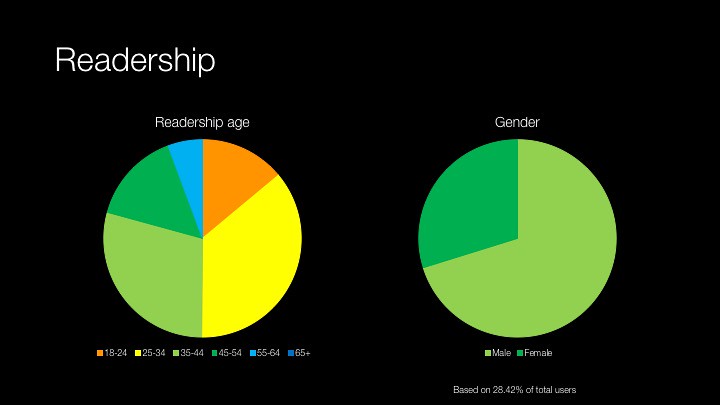
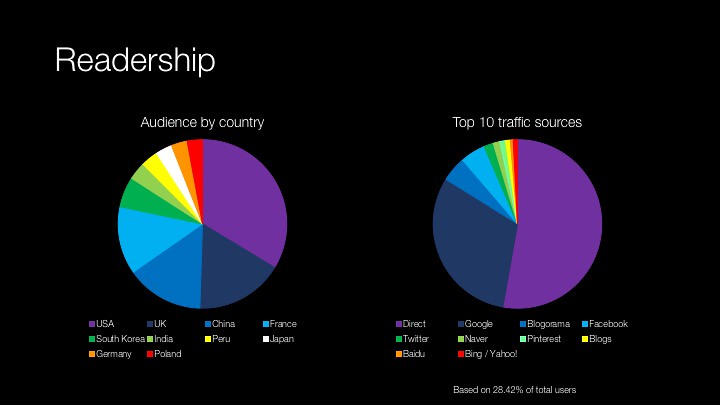
    30 percent of the top posts from the first half of the year made the cut through the whole of the year, which surprised me as I thought that they would benefit from additional ‘evergreen’ search traffic.  

    Slide3

    Slide4

    Lessons learned

    • There is still an interest in long form content and research
    • There was less of an interest this year in purely social platform based subject matter materials
    • Evergreen content doesn’t seem to work as well as previously