Category: gadget | 小工具 | 가제트 | ガジェット

What constitutes a gadget? The dictionary definition would be a small mechanical or electronic device or tool, especially an ingenious or novel one.

When I started writing this blog the gadget section focused on personal digital assistants such as the Palm PDA and Sony’s Clie devices. Or the Anoto digital pen that allowed you to record digitally what had been written on a specially marked out paper page, giving the best of both experiences.

Some of the ideas I shared weren’t so small like a Panasonic sleeping room for sleep starved, but well heeled Japanese.

When cutting edge technology failed me, I periodically went back to older technology such as the Nokia 8850 cellphone or my love of the Nokia E90 Communicator.

I also started looking back to discontinued products like the Sony Walkman WM-D6C Pro, one of the best cassette decks ever made of any size. I knew people who used it in their hi-fi systems as well as for portable audio.

Some of the technology that I looked at were products that marked a particular point in my life such as my college days with the Apple StyleWriter II. While my college peers were worried about getting on laser printers to submit assignments, I had a stack of cartridges cotton buds and isopropyl alcohol to deal with any non catastrophic printer issues and so could print during the evening in the comfort of my lodgings.

Alongside the demise in prominence of the gadget, there has been a rise in the trend of everyday carry or EDC.

  • The insiders guide to smartphone launches

    MWC is one of the key dates in the diary for smartphone launches by manufacturers. Apple marches to the beat of its own drum, but Android manufacturers try and go close to MWC:

    • Samsung has gone out the week before with its foldable smartphones
    • Huawei starts off at MWC as one of a series of launch events for their products
    • Sony Mobile launched there, as well as other minor Android manufacturers


    The reason why they go to MWC is that it has a critical mass of journalists in Barcelona covering bigger impact stories.

    Mobile World Congress 2014

    Expect all kinds of hype on 5G that the smartphone vendors can then ride on.

    Why are smartphone launches news?

    So we know that smartphones are the most personal technology for consumers. For many of us it accompanies everywhere from waking us up in the morning, to work and back again. Some people even take it to the toilet. By definition the devices that we’ll be using through the next year or two will be news.

    But its a miracle that the launches make news since the details of the phones are often leaked. Specifications usually come out through sources in the supply chain. This usually affects both iOS and Android devices.

    Where Android device manufacturers differ is in later leaks. Handsets are often photographed during testing revealing the industrial design. There is often video giving an idea of device real world performance.
    These leaks aren’t accidental, but is often down to egotism or hubris of senior executives. This is very different to the discipline and self-control shown by Apple executives.

    This is often post-rationalised as building buzz. This is counter-intuitive to PR and marketing perceived knowledge. It would make it very hard to justify the kind of large scale dog-and-pony show used to showcase a new phone.

    So far, no phone launch has been seriously hurt by the ego-leak. But now things might change. We’re at a stage were smartphones are a mature sector. Total global unit sales are down year-on-year, this will impact media coverage of smartphone launches over time.

    The launch isn’t the end of the beginning

    The launch event is just the start of activity. Next comes the review programme. This means putting phones in the hands of media journalists and increasingly in the hands of influencers.
    Influencers are more important for a few reasons:

    • They flood social channels in particular YouTube with positive content
    • They’re naturally more likely to react positively as access and devices are still novelties for them compared to journalists
    • Influencers provide reach of marketing messages. Many manufacturers don’t advertise as much as they should relying too much on PR in their marketing mix
  • Brick and mortar retail + more

    Forrester: Why Brick-And-Mortar Is Failing Luxury 02/25/2019 – the failure is department stores rather than ‘owned’ brick-and-mortar stores. You could also argue that department stores are primarily aimed at the mid market part of luxury which is being crushed

    The Kraft Heinz experiment in radical cost-cutting has failed. | LinkedIn – imagine if 3G Capital had succeeded in their hostile bid Unilever as well? 3G Capital deployed zero budgeting the wrong way. Focusing on cost cutting rather than budget optimisation. They haven’t supported their brands and now its coming home to roost

    Number of ‘McRefugees’ increasing, study finds | HKEJ Insight – a seven fold increase over 6 years. More on the background on McRefugees

    Luxury Brands Learn How to Speak Streetwear Their Own Way | High Snobriety – High Snobriety on the luxury fashion hybridisation. If you like that article you’ll love Louis Vuitton, Supreme and the tangled relationship between streetwear and luxury brands

    Explaining p-values with puppies – Hacker Noon – best bit of content that I’ve read all week

    LG’s Dual Screen foldable phone breaks apart – BBC News – probably much smarter approach. I still don’t get what the use case is

    Malaysia Airlines pitch called off – agencies get apology from CEO and compensation – Mumbrella Asia – be a client organisation like this

    Chinese Whispers: Tourists Spend Less on Luxury Goods When Traveling in Japan and Hong Kong, and More | Jing Daily – the massive size of China’s e-tailing sector is insane

    Why Meituan Dianping is one of Fast Company’s Most Innovative Companies – recommendation of services a bit like Amazon’s product recommendations

    CYC – Technology overview – one of the best critiques of machine learning that I’ve seen. Cyc have spent decades building rules to move towards artificial intelligence. They now have products that do narrow jobs in certain verticals (PDF)

    ‘Huawei Mate X’ foldable phone leaks ahead of unveiling – 9to5Google – where’s the screen from; I thought this was Samsung exclusive technology. Why would they help Huawei?

    U.K. cites big se­cu­rity is­sues with Huawei (The Washington Post), 21 Feb 2019 – Huawei shockingly slow at fixing Infosec issues

  • Is there a luxury smartphone segment?

    There are luxury smartphones, but is there a meaningful luxury smartphone segment?

    From Apple’s iPhone price inflation to Huawei and Blackberry’s Porsche Design devices, manufacturers have looked to cater to a ‘luxury’ consumer.

    Prior to this is you had the Vertu phone with its concierge service and niche players like Goldvish catering for the the Gulf based clientele and Russian entrepreneurs. TAG Heuer tried launching its own phone.

    Pierre Cardin approach to licensing

    Prada and Bang & Olufsen had collaborations with Korean manufacturers. Even Dolce & Gabbana allowed their names to be used on a gold anodised Motorola RAZR. But these brand licensing deals rather like what Pierre Cardin were famous for in the 1970s and 80s.

    There was little input in the product beyond doing a launch.

    Luxury is an attachment

    Luxury brands have been smart enough to jump on the tech bandwagon in their product accessories. I used to have a Coach-made pouch for my Palm V courtesy of Sun Microsystems that I got given as part of a conference goody bag. (The dot-com era meant that money was thrown around willy-nilly).

    There were a variety slide in pouches from the likes of Louis Vuitton for Blackberry devices and Apple iPhones respectively. This then evolved into cases like Moschino’s famous ‘McDonald’s fries’ box.

    moschino

    Where’s the missing space?

    We know that China has become the workshop of the world. We know that Qualcomm’s reference designs, Google’s Android and Jolla’s Sailfish OS make smartphones easy (relatively speaking) to roll out.

    We also know that luxury firms are not afraid of:

    • Global supply chains and manufacturing in China
    • Attempting to step into complex manufacturing (like Louis Vuitton and Montblanc’s entry into watchmaking) or to do technology

    One only has to look at connected watches from the likes of Breitling or Louis Vuitton. Montblanc’s e-strap was way ahead of Sony’s WENA Wrist Pro Smart Watch Band.

    We know that luxury brands have moved away from the the stereotypical luxury buyer being an older western person of means to a younger Asian person with family money. That’s why we’ve seen the coalescence of streetwear and luxury brands.

    So where is the luxury smartphone? And why aren’t luxury brands embracing the space?

    Price elasticity

    I suspect that the issue is technology isn’t price elastic in the same way that luxury product categories are. Technology products by their nature are ephemeral. The benefits of technology products depends on network effects rather than exclusivity.

    In his blog post, Is the pace of technology adoption really speeding up? Nigel Scott put together evidence to show that price points and technology adoption are intrinsically linked. We are not in a state of constant acceleration of technology adoption, but instead only adopt it when the price is right.

    It would be reasonable to assume from this work that there is an inelasticity in technology pricing that makes luxury smartphones hard to sustain. It also explains why relatively low price accessories make more sense than ‘luxury’ smartphones. This seems to be a conclusion that Apple has some to (at least in China). It has rolled out discounts through third party channel members and made devices cheaper to purchase with zero interest financing.

    This makes the moves by Huawei and Samsung beyond Apple pricing with their latest phone launches a bit odd and a definite move to define a luxury smartphone segment. These must be halo effect handsets with no expectation of real profitable production; rather like Ford’s special cars like the GT-40. More luxury related posts here.

  • 3 year phone contracts + more things

    Paying for Keeps | CC Insight – 3-year phone contracts will suppress smartphone market even further, that includes 5G handsets (the why 5G in a handset is a whole other question). 3-year phone contracts will also likely encourage SIM only shopping. More wireless related content here.

    MOFT – World’s First Invisible Laptop Stand – of course early laptops had more opportunity to do ergonomic design which isn’t available when you fallow Apple’s ‘size zero’ design ethos. My first laptop an Apple PowerBook 165 had small rotatable legs. I am surprised that class action suits aren’t a thing due to RSI and carpal tunnel syndrome on modern laptops. The ergonomic information required to make the case for MOFT has been available for decades

    Uncover Harassers – rage as a plug-in. Surprised that there isn’t a UK version for gammons and remoaners respectively. Download this plug-in to optimise you’re being triggered. I get where they coming from but I can also see the downside of it as well

    The Facts About Facebook – WSJ – Zuckerberg’s op-ed falls flat with WSJ subscribers. A lot of people have written out how this back end binding of the services is as much about fending off coming regulation as anything else. Think Internet Explorer and Windows when Microsoft were taken to task. Read also Opinion | Mark Zuckerberg, Let Me Be Your Ghost Writer – The New York Times – funny but true, love the VCR analogy (paywall)

    I Bought a Fake Canada Goose Jacket on Amazon – The Atlantic – Amazon is full of fake stuff. There doesn’t seem to be a vendor quality control facility on Amazon Marketplace

    Global mobile ad spend set to tip TV in 2019 thanks to programmatic boom, and 5G boost – a 5G boost really?

    Huawei/Edelman Relationship Ends Before It Starts | Holmes Report – very interesting reading and the optics are pretty bad for Huawei.

    Xiaomi Mijia laser 4K projection TV goes on sale for 14999 Yuan ($2210) – Gizchina.com – who has clear space for a 100 inch screen to be thrown up on a wall?

    China has a special passport for its elites—like Huawei’s detained executive — Quartz – the smoking gun that connects Huawei to the government in the way that the company has always denied. I was really surprised that more hasn’t been made of this story. A P series or ‘Public Affairs’ passport is a non-diplomatic, but otherwise VIP passport for party officials and others who are very tightly involved with the Chinese government. It is the smoking gun that links Huawei and the Chinese government in a way that hasn’t been previously done and shreds a lot of Huawei’s counter arguments

    Tencent, NetEase Shut Out Again in New Batch of Games OK’d by China – Variety“Given the current speed of new game approval, the backlog of games waiting for licensing, and the government’s stricter control over game content, we estimate it could take two to three years before the Chinese games industry stabilizes,”

    ‘They need the scale’: DTC brands like Peloton and Chewy are buying more TV ads | Digiday – because TV advertising still works

    WSJ City | Russia accuses Facebook Twitter of failing to comply with data laws – surprised more countries aren’t Balkanising personal data storage

  • Most popular blog posts of 2018

    It’s that time of year again when I reflect on the things that I’ve done and what I can learn from the year. I wanted to get this out there whilst I still have a bit of respite from the holiday cheer. 

    In reverse order

    Reuse, re-edit and remix – the quality and impact of creative is a key question that is being asked at the moment. Marketers have finally woken up to the power of brand building as well as performance media. Which then begs the question what’s the minimum viable creative tweaks to effective creative that can be used?

    Apple – special event (September 2018) – trying to cut through the formulaic delivery of the company’s new products to understand what where the key salient points. I was surprised that this generated far more interest than a similar keynote at Apple WWDC which was much more interesting. 

    Enron and the net in 2000 – pre-Facebook the net was a much more decentralised place. Enron failed in their vision of a real time market for broadband, so I decided to work out what happened to some of their ‘partners’ at the time.

    Ramblings on consumption – this started off as a collection of disjointed notes I made whilst travelling to see the family in Ireland 

    Recommendations for a marketers bookshelf – you can’t dismiss the power of a good listicle. 

    This wasn’t the internet we envisaged – looking at the media of the 1990s we were promised an immersive visually stimulating interactive experience. Unfortunately we ended up with Instagramers and Facebook

    Throwback gadget: Bose Wave system – I still use a Bose Wave stereo due to the big sound that you get from a compact size. Its modular nature meant that it has weathered the iPod, DAB broadcast radio and internet streaming extremely well

    Jargon watch: zhuang bi (装b) – an exploration into Chinese l33tspeak. 

    Oprah time: Operation Elop – Nokia accounted for 25% of the Finnish economy at one stage and then spectacularly fell from grace, with the iconic phone business being sold to Microsoft. Yet the definitive history of what happened has never been licensed and translated by business publishers. I got to read a crowdsourced translation instead. 

    Things I’d like to see in 2018 – included in this list was innovation in smartphone experience (which we don’t have at the moment), a leaner web and critical thinking around the hype of crypto currencies. 

    My web toolbox – some of the tools that I was using in early July this year. 

    How to use RSS – with so many people now getting algorithmically selected, part of the solution is by going back to RSS and Atom feeds from trusted sites. So I threw together a guide to getting started with Newsblur

    The advertising industry post prompted by WPP’s 2017 financial results – how much of WPP’s difficulties are due to changes in the client and media environment versus WPP’s business?

    Social networks 10 years ago – 2018 will be looked back on in internet history as when the elites finally woke up to the dominance (ex-China) of Facebook, Google, Amazon and Apple. Looking back at 2008, it is hard to believe how much the social network eco-system changed

    Mercedes Benz China Syndrome – Chinese netizens are still jumping the Great Firewall to vilify western brands who reflect views that ‘offend the Chinese people’ – even when this content is aimed at non-Chinese audiences. Mercedes’ offence was an Instagram image with one of their cars and a quote from the exiled Dalai Lama. Dolce & Gabbana didn’t learn from the Mercedes experience. Mercedes and other brands saw the Chinese government get involved in what would be considered to be extra-territorial exceptionism. This mirrors and contrasts with the Chinese reaction to the Canadian arrest of Meng Wanzhou. The Chinese foreign ministry accused the US and Canadian governments of overreach. 

    Oprah time: Directorate S by Steve Coll – book review of Directorate S which discusses the complex relationship between the US war on terror and Pakistan

    Personal online brand – the perennial debate of should you own your own site or build your reputation on someone else’s platform?

    Out and about: Sicario 2: Soldado – I was so looking to this film and felt so disappointed when I got to watch it and was presented with a grand vision at the start that quickly fizzles out to a mediocre homage of the original, with one eye on building a franchise. 

    Dawns Mine Crystal by Yunchul Kim at Korean Cultural Centre – amazing art installation that I was fortunate to see. It moulded art and science as part of the Art @CERN project. 

    The influencers post – a post on the irrational exuberance associated with influencer marketing. I suspect that we’re close to peak influence.

    Chinese smartphone eco-system for beginners – I presume that its very Googleable – this post was inspired and featured a video on smartphones in China by Winston Sterzel earlier in the year. I then put accompanying background information to give it more context for marketers. China is changing a lot, one consequence of this is that Winston is looking to move to the US and visit China occasionally rather than live there, like he has been for the past decade.

    The long and the BBH of it – Binet’s The Long and the Short of it has been a strategists go to reference for a while. BBH pointed out the benefits of expanding the data set. However its easier to snipe from the sidelines rather than doing something meaningful about it.

    App constellations 2018 research – this built on research that I had done in 2014 and 2016. It was the most trafficked post for the first half of the year. It was also the post that took me the longest to research and I managed to lose my archive data file soon afterwards. I will revisit it, but will have to try and pull the data from these images for the basic numbers!

    Innovation: a few thoughts – this post came from the coalescence of many things that were kicking around in August and early September. My friend Nigel Scott had come up with some interesting research on venture capitalists; disabusing any illusion of science in their investment selection. You had ‘struggle porn’ being championed on LinkedIn; which made the wrong correlation between effort and innovation. Finally you have big technology companies with an inflated sense of their manifest destiny a la ‘software is eating the world’ and the hubris of Google, Facebook, Amazon, Tesla and Apple. I pulled ideas from across the board, borrowing a lot from Kevin Kelly’s concept of The Technium

    What if stories are brain code – storytelling is treated as a science within the creative  sector. The reality is that its based a pretty shaky base. Whilst the formulation of storytelling is suspect; psychological research indicates that stories are even more powerful than we previously realised. 

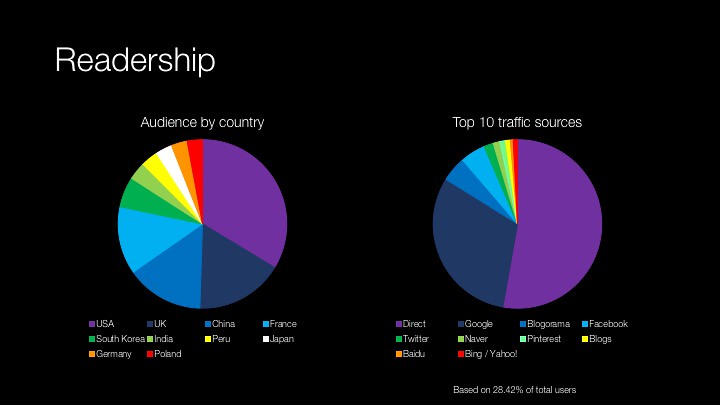
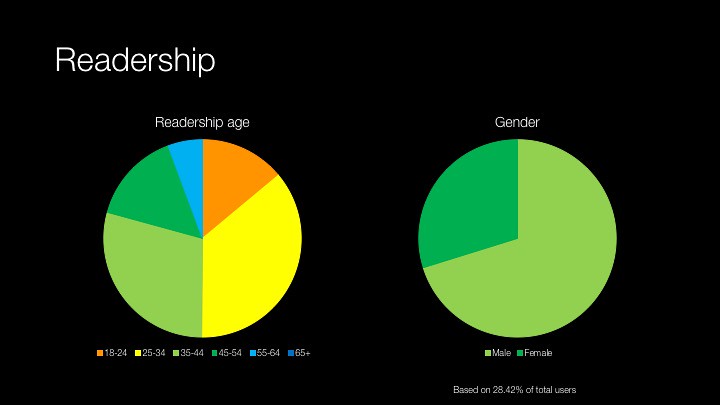
    Some data points

    30 percent of the top posts from the first half of the year made the cut through the whole of the year, which surprised me as I thought that they would benefit from additional ‘evergreen’ search traffic.  
    Slide3

    Slide4

    Lessons learned

    • There is still an interest in long form content and research
    • There was less of an interest this year in purely social platform based subject matter materials
    • Evergreen content doesn’t seem to work as well as previously